Whether it is opening a bank account or investing in a mutual fund, most users first move is to "Google it." In fact, according to Google's Year in Search report, there has been more than 61% growth in personal loan queries and 72% growth in mutual fund queries. This statistic shows the growing need for the finance industry to adopt digital marketing. Here is a complete guide on digital marketing for finance, one that will help you understand the benefits and ways you can use it along with case studies and best practices.
With over 470 million active users on the Internet, India is the world’s second-biggest online community. The figures are estimated to increase to a whopping 635 million by the end of 2021. These stunning statistics are proof that digital marketing for the financial industry is a guaranteed way to reach a large percentage of the Indian population and convert them to loyal customers.
The dynamic medium of the Internet is a two-way street. Apart from providing financial sectors with an excellent platform to market their brand and feature their products, the online space also offers the benefit of evaluating your services and seeing what works. You will also have complete access to analytics and other such statistical data to track the performance of your digital campaigns.
Customer satisfaction is of vital importance in the finance sector. Ensuring your consumers are happy and satisfied with your services is what drives the banking sector and digital marketing for the finance industry offers just that. From online posts to discussion forums, you will get a closer insight into what your customers are looking for in your products and how you can improvise your services for better consumer delight.
There is no doubt that marketing your brand on the digital space costs much lesser than traditional advertising and branding. Apart from comparatively lesser costing, financial organisations will also get a better reach and can target their audience more effectively. Banks and other financial institutes can take complete advantage of this cost-effective technique and have resorted to digital marketing for the financial industry as their branding strategy.
Now that we know the importance of digital marketing for the finance industry. Let's take a look at ways the finance industry can use digital marketing to reach a wide audience and create a powerful brand online.
Banks and other organisations in the financial sector can leverage digital marketing for the financial sector as their branding strategy by working neck-and-neck with a digital agency. These agencies, such as Social Beat, provide end-to-end digital solutions from social media posts that go viral to top-notch website content that will rank you in the first page of Google.
There are an estimated 300 million smartphone users in India and this statistic is expected to reach a mind-boggling 2.3 billion by the end of 2022. With such a large percentage of the Indian population relying on apps for their daily chores, it is time you dive into the digital space with a high-end app, designed to cater to every need of your customers.
Whether you are a leading bank or a financial data aggregator, investing in a good app is a guaranteed way to take your business to towering heights. In today’s day and age, people like to be on the move even while making financial plans or surfing the internet for research. Apart from merely searching for information, most money transfers and other financial transactions also happen over the phone. With a user-friendly app, all your services and programs will be available at the click of a button which will lead to higher lead conversions and, ultimately, customer satisfaction.
You can also explore the concept of Progressive web apps for your company. This phenomenon is one of the top digital marketing trends in 2018 and is guaranteed to change the outlook of your financial organisation.
Financial institutes can increase the exposure of the organization by tapping on the reach of social media marketing. India is leading the online community with 241 million active users on Facebook. This only means that a large number of potential customers are currently scrolling through their social feeds and there is a possibility that a lump sum of this audience is in the lookout of a reliable and reputed financial partner. With relatable social media posts, and engaging videos, financial organisations can easily use content to engage with their target audience and widen their consumer database. You can also track the performance of your posts through advanced social media analytics tools and strategize accordingly. For more insights on digital marketing for the financial industry, check out our blog on the Facebook marketing trends of 2017.
FundsIndia is India’s biggest online investment platform with over 1 million consumers. In one of their most recent Facebook campaigns, on investing in mutual funds, they targeted the women of India with a quirky creative and copy.
Additionally, they also used a humorous vox-pop video to understand peoples' spending and saving habits. This video helped FundsIndia with their brand awareness and reach.
In today’s day and age, the first thing which pops up in a consumer’s mind while looking for a particular service or product is to perform a mobile search. If you are considering digital marketing for the finance industry, one of your first steps should be to ensure you rank on Google. Focusing on optimal search engine optimization will drive a higher traffic to your website which, in turn, will lead to higher lead conversions.
You can start by ensuring your organisation is featured on Google local listings to increase the footfall to your outlets. You can also get showcased on Google My Business listings to give potential customers a brief insight of your organisation. Apart from Google listings, it is also a good idea to leverage the power of content marketing to get ranked. You can promote your services and packages with engaging blogs and other posts that have the potential to both ranks on Google and go viral on social media. However, make sure you explore all content amplification strategies to promote your content. It is also vital to incorporate all the keywords and trending topics in your blog posts for better results.
Facebook and Google ads have taken the world of digital advertising by storm. From website conversion ads to carousel and lead ads, banks can opt for an array of advertising techniques to drive enquiries and quality leads. You can also market your brand with a creative combination of videos, images and copy to attract your target group. Facebook is the best bet when it comes to online advertising as you can opt for detailed targeting based on age, geographic location, content consumption, online behaviour and many other such demographics. You can also target the users who have previously clicked on your ad or recently visited your website for leads of premium quality.
A Google ad is the other “non-social” type of ad financial organisations can invest in to widen their clientele. These ads show up in Google when potential customers type in the relevant keywords in search of a renowned banking institute.
Email marketing is the most traditional and effective type of online branding, especially when it comes to digital marketing for the financial industry. With the beginning of 2018, this trend has been upgraded with an improvised version of customized emails. Reaching out to your potential consumers with personalized emails featuring the various offers and packages provided by your organization is a guaranteed way of increasing lead conversions. For example, if a user has logged into your website and shown interest in your services by subscribing to your newsletter, you can nurture the lead with regular notifications and offers provided by your firm to attract them further. According to a recent survey, drip email marketing provides a 119% click-through rate on authentic emails.
Apart from lead nurturing, drip emailers are also effective triggers to close incomplete transactions. For example, if a user had clicked on one of your financial programs or was in the middle of a transaction but could not complete the task, your digital team can target them with follow-up emails as gentle reminders. The emails can be customized as per the demographics of the user, with an effective call-to-action to close the deal in a single click. Featured below is one of the creative used in a drip emailer for one of our top clients – Kotak Asset Management who have engaged in digital marketing for the finance industry.
Influencer marketing is one of the top digital marketing trends of 2017 and is expected to continue its reign in 2018. There is a personal element of trust and assurance when customers choose their financial partners based on the advice and suggestions of a commoner and that is exactly the type of branding influencer marketing has to offer. Influencers upload engaging posts and modest reviews in the form of blogs, videos and pictures which has the potential to instantly attract viewers and convert them to consumers. Influencer marketing is one of the main pillars of digital marketing for the finance industry and is definitely something you should leverage for your organisation.
Speaking about digital marketing for finance, follow our YouTube channel Paisa Pujari for insights on how to control your finances. Here's a video on the smart use of credit cards, to get you started:
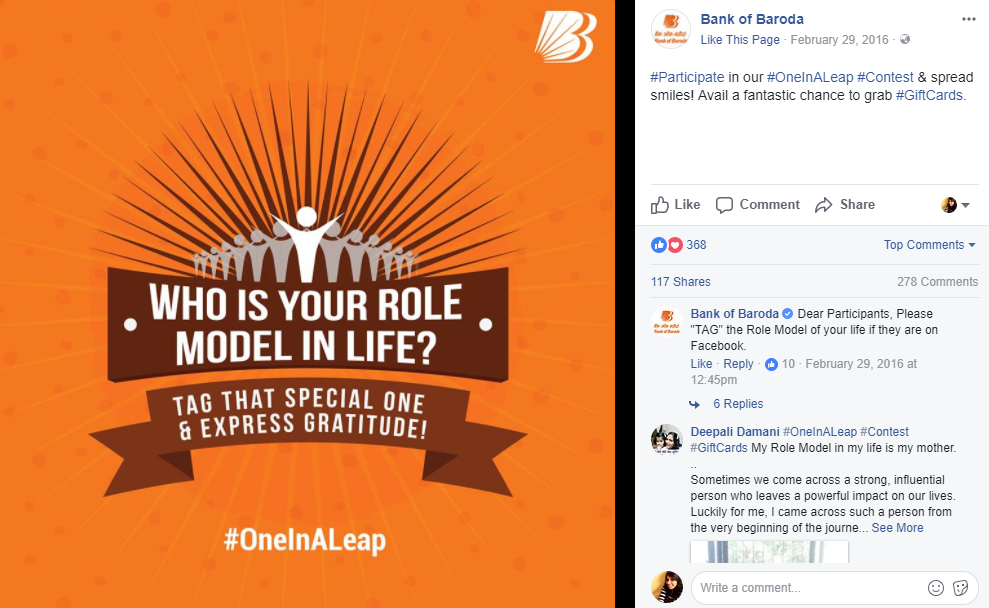
Bank of Baroda is one of the first public banking organizations to have resorted to digital marketing for the financial industry. Their marketing team focused on creating a premium presence on the online space rather than giving plain emphasis on the number of followers. Each of their campaigns had a specific objective from promotional content to lead generation. One of their most commendable campaigns was that of “One in a leap”. In this campaign, the bank put up a post on Facebook asking their customers to tag the one person who is a role model in their lives. The post was put up on the 29th of February during the leap year of 2016. The hashtag #OneInALeap was trending for a good six hours along with the hot topic of the day – the Indian Union Budget 2016.
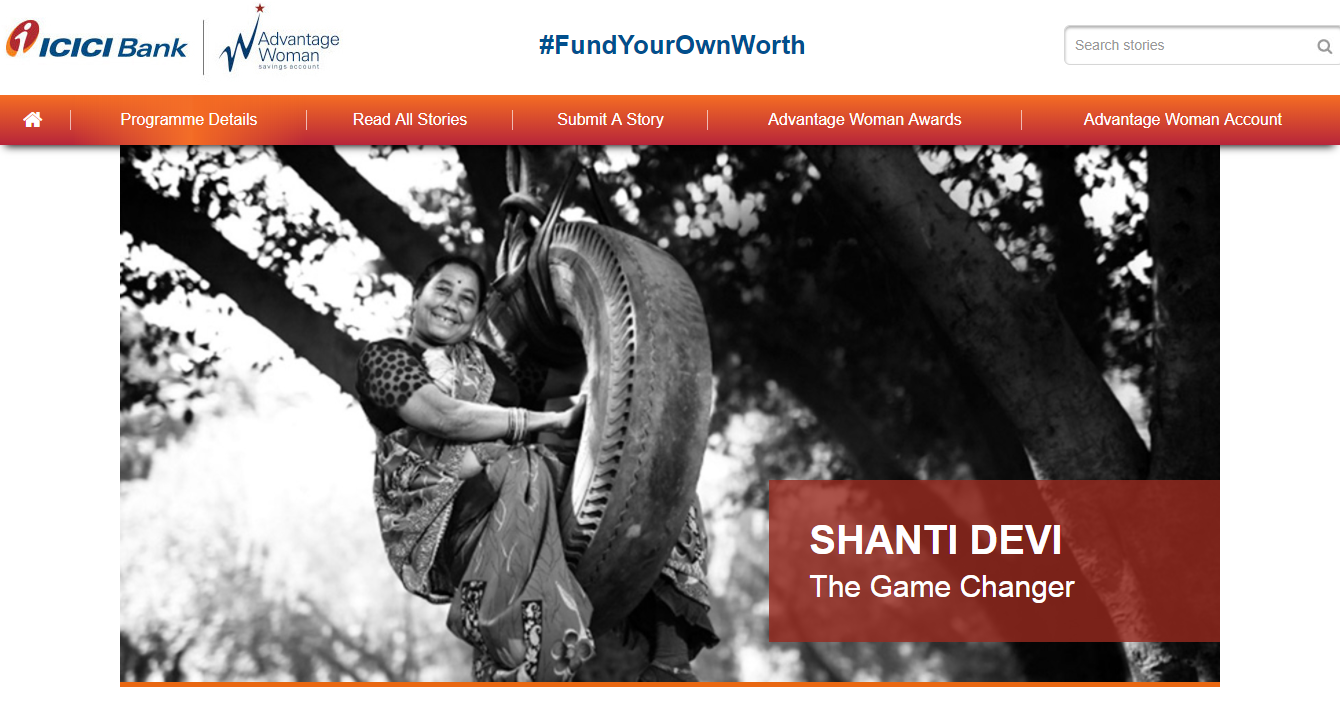
Being one of the leading banks in the nation, ICICI tapped the Indian female population with the #FundYourOwnGrowth campaign. The campaign focused on encouraging women to invest in themselves and not be tied down by the shackles of the society. Women around the subcontinent could enroll in the Fund Your Own Growth program and open a woman’s account to enjoy a plethora of irresistible offers and benefits. A lot of online traffic was driven to their website which showcased the program details, advantages of opening a woman’s account and a series of inspirational stories of real women and their struggles against poverty. Through this campaign, the bank took the angle of empowering women to sell a financial product. The campaign also included a 2-minute video ad featuring top Indian actress Konkana Sen Sharma which was splashed on all major digital video platforms, including Youtube.
Apart from banks and leading monetary institutes, B2B organisations that cater to the technologies involved in the financial sector are also focusing on digital marketing for the financial industry. BijliPay, one of India’s top end-to-end providers of payment solutions, collaborated with Social Beat to up their digital game and gain quality leads from the online space.
When the Rs 1000 and Rs 500 notes were demonetized in the end of 2016, a lot of businesses realized the need to go digital in order to survive in the market. Understanding this demand, BijliPay used Google to advertise their mPOS devices (card swiping machines). The primary objective of the campaigns was to acquire more customers in the wake of Demonetisation. In order to achieve our targets, we performed AB testing for different landing pages and altered the copies of various search campaigns based on what was performing well. Our ground-breaking campaigns landed 3,569 lead conversions with a cost per conversion of just Rs 285.
With an average of 225 million active Indian users through mobile every month, YouTube is the world’s favourite search engine for videos, emerging as a game-changer in every brand’s marketing strategy. Keeping this in mind, we partnered with Sundaram Mutual Fund to leverage the reach and branding of YouTube Masthead ads while introducing a new fund offer. Masthead ads are primarily used by brands to create a buzz about a product or service and reach out to consumers in a wide range of demographics. They are displayed on the homepage of YouTube and charged on a daily basis. The open-ended equity scheme offered by Sundaram Mutual Fund was advertised in a short 20-second Masthead ad on YouTube, and the results were phenomenal.
The primary objective of the campaign was to increase awareness about the brand, drive traffic to their page and increase the number of subscribers with the introduction of the new fund offer. The 20-second Masthead ad spiked the number of subscribers on Sundaram Mutual Fund’s YouTube page from a mere 363 to a whopping 56K in just a matter of 24 hours.
With such astounding statistics and mind-boggling figures, there is no doubt that digital marketing for the finance industry is an emerging trend which is here to stay. It is time you leverage the power of digital and secure the future of your financial organisation.
At first glance, Quora doesn’t seem like it would be an important tool for a marketer. However, underestimating the value of Quora can be one of the worst mistakes you can make for your brand. Quora has 1.5 million visitors every month. That’s 1.5 million visitors who have the potential to discover your brand and become prospective leads. This is why one of the biggest digital marketing trends of recent times has been the growing focus on Quora. Quora has a distinct edge over other question and answer forums because of its highly monitored content. User profiles are strictly verified and content is routinely checked for quality. Building your brand’s presence on Quora can help increase awareness of your brand, increase traffic to your site and even generate leads. Here are seven crucial reasons why your brand needs to make use of Quora in its overall marketing strategy.
The biggest advantage Quora offers is that it is made up of a large community built on trust and whose members rely on each other for information. When you provide informative answers to questions users pose, you’re automatically increasing the credibility of your brand. Quora allows you to engage in meaningful conversations with your target audience and establish your brand as an expert in your field.
However, it’s important that you never attempt to oversell your brand on Quora. The community on Quora is distrustful of marketers and hates self-promotional material. When you’re marketing your brand on Quora, ‘less is more’ is a strategy that always works. Instead of speaking about your brand in great detail, focus instead on providing informative answers to the questions being asked. This will gradually build your brand credibility and bring users organically to your site.
Google search results often include Quora posts among its highest ranking sites. This makes Quora a powerful SEO tool to drive organic traffic to your site. You could even increase your chances of showing up in the top results by strategically using important keywords with the help of keyword research tools. However, you need to make sure your content is relevant. Dropping keywords with abandon and speaking extensively about your brand with little to no connection to the actual question will decrease your chances of showing up in search results.
One of the biggest digital marketing trends this year has been the growing importance of influencer marketing. If you’re struggling to find key influencers for your brand, Quora could be a great resource. There are many users who are identified as key contributors by Quora because of their highly informative answers. Users rely the most on these key contributors because they have repeatedly established their credibility. You can engage with these contributors by answering their questions or by providing comments to their answers. You can even directly reach out to them and ask if they would be interested in helping you promote your brand.
If you have excellent content and blog posts on your brand’s website, then Quora is one of the best ways to amplify your content. Again, the key here is to be subtle about promoting your website. Instead of replying to a question with, ‘Visit my website for information about this’, introduce it slowly within your answer. Your answer needs to cultivate interest that will actually make users curious enough to visit your blog. Provide key information within your answers and link your content to it by saying that you’ve written about it in more detail on your blog.
You can also use Quora to crowdsource information for your article. You can mention that you’re writing a blog on ‘How to Improve SEO Rankings’ and ask users for their tips on the subject. When users feel like they have actively contributed to a blog post, they will even be more likely to share it themselves.
You don’t need to conduct expensive, complicated surveys when you have a simple resource like Quora at your disposal. Instead of guessing what your target audience needs, why not let them tell you directly? The questions on Quora are an invaluable source of information about what type of content your target audience will find engaging. If a number of people are asking questions about the same problem, can your brand be the solution to it? Questions (and their answers) are great ways to learn more about your customers, the way they think, what they use and what they need. By actively catering to their problems, your brand can continue to stay relevant.
If you’re stumped for new content ideas, trawling through Quora can help you ideate. A good blog post needs to provide answers to relevant questions anyway so what better place to find these questions that Quora? For example, if a number of people are asking, ‘How do I increase my Instagram engagement?’ then you immediately have an idea for a relevant blog post. Using questions on Quora to ideate for your blog also serves up another advantage. You can link the blog post you’ve written along with your answer to the question and amplify it further.
Thought leadership is a coveted badge every marketer wants for their brand. Establishing thought leadership makes your brand an authority in its field and increases trust in it. Building thought leadership can take some time, but the payoff makes it all worth it. One of the best ways to establish thought leadership is through Quora. By providing meaningful, informative answers to your consumer’s questions, you’re demonstrating the extensive knowledge you have on the subject. Many brands struggle with building thought leadership because they don’t know how to steer a conversation in the direction of their brand’s offerings. Quora saves you the trouble because the conversation already exists; you just need to contribute to it.
Clearly, no marketer can afford to ignore Quora if they want to successfully build their brand’s digital presence. Quora is even more essential when it comes to marketing for a start-up because it helps new consumers come across your brand. So take full advantage of this site for a well-rounded digital marketing strategy.
This article was previously published as Quora: A must-have in your digital marketing playbook on Business Line on Campus.
Considered one of the biggest property markets in India, Mumbai has many real estate developers trying to reach their target audience online. Digital Marketing is one of the primary channels to connect and engage with customers online and generate quality leads. The best real estate marketing companies in Mumbai have noticed this trend are willing to go the extra mile to help real estate developers tap the online space. Here’s a detailed report on the digital marketing strategies of the top real estate developers in Mumbai.
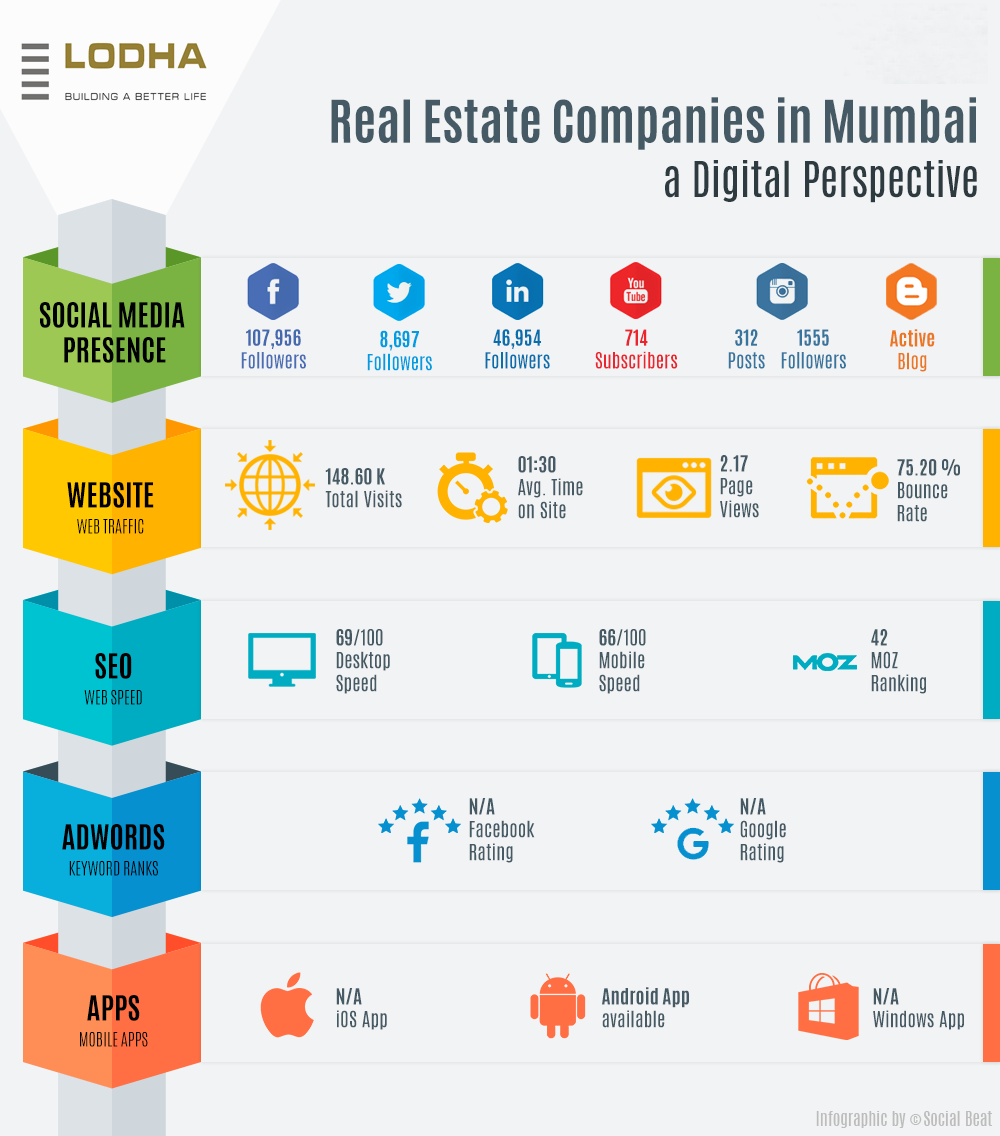
Lodha Group is one of the leading real estate developers in Mumbai and the most profitable players in India. They are known for making landmark developments in residential and commercial spaces and pioneering new trends.
UX Audit:
They have an interesting design of image slider that showcases all the project launches and promotions. The project locator is a nice filter functionality to find project developments. Project page showcases the projects based on their location and has the information about the price too. This leads to the enquiry page with project brief and lead generation form. The website is, however, not mobile-friendly as the text is too small to read and the contents are wider than the screen.
Key Features:
Web Insights:
| Total Visits | Avg. Time on Site | Page Views | Bounce Rate |
| 148.60K | 00:01:30 | 2.17 | 75.20% |
Moz rank: They have a Moz rank 42 for Domain Authority.
Website Speed:
Twitter: They have an active Twitter account with around 8000 followers. They do 20+ tweets a week and have no promoted tweets. They tweet about a wide array of topics ranging from their projects to the general industry based news. In spite of these, engagement is low on tweets.
Facebook: They have an active page with around 100000 followers. The engagement is good, highlighting the use of promoted posts. Their content includes customer testimonials and event invites.
LinkedIn: They are very active on LinkedIn and have around 47000 followers. Below is a recent post about demonetisation, which received a good response
Youtube: They have 720+ subscribers with not-so-engaging videos
Google+: Their Google+ account is active having 35 followers.
Instagram: The account is active and has 1500+ followers.
Content Marketing: Though the blog page is not very attractive, they are posting at least 4 articles per month. They have a live chat option on their blog.
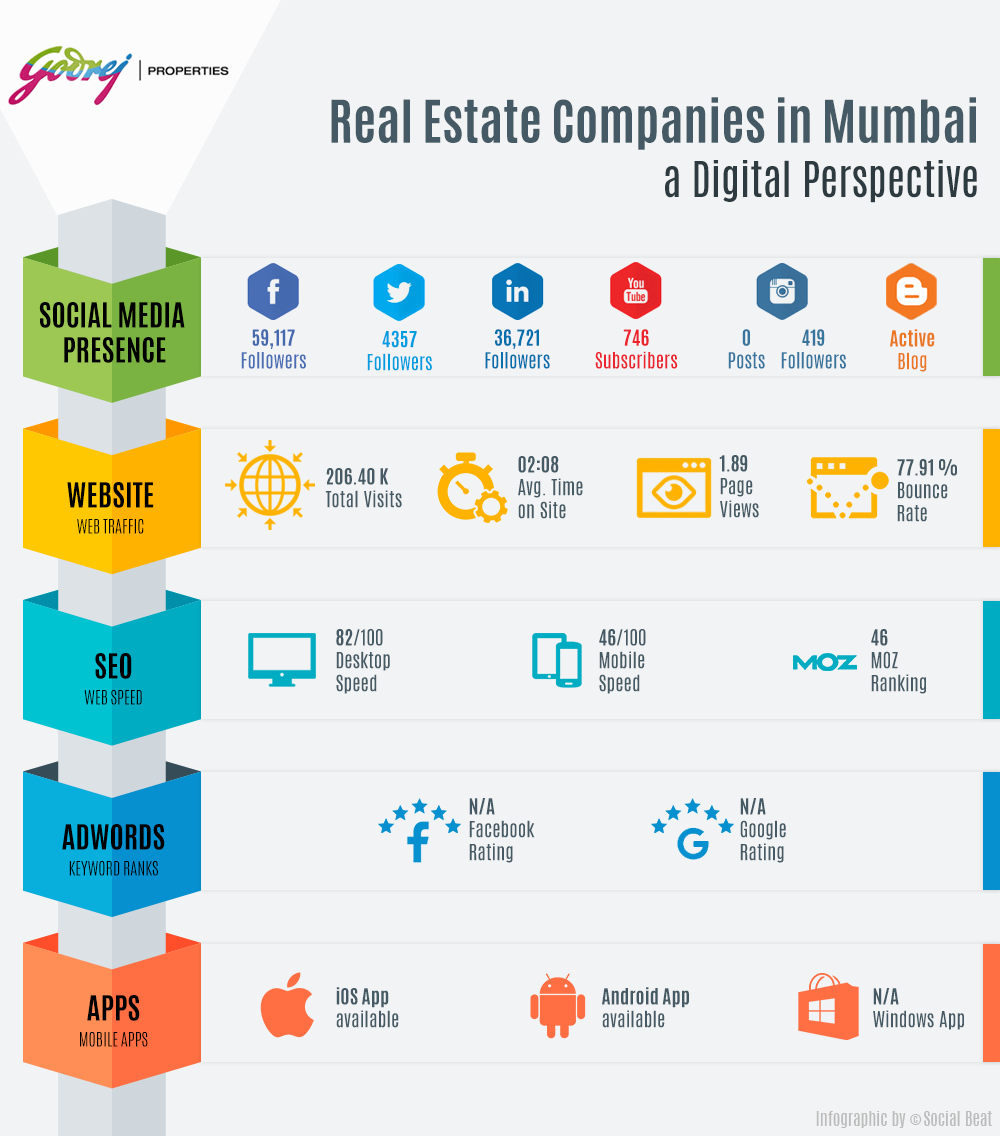
Godrej Properties develops residential, commercial and township projects across 12 cities in India. They provide imaginative and extraordinary spaces keeping customers’ needs in mind, making them one of the top real estate developers in Mumbai.
UX Audit:
They have a well-organised menu catering to different kinds of website users (buyers, investors, NRIs etc.) They also have a nice hierarchy for project menu, leading to different property projects. Individual project pages include features like project overview, highlights and enquiry form. Their page is mobile friendly.
Key Features:
Web Insights:
| Total Visits | Avg. Time on Site | Page Views | Bounce Rate |
| 206.40K | 00:02:08 | 1.89 | 77.91% |
Moz rank: They have a Moz rank 46 for Domain Authority.
Website Speed:
Twitter: They don’t have a twitter account for Godrej Properties.
Facebook: They are not very active on Facebook but they still have around 58000 followers. Below is a recent video post, which has received some responses and views.
LinkedIn: They are active in LinkedIn with around 36000 followers. Compared to other social channels they are more active on LinkedIn.
Youtube: They have 740+ Subscribers and videos in their channel are pretty engaging, having a decent number of views.
Google+: They have an active Google+ account having 474 followers.
Instagram: They have 400+ followers on Instagram.
Content Marketing: They have been blogging since May 2016. They have 15 articles as of now, and they have a separate domain for blogging.
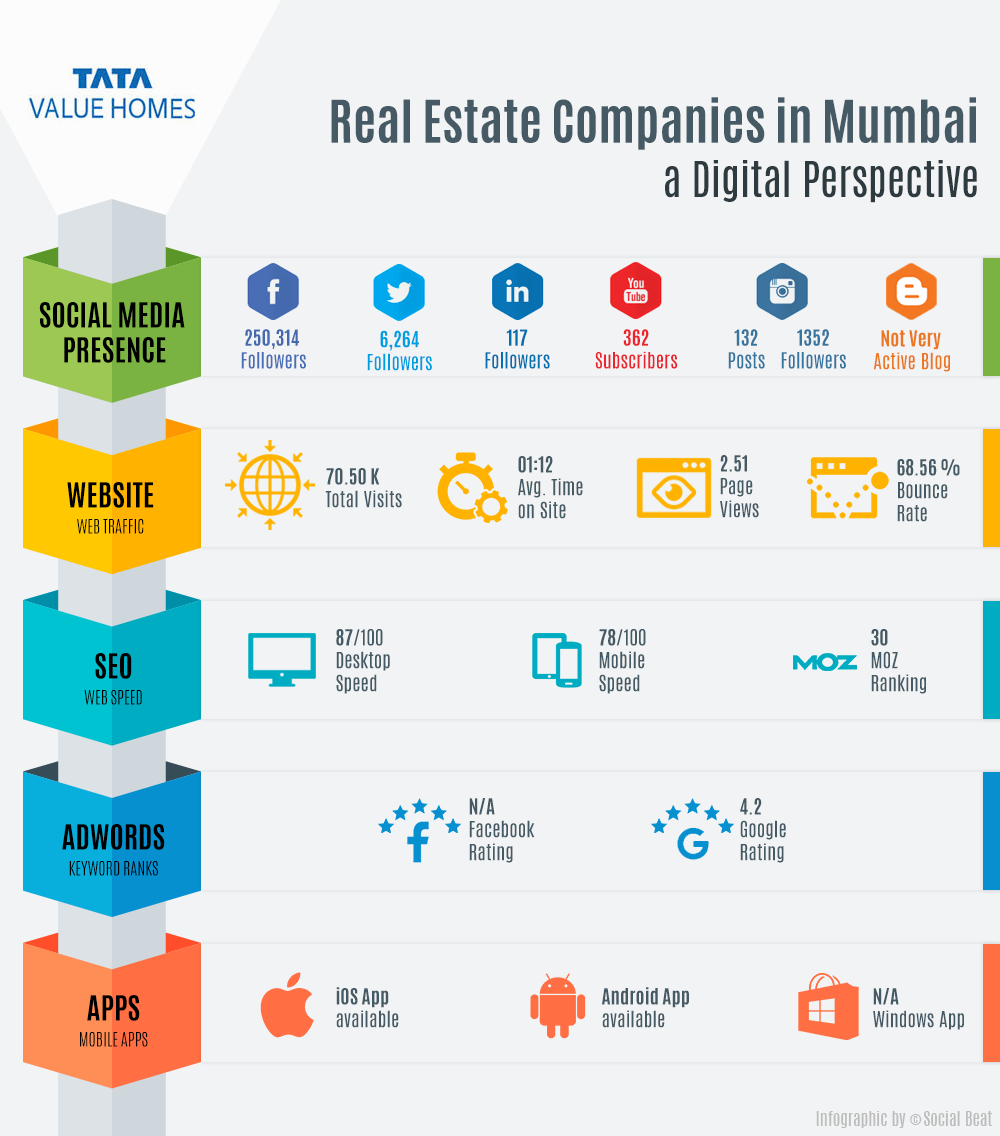
Tata Value Homes is a subsidiary of Tata Housing. It is one of the larger real estate companies that focus on low-cost housing with modern amenities.
UX Audit:
They have allocations to provide a quick filter for the audience based on the city/location of the user. The quick search option leads to a map with property locations highlighted for user convenience. Showcasing their featured projects on the homepage with prominence is an interesting feature. Laying out interesting blogs on the homepage is another noteworthy feature.
Key features:
Web Insights:
| Total Visits | Avg. Time on Site | Page Views | Bounce Rate |
| 70.50K | 00:01:12 | 2.51 | 68.56% |
Moz rank: They have a Moz rank 30 for Domain Authority.
Website Speed:
Twitter: They have around 6000 followers. They aren’t tweeting on a regular basis and they use the same content across social media platforms.
Facebook: They have around 250000 followers and have boosted some posts a few months back, but recently they are not very active. Below is a boosted post shared a few months back which has a large number of likes and responses.
LinkedIn: They have only 110+ followers, and the page has no posts till date.
Youtube: They are current not active. Their last uploaded video was 4 months ago.
Google+: They have an active Google+ account with 85 followers.
Instagram: They are also active on Instagram having 1300+ followers.
Content Marketing: They have posted only 3 blogs in 2016, highlighting the missed opportunity in content marketing.
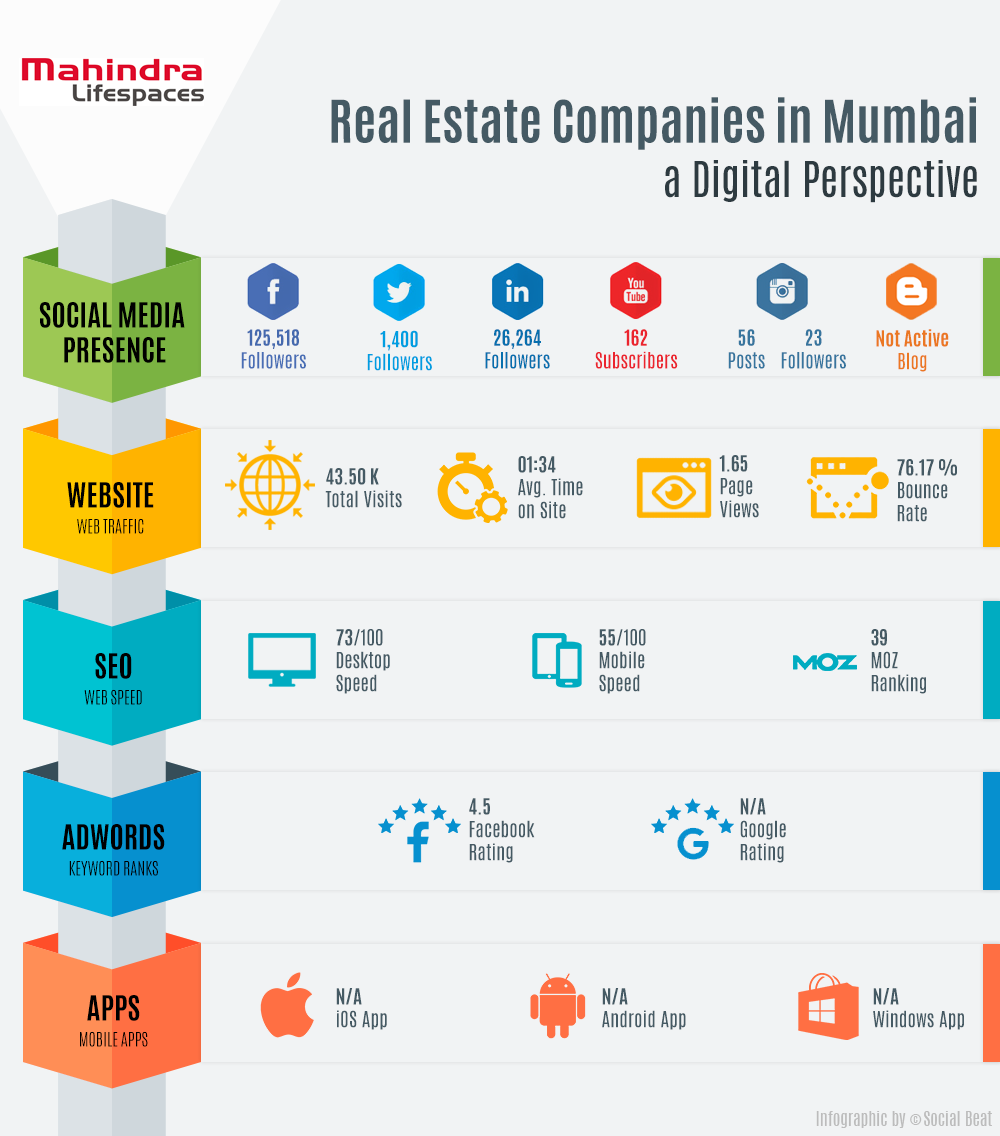
Mahindra Lifespaces is the real estate company of the Mahindra Group. They are one of the top real estate developers in Mumbai and the first Green Home Developer with Green Design & Healthy Living as their main focus across their projects.
UX Audit:
The web page has nice project filter on the home page following the banner. Sticky enquire now button to provide constant CTA is an interesting feature. A section to attract NRI investors is also present. Menu dropdown feature is quite interesting, especially the categorized submenu for projects.
Key features:
Web Insights:
| Total Visits | Avg. Time on Site | Page Views | Bounce Rate |
| 43.50K | 00:01:34 | 1.65 | 76.17% |
Moz rank: They have a Moz rank 39 for Domain Authority.
Website Speed:
Twitter: They are active on twitter with engaging tweets. Below is a public awareness tweet.
Facebook: They are very consistent in boosting posts and are active on Facebook, having around 125000 followers.
LinkedIn: They have an active LinkedIn page, which has around 26000 followers. They are posting engaging contents on a regular basis.
Youtube: They have only 160+ subscribers. They upload two to three videos per month.
Google+: They are not active on Google+ and have only 6 followers
Instagram: They are active on Instagram having 50+ followers.
Content Marketing: They don’t have a company blog.
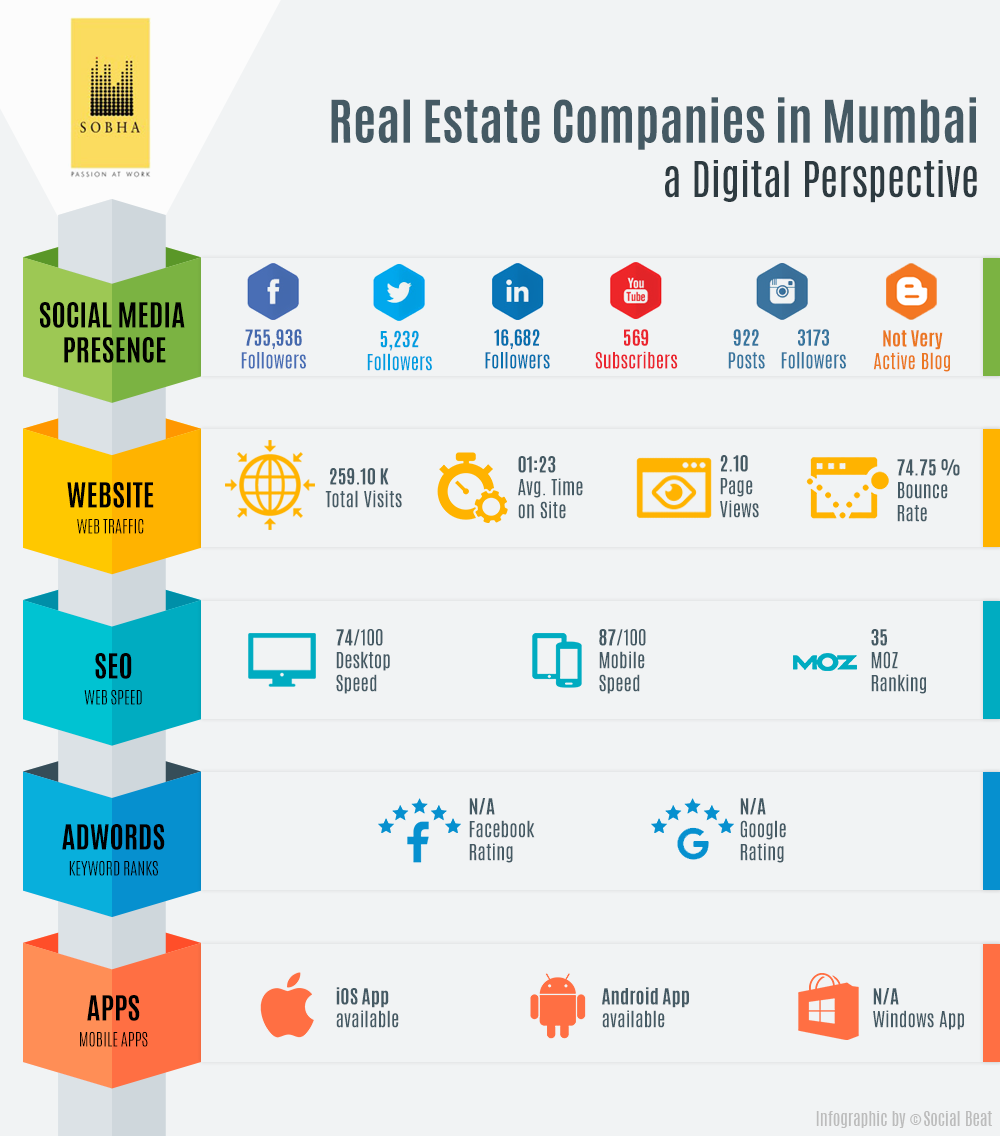
Sobha Group is one of the largest real estate organizations in India and the Middle East. They focus on delivering the highest levels of quality, with no compromise, making them the top real estate developers in Mumbai.
UX Audit:
The premium images rolling in the banner connects the user to the luxury of the brand. The main menu could have been more prominent instead of being placed against the sliding banners. Apart from that, the site has a very nice organization of the project information – presented state-wise and sorted by price.
Key Features:
Web Insights:
| Total Visits | Avg. Time on Site | Page Views | Bounce Rate |
| 259K | 00:01:23 | 2.10 | 74.75% |
Moz rank: They have a Moz rank 35 for Domain Authority.
Website Speed:
Twitter: They are very active in Twitter having around 5000 followers and they do 3 to 6 tweets a day which is a lot compared to other developers. They have a diverse set of tweets ranging from new project launches to general industry based news. Despite these, engagement is low on tweets.
Facebook: They have an active page with around 7 lac followers and they have been posting at least twice a day and the engagement is good. Below is an organic post which had a good response.
LinkedIn: They are very active in LinkedIn having around 16000 followers.
Youtube: They have an Active Youtube account with 570+ subscribers and they have interesting Testimonial videos.
Google+: They have an active Google+ account with 554 followers.
Instagram: They are active on Instagram with 3100+ followers
Content Marketing: They have a blog, which is not active.They do not have any mention about their blog on their website.
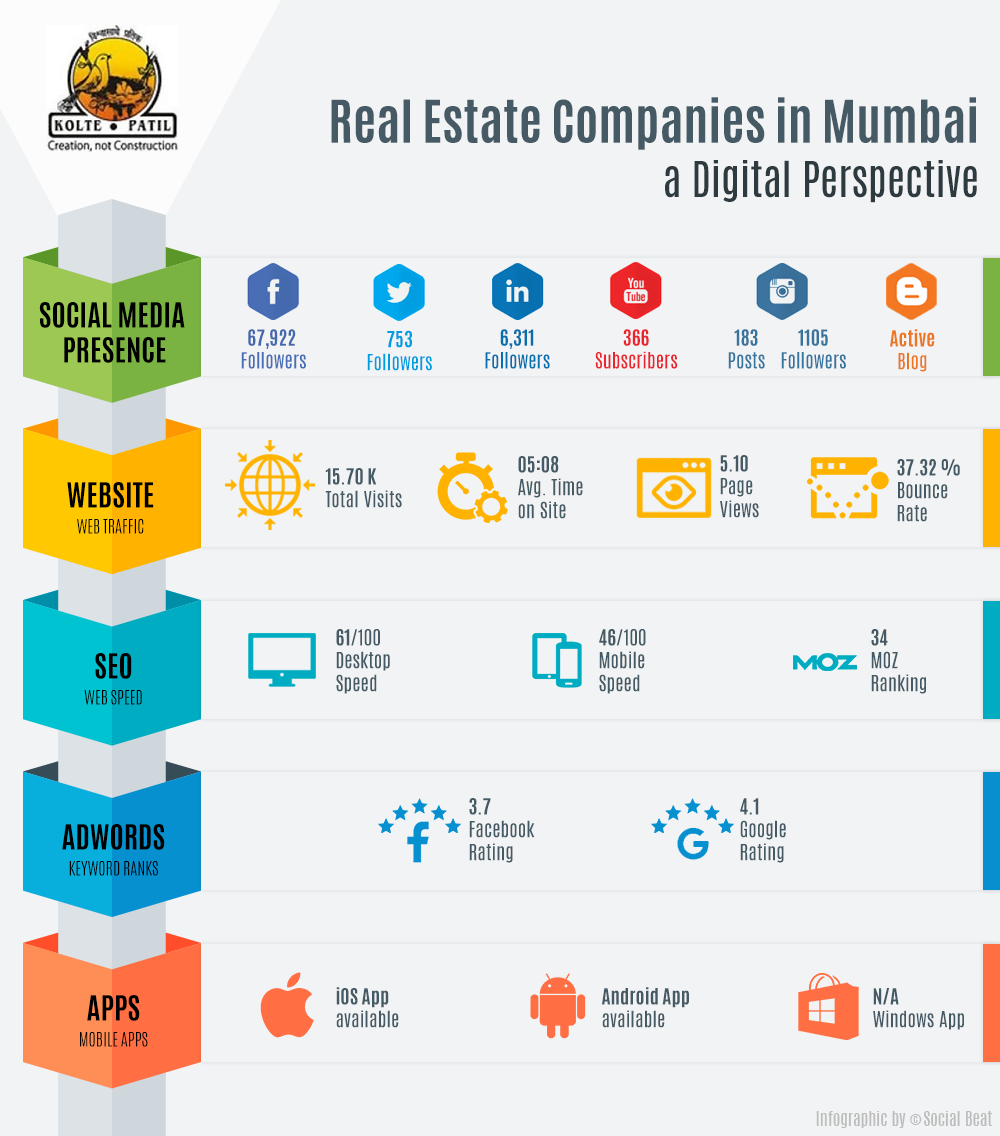
Founded 2 decades ago, Kolte-Patil has built residential, commercial, retail, and integrated township projects till date.
UX Audit:
Interesting zoom in feature on the banner images attracts the users. Well organized menu putting out all the necessary information is a great feature. Book Online page showcases all the projects with the quick facility to book. They also have live chat option in all the pages.
Key Features:
Web Insights:
| Total Visits | Avg. Time on Site | Page Views | Bounce Rate |
| 15.70K | 00:05:08 | 5.1 | 37.32% |
Moz rank: They have a Moz rank 34 for Domain Authority.
Website Speed:
Twitter: They have around 10000 followers and are highly active on Twitter. Their tweets are very engaging.
Facebook: They are having around 67000 followers and post twice a week.
LinkedIn: They have around 6000 followers and are moderately active on LinkedIn with 3 to 4 posts per month. Below is a post, which got pretty good responses.
Youtube: They are not very active and have only 367 Subscribers. Their videos have a decent number of views.
Google+: They are active on Google+ with 114 followers.
Instagram: They are also active on Instagram having 1100+ followers.
Content Marketing: Though they do not have an attractive blog page, they are posting 2 articles every month.
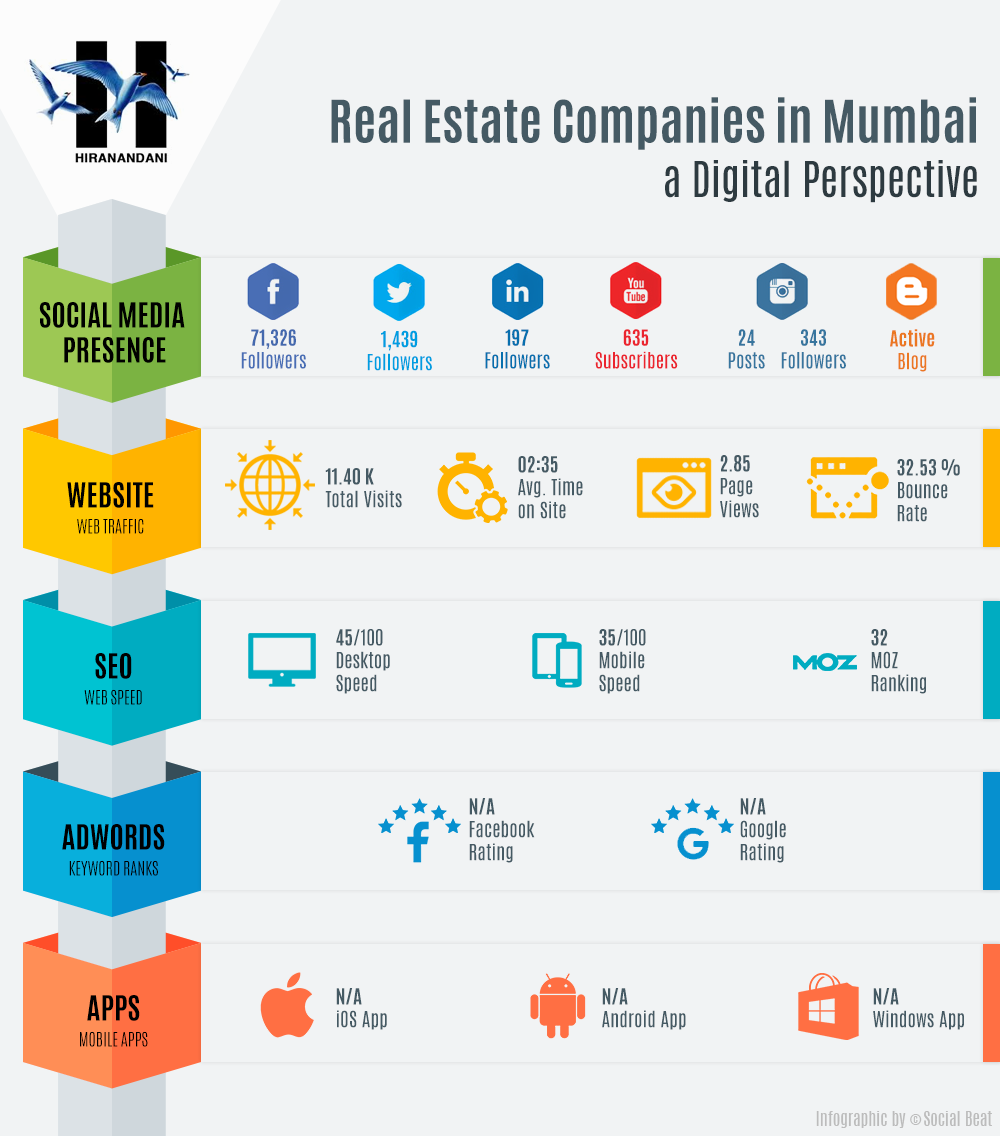
Pioneering new technologies & bold design, Hiranandani Developers have created residential townships & commercial complexes meeting the expectations & lifestyle of the people.
UX Audit:
Their Homepage design focuses on all the launches/promotions. Placement of a common enquiry form across all projects, to make enquiries for the visitor easier is appreciable. The website is mobile friendly.
Key Features:
Web Insights:
| Total Visits | Avg. Time on Site | Page Views | Bounce Rate |
| 11.40K | 00:02:35 | 2.85 | 32.53% |
Moz rank: They have a Moz rank 32 for Domain Authority.
Website Speed:
Twitter: They have around 1400 followers and are highly active on Twitter with at least 4 to 5 tweets every day.
Facebook: They do have an active page with 71000 followers. Below is a Selfie contest post, which was engaging and had good responses.
LinkedIn: They have only 190+ followers in LinkedIn and they haven’t posted anything until now.
Youtube: They have 630+ subscribers on Youtube. Though they are not active on YouTube, they have decent views for their engaging videos.
Google+: They are not active on Google+ and have only 29 followers.
Instagram: They are active in Instagram having 300+ followers.
Content Marketing: They have their blog in Weebly and actively post articles about real estate, their ongoing projects, and latest industry related news.
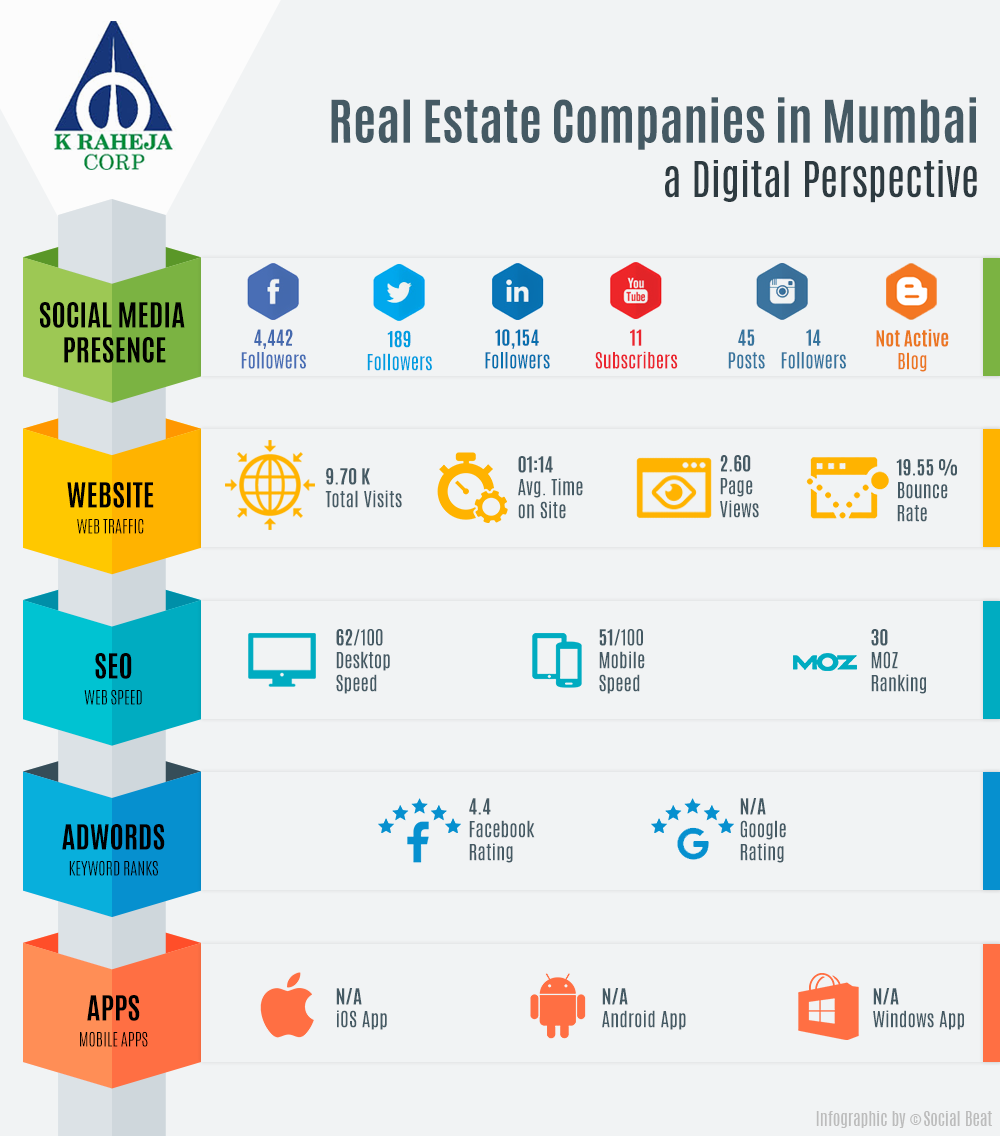
K Raheja is one of the most trusted real estate developers in Mumbai and the Indian subcontinent. From residences to workplaces, hotels to retail destinations, they have made a meaningful impact on the evolution of modern-day living.
UX Audit:
They have a Minimalistic home page with user engagement focussed to the menu. Explore our Projects feature introduces users to all the brands, where each brand project page comes with details of the project and enquiry provision. Their website is not mobile friendly because the text is too small to read and the content is wider than the screen.
Key Features:
Web Insights:
Total Visits |
Avg. Time on Site |
Page Views |
Bounce Rate |
| 9.70K | 00:01:14 | 2.60 | 19.55% |
Moz rank: They have a Moz rank 30 for Domain Authority.
Website Speed:
Twitter: They have only 180+ followers, and they have good quality tweets with no engagement. If they promote their tweets, they can get results.
Facebook: They have 4500 followers on Facebook. They are consistently posting 6 to 7 contents per week all are organic, so they are getting low responses and engagements. Below is an interesting post with not much engagement.
LinkedIn: They are not active on LinkedIn but have around 10000 followers and they haven’t posted anything till now.
Youtube: They are not active on Youtube and have only 11 Subscribers, and their last upload was a year ago.
Google+: They do one post a week in Google+ but still they have only 8 followers.
Instagram: They have only 8 followers in Instagram.
Content Marketing: They don’t have a company blog.
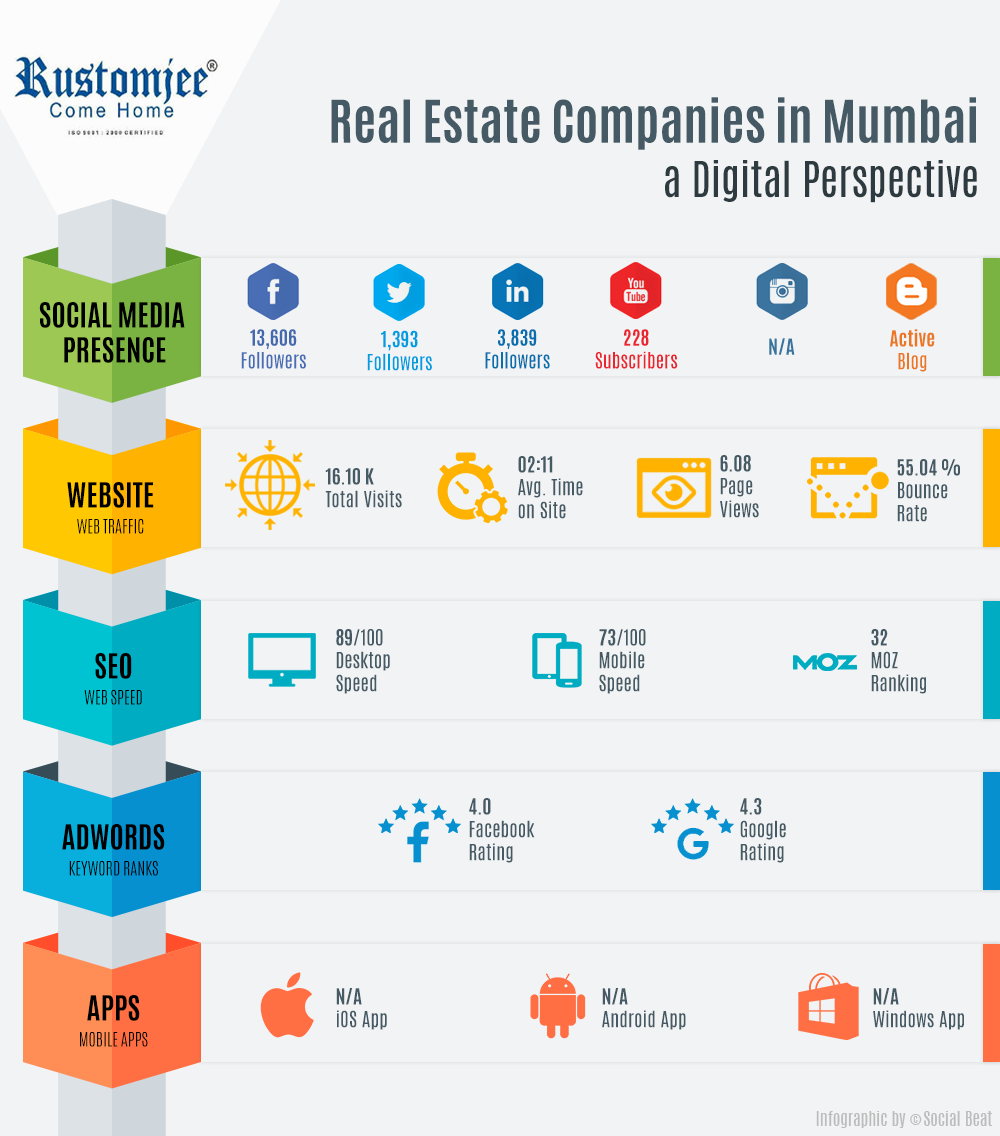
Rustomjee Spaces have transformed 10 million square feet of the city into premium townships, corporate parks, retail spaces, and 8,500+ homes with a special focus on Mumbai Metropolitan Region.
UX Audit:
The web page has a simple banner with prominent CTA and Project locator. There is a showcase of featured properties, and they do have an enquiry form. Project Explorer has filters that would help the user to find properties easily and closer to their choice and their website is mobile friendly.
Key Features:
Web Insights:
| Total Visits | Avg. Time on Site | Page Views | Bounce Rate |
| 16.10K | 00:02:11 | 6.08 | 55.04% |
Moz rank: They have a Moz rank 32 for Domain Authority.
Website Speed:
Twitter: They are active having 1400 followers on Twitter, and they have been consistently tweeting 6 to 9 tweets per week. They have no promoted tweets so there is only little responses. Below is an interesting tweet with little engagement.
Facebook: They have around 13000 followers posting 5 to 6 times per week with little response. All their posts are organic. They might get good engagements if they boost their quality posts.
LinkedIn: They aren’t active past 3 months, but they have decent engagements in their previous posts.
Youtube: They have 220+ subscribers, and they are uploading 3 to 4 videos per month. They have decent views. All the videos are real estate Industry related.
Google+: They are not active on Google+ for the past 2 years.
Instagram: They do not have an Instagram account.
Content Marketing: They are maintaining 2 blogs and have been posting their project related and educative articles at least once per month.
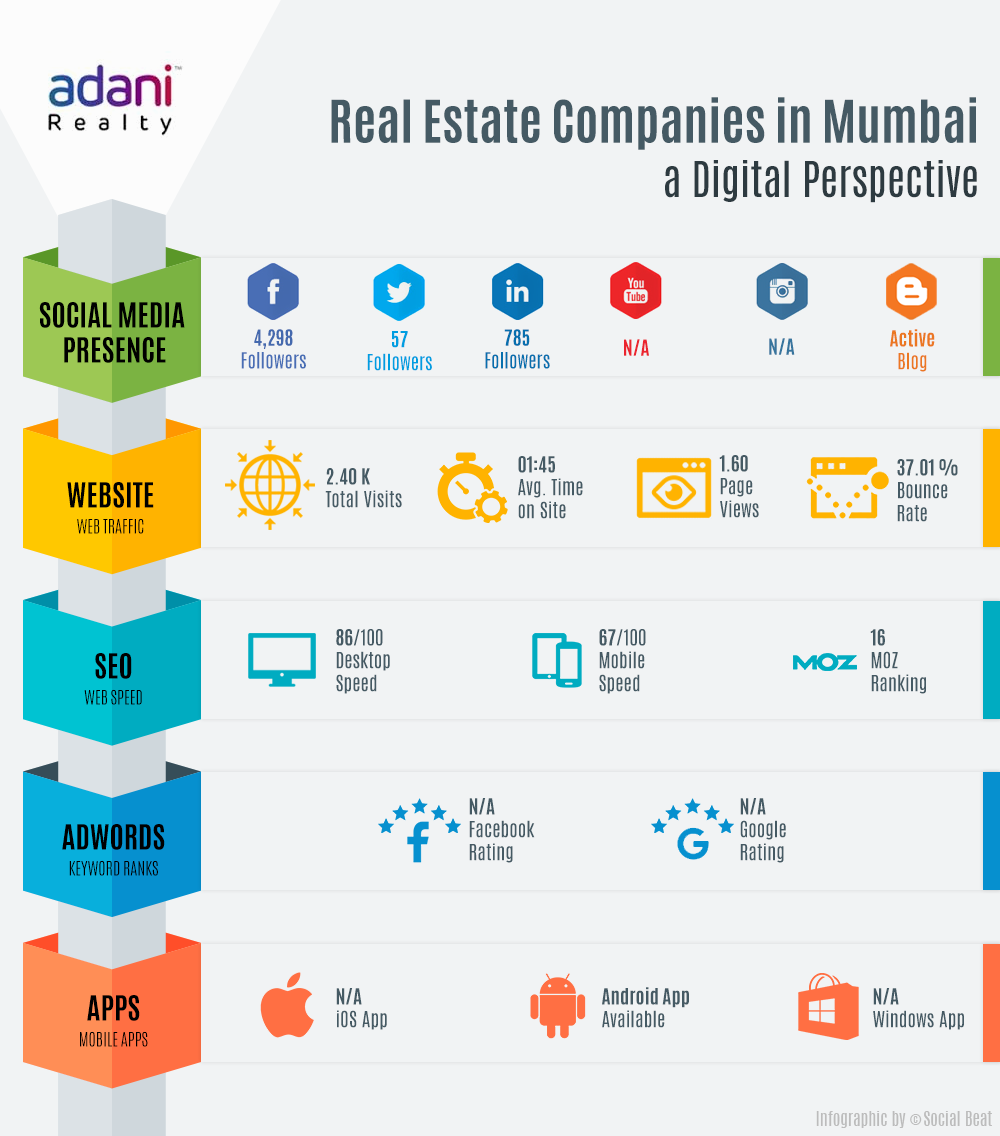
Adani Realty has been developing residential, commercial and social club projects across Ahmedabad, Mumbai, Gurgaon, Kochi & Mundra.
UX Audit:
Their web page has an interesting single scroll homepage design, which focuses on two utilities - one showcasing all their launches and promotions and the other leading the visitor directly to projects/gallery/other information via the menu. Elegant project showcase with the project overview and CTA's leading to individual project websites are some of the noteworthy features.
Key Features:
Web Insights:
| Total Visits | Avg. Time on Site | Page Views | Bounce Rate |
| 2.40K | 00:01:45 | 1.6 | 37.01% |
Moz rank: They have a Moz rank 16 for Domain Authority.
Website Speed:
Twitter: They have 50+ Followers in Twitter and are moderately active. They do 4 tweets per month. Below is an interesting post having low engagement.
Facebook: They are active in Facebook having around 4k followers, and they do at least one post per day and have boosted a contest campaign, which had a good response
LinkedIn: They have 785+ followers and are not that active. They do 4 posts per month and the engagement is low.
Youtube: They don’t have a Youtube channel.
Google+: They are not active in Google+
Instagram: They are not active on Instagram
Content Marketing: They have an active blog in their website itself, and there are around 300 articles.
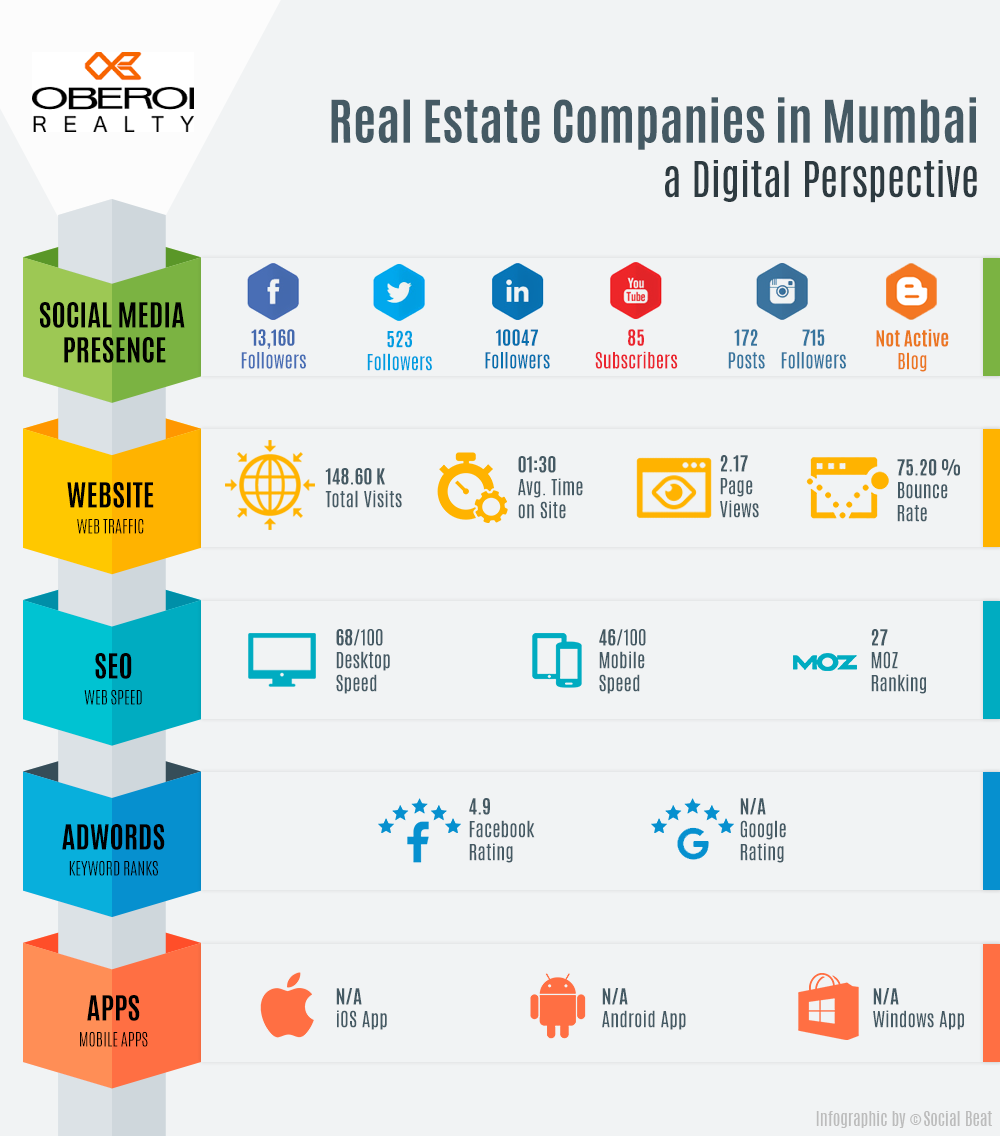
Oberoi Realty has developed over 39 projects at strategic locations across the Mumbai skyline. Over the past three decades, they have been consistently providing high-design and quality residential, commercial, and retail spaces.
UX Audit:
The banners and featured projects provide prominent information to the audience coming to their site. Individual project pages are organized state/city wise to make the navigation easier for the users. Schedule a visit is a useful provision for interested buyers/investors.
Key Features:
Web Insights:
| Total Visits | Avg. Time on Site | Page Views | Bounce Rate |
| 148.60K | 00:01:30 | 2.17 | 75.20% |
Moz rank: They have a Moz rank 27 for Domain Authority.
Website Speed:
Twitter: They are moderately active having only 50+ followers, and they do 2 to 3 tweets per day mostly about their ongoing projects.
Facebook: They are active on Facebook with around 13000 followers posting 3 to 4 times a week. Their posts are organic and have decent engagements. Below is an interesting post about their project.
LinkedIn: They are moderately active with around 10000 followers. They do post 3 to 4 times per month, and the posts are engaging with good responses.
Youtube: They are not active this month but have 80+ subscribers. They have many testimonial videos which are having a good number of views and response.
Google+: They are not active on Google+.
Instagram: They are highly active on Instagram having 700+ followers.
Content Marketing: They don’t have a company blog.
There is no doubt that the best real estate marketing companies in Mumbai are on the lookout to help leading real estate developers leverage the power of going digital. Make sure you read through our blog on Digital Marketing by Real Estate Developers in Bangalore and our detailed Case Study of How a Real Estate Company grew via Digital Marketing for better insights.
You can also check out our blog on how Casagrand generated a record 190 crores in revenue via Facebook for a detailed understanding of digital marketing for real estate.
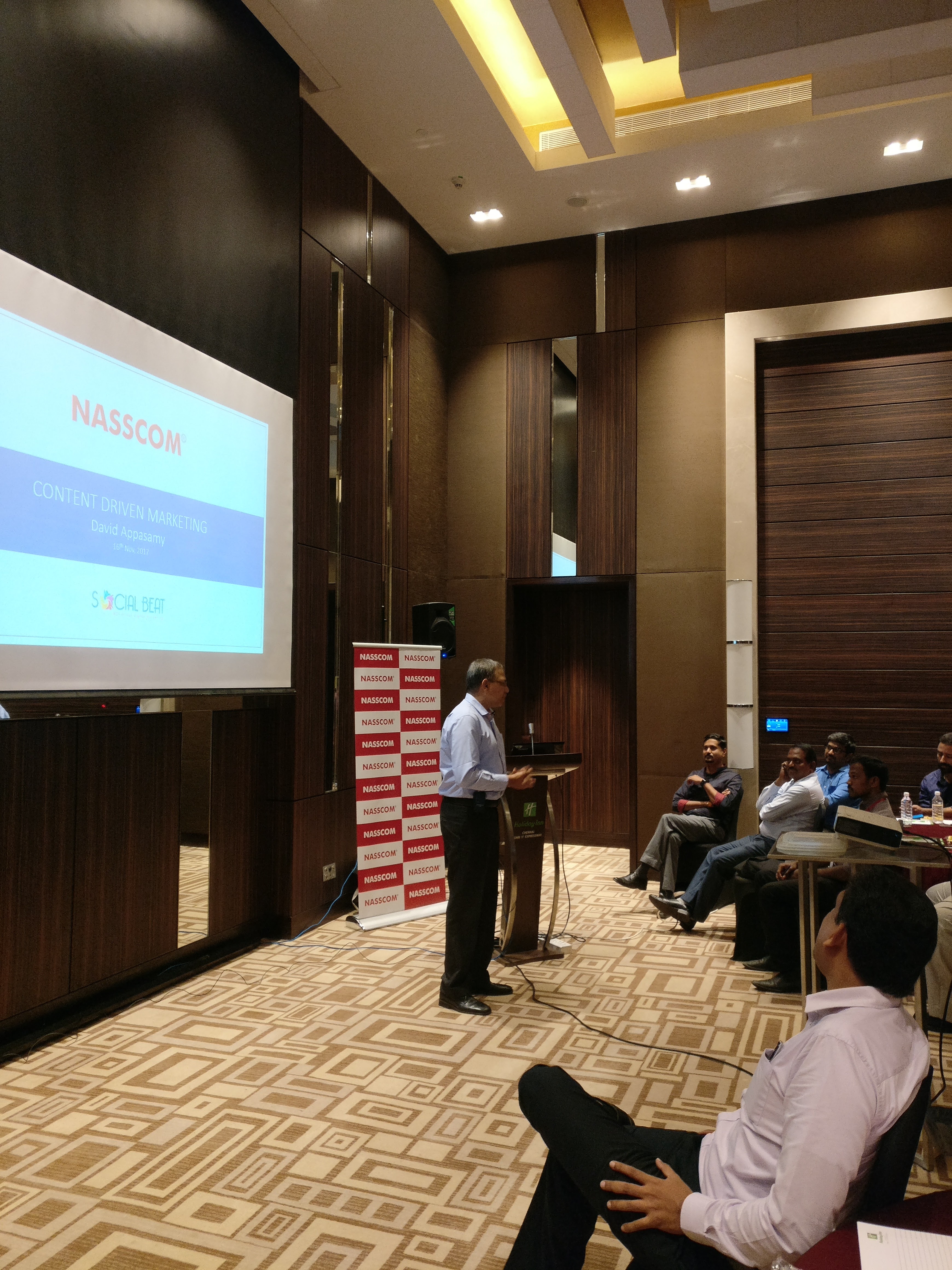
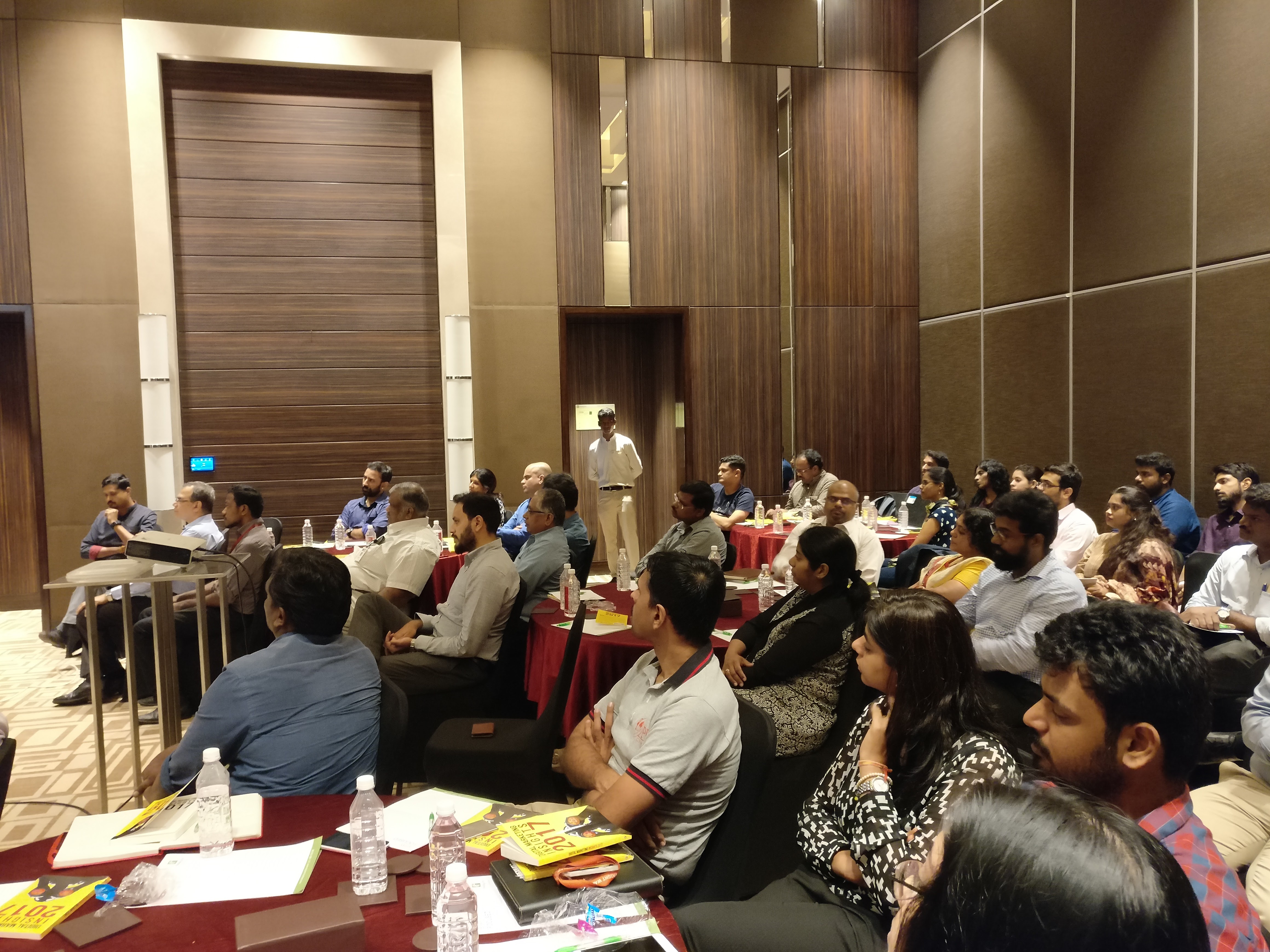
Social Beat was proud to be part of the NASSCOM Content Marketing Masterclass which took place at Holiday Inn, OMR, on the 16th of November, 2017. The session was led by David Appasamy, head of Branding and Strategy at Social Beat and provided insight on how content marketing can be effective for lead generation in the B2B sector. The session introduced the attendees to the strategic imperative of marketing and highlighted the importance of content marketing in the digital space.
The insightful session threw light on how content marketing builds credibility, confidence, and preference by establishing thought leadership and helps win attention, engage with and convert prospects into customers. It also focused on the ways in which this marketing strategy enhances and amplifies other marketing initiatives such as Social Media Marketing, digital advertising, and lead generation.
The Masterclass included a workshop to provide insights into:
You can view the presentation from the workshop below:
As the old saying goes, “Content is King” and the dynamic industry of digital marketing is not an exception to this universal notion. In today’s digital world, content marketing is the go-to marketing strategy to make your brand trend by targeting your audience and engaging them with your brand. However, it is a common theory to only associate blogs to content. Our minds have been tuned to the fact that good content can only be written in the form of chunks of text. But, in reality, there are many types of content, from catchy videos and hilarious gifs to stunning pictures and gripping podcasts. The plan is to engage your target audience through a means of information which they find interesting and which also promotes your brand in a subtle way.
Nevertheless, with the plethora of information available online at the mere click of a button, making your content rank in the first page of search engines with a strong SEO strategy is quite a herculean task. The key lies in creating content that your target group relates to and religiously promoting it in social media to reach out to your potential consumers. Good targeting will lead to higher engagement on the post, which will lead to a domino effect of it ultimately being flagged off as viral content.
That being said, brands have begun adding heaps and loads of content to their marketing plans. From expansive blogs to informative videos, they are leaving no stone unturned in making sure their brand is out there. But is that enough? Sure this will make the brand get out there but is it really “out there”?
The secret, to making content truly stand out of the oodles of information flooding the Internet, is to post limited information which is 10X better than what is already out there and is packed with the potential to go viral. However, the only way you can truly reach your audience is by vigorously promoting it. Splashing your content on various digital platforms through paid promotions and ads will boost your reach and also give it the push it needs to go viral. A viral post creates a lot of buzz in the target group and ultimately helps in generating leads for the business.
At Social Beat, we religiously follow the “Less is more” content marketing strategy in which we focus on producing high-quality content to amplify on digital media rather than expansive quantities of average content. The idea is to create original and relatable content that also uplifts your brand name and gives it the recognition it deserves. The strategy involves the following approaches:
As per Buzzsumo, Brian Dean of Backlinko has executed this content strategy to great effect. Brian has published just 53 posts over the last five years, less than one a month. These posts have driven nearly 4m visitors to his site. The average shares and links per post are what most of us can only dream of: an average of 2,490 shares, and 275 links from unique domains, for each post.
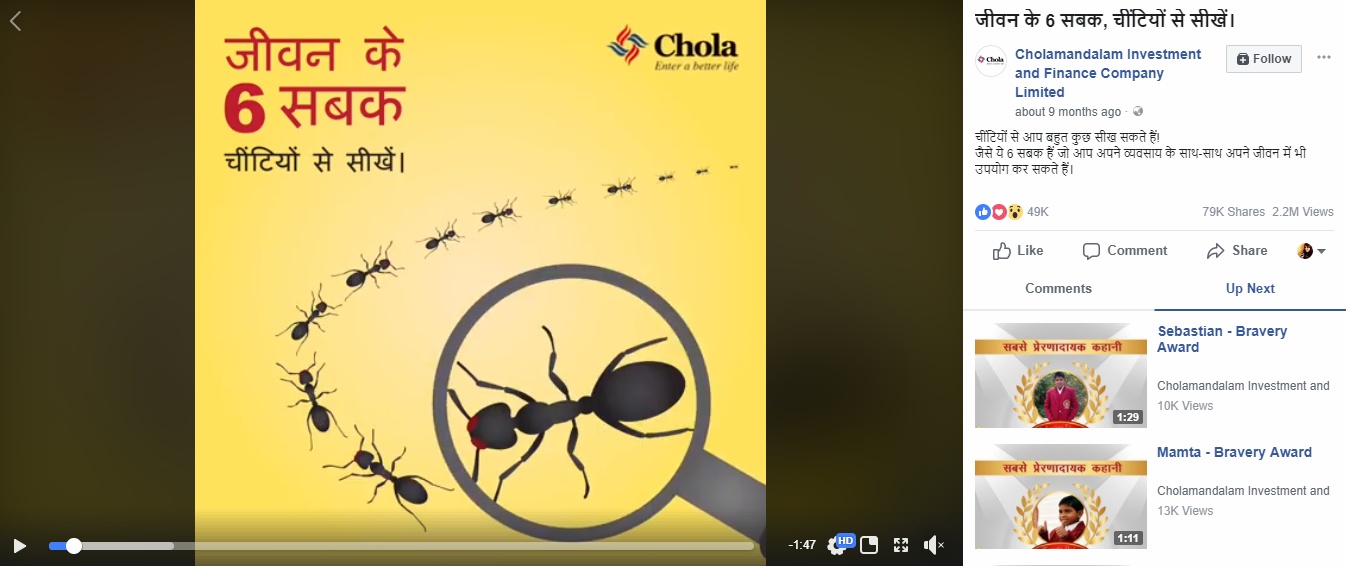
One such post that went viral with a paid reach of 3,51,565 and an organic reach of 64,79,859 is an informative video for one of our clients from the finance sector. Since our client provides financial services, we engaged their target audience with an explanatory video on the money-saving lessons we can learn from an ant. With total ad spends of Rs. 5000, we reached a total of 68,31,424 people, with 21,65,549 video views and 93,241 shares on Facebook. Additionally, we also customized the ad by using a regional language to make it more relatable and simple for the target audience. This way, we struck gold by amplifying content through both content marketing and native advertising.
To sum it up, it is all about quality instead of quantity in the powerful world of content marketing. Creating engaging content and pushing it to go viral with vigorous promotions and effective ads can not only help in branding your company but also boosts your reputation and authority.
Brands usually are under the misconception that the more content you create, the more visibility you’ll achieve. However, this is not true. Keeping the “Less is More” content strategy in mind, let’s take at a look at the current ad spends model of a company and the ways we can improvise on spending the same amount for a wider reach.
As per the current model, if Rs. 50,000 is allotted for content marketing, Rs. 40,000 of it is used for generating content, and Rs, 10,000 is used to promote posts on social media. Following is a rough estimate of the reach and total number of clicks tracked on a monthly basis:
| Ad spends (FB Promotions) | Rs 10,000 |
| Content creation by Influencers | Rs 40,000 |
|
Total |
Rs 50000 |
| Total no. of people reached | 1,50,000 |
| Total clicks | 10,000 |
By applying the “Less is More” content marketing strategy, the brand will focus on reaching a wider set of audience and generating more leads with the same amount spent on promotions. The plan is to generate content of premium quality and authenticity and promote it on social media for a higher number of link clicks and prolonged engagement in the same budget.
| Ad spends (FB Promotions) | Rs 30,000 |
| Content creation by Influencers | Rs 20,000 |
| Total | Rs 50000 |
| Total no. of people reached | 4,50,000 |
| Total clicks | 30,000 |
With all the statistics mentioned above, it is safe to say that though creating gripping content will help you achieve your content marketing goals, the key lies in promoting it effectively. Creating a handful of relatable posts every month and promoting it vigorously on networking channels is the foolproof way of grabbing the attention of a visitor and converting them into a loyal customer.
Having a blog has become mandatory for all organisations. However, with so many blogs out there, how do you ensure your blog is search engine friendly? The best way to do that is through SEO and content. If you are using a WordPress blog, here are 10 plugins that you should use.
1. Yoast SEO
Yoast SEO is one of the most popular plugins for WordPress. It can handle almost all on page elements except markup data and schema tags.
Notable features included in this plug-ins are:
If you are looking to install this plugin, read this step by step tutorial to set up this free SEO plugin.
2. Accelerated mobile pages (AMP)
AMP is a project designed by Google and Twitter to make mobile pages to load quickly. AMP is a kind of Facebook Instant Articles. There are many plugins available to implement AMP in Wordpress sites. The best plugin for AMP in WordPress is "AMP for WP - Accelerated Mobile Pages." Once it is implemented, the page loads quickly, especially on mobile devices.
Increasing the website speed is one of the key factors in ensuring your website ranks on Google. It increases the speed by serving static pages rather than dynamic content. The plugin optimises HTML, CSS, and JavaScript resources by compressing them and thereby ensuring the page loads fast.
4. All In One Schema.org Rich Snippets
All in one rich snippet is a free plugin, which currently has 79 5-star reviews from the WordPress community. This plugin is used basically to provide a summary of the page in the search results on Google, Yahoo, Bing and even in Facebook news feeds. It does so by using an interactive format with star ratings, author photo, image, etc. Many webmasters use this plugin to get higher rankings in search results.
ShortPixel Image Optimizer has over 50,000 Installs and the main motive of this plugin is to compress JPG, PNG, GIF and even PDF document. By doing so, it reduces the load time of the website and increases rankings of your website in search results. It also has the option to bulk optimize through media library. This plugin supports both HTTP and Https version of the website.
6. BJ Lazy Load
This plugin allows us to load your website quickly which is good for SEO. It replaces web site's post images, thumbnails, gravatar images and iframes with a placeholder & loads content as it gets close to enter the browser window when the visitor scrolls the page.
Using outbound and inbound links are extremely important for a blog post. However, when you use outbound links, it is important to make sure it is a nofollow link. The Rel Nofollow check box does exactly that. When you install this plugin, it gives you a checkbox in the insert/edit link popup for adding nofollow attributes.
8. Redirection
Redirection is a plugin for WordPress to manage 301 redirections, keep track of 404 errors, full log report of 301 redirections. All URLs can be redirected with this plugin except the URL, which doesn't exist.
9. All In One WP Security & Firewall
Although Wordpress is secure on its own, it is a good idea to have a security plugin on your blog page. The plugin has numerous account security features such as password strengthening tool and has the ability to check if any of the accounts have an identical username of passwords. It also provides a security score, which will tell you how secure your website it is.
10. Yet Another Related Posts Plugin (YARPP)
Keeping people for as long as you can on your website is a great sign for better SEO. A low bounce rate is a hint that your users are finding value in your site and spending more time. One of the best ways to improve this area is to install Yet Another Related Posts Plugin. This plugin displays relevant post related to the current content. This will ensure the users are given interesting content to read and makes sure they spend more time on your site.
We hope this article helped you to get some ideas about must have SEO WordPress plugins every website should have.
Surprising? These figures might sound counter-intuitive with so much focus on English given in digital media today. But it’s a fact that there has been a profound growth of regional content online. Consequently, this holds a massive implication for brands which are not leveraging regional languages for marketing their brand. With an anticipated CAGR of 41% over the next few years, the opportunity will only grow bigger. Taking that into account we have launched 22 languages. This website provides organizations with access to an audience of more than 50 million users nationwide. Companies can use a multilingual marketing strategy to showcase their products and services in over 22 languages through this medium. To understand this concept better, here are a few interesting insights from the latest study done by KPMG India and Google on the growth of vernacular languages in India on the digital front. Check out this video to understand why your brand must adopt a multilingual strategy:
Digital news has caught up easily because of its simplicity. Data is usually accessible through an app or a website with mobile compatibility. Big names have realized the importance of digital media due to the silent downfall in newspaper and magazine sales. Currently, there are 106 million users viewing digital news in local Indian languages. This figure is anticipated to add up to 180 million users by 2021. However, Hindi, Marathi, Bengali and Tamil make up 80% of the current users. The major categories of type of news viewed are general, sports and politics. This only means that there is a dire need of more companies to enter this segment, to keep India more informed and updated.
Digital Classifieds are a very big sector. This sector has the potential to cause a ripple effect as people interact with each other in the same area and subsequently belong to the same target group. This would cause information to travel to a larger audience. Furthermore, Indian language usage would provide an extra boost by causing the information to reach nooks and corners of rural India. The top categories, which are looked up the most in classifieds, are matrimony, recruitment and real estate. Nevertheless, the only obstruction in digital classifieds is the lack of availability. This sector is anticipated to grow to an astonishing 100 million user base in the coming five years with individuals fluent in Hindi, Tamil and Kannada forming 70% of the total users by then.
The sector of digital payments is estimated to grow at 30% CAGR and a humongous 175 million consumers are expected to use it with Indian language interface by 2021. These gates are mostly used for mobile recharge and utility bill payments. Tamil, Telugu and Kannada are heading the charts in the languages open to quick adaption and will form half of the users on the digital payment platform.
According to statistics, Indian language users prefer buying electronics online rather than apparels or other accessories. As for the sellers, it has become much more convenient for local sellers to reach e-commerce giants like Amazon. One can sell their products on Amazon in five easy steps - the steps being creating an account, listing, taking products live and handing over the product to Amazon for delivery. It is quite convenient and hassle-free. The user base for e-commerce in local languages is growing at a high rate. It has a CAGR of 32% and is expected to add 120 million users in the upcoming five years. This popularity can be attributed to two major factors as voted highest by consumers: Firstly, the availability of better promotional offers and secondly, the huge variety of products available online which may not be present in the smaller cities or towns of India. The main obstruction users experience is the lack of end-to-end compatibility in Indian languages. However, as these obstructions show signs of quick recovery, e-tailing in local languages apart from e-commerce in English, will be a lucrative segment for the e-giants.
It is no surprise that impressive progress has already been made in this segment. Currently, a mass population of 162 million exists as the user base. Keeping in mind that the predicted user base by 2021 is 392 million Indians, there is much more that can be done in the digital entertainment arena. The content has the space to be comparatively more experimental and creative than other platforms as the adoption rate is 90% for this sector. The viewer’s quickly adapt to the kind of material available to them. These users consume both audio and video mediums.
To tap into this huge market, we used local languages for our informative videos like the Chola Finance video which was very well received by the Hindi speaking locals. The video got a whopping 1,751,355 Views and more than 64,000 shares.
The challenge remains in picking the right medium like Facebook, Hotstar, Youtube, tvfPlay or other regional channels.
If you are looking to create videos, read our blog on how to create low cost videos.
There are currently 41 million users under the segment of online government services. It is increasing at a CAGR of 33% and is expected to land at a massive 172 million in the next five years. Some of the applications that constitute online government services are tax filling, applying for government jobs and knowing about new rules and regulations. The Indian Government can use this platform to increase transparency and cut down corruption. However, limited local language enablement combined with lack of interest and awareness poses a huge obstruction which needs to be addressed immediately.
Chat applications currently have a 170 million user base and are anticipated to reach a 400 million user base by 2021. Hindi is topping at a huge margin of 50% as of now. Kannada is expected to grow to a far second with a whopping 20% in the coming years. The major challenge in this is the upgrade needed in voice to text, language keyboard and transliteration.
Social media platforms have a total of 115 million local language users as of now. This figure is expected to grow to 300 million by 2021.The South is anticipated to dominate this area due to its better adoption skills.
Digital write ups are a very interesting scope for Indian languages on the digital platform. It will provide visibility for the users who want to put their content online. It will also provide job opportunities for local people by companies looking to improve their SEO options by generating more local language content online. Additionally, mobile friendly blogs are preferred by users. 54% of Indians would adopt reading write ups if they are optimized for mobile screens.
This ongoing shift in India’s internet scenario has not gone past unseen by the Indian Government. Taking into account the increase in smart phone availability due to cheaper prices, a 176 million increment is expected till 2021. A striking 90% of these consumers are anticipated to be Indian language users. The government has taken this into account and made it mandatory for mobile phones sold in India to be Indian language friendly. Additionally, the government has also taken an initiative to make 60 million rural households digitally literate.
There are approximately 500 million Indian language users online. This figure will significantly have a huge impact on the nature of content presented on digital platforms. Additionally, this audience will be more inclusive of the elderly and the rural population. Also, as long as the type of sectors is concerned, Digital Classifieds, digital news and financial solutions will see a major boost.
Due to the local reach, many B2C users might exploit the Indian language user base on various channels. Digital marketing in Indian local languages will get them untapped markets in India. The companies which will be involved could be news sites, e-commerce players, insurance companies and m-wallets to name a few. In tier 2 and tier 3 cities, this can be encashed at a higher level. Since 90% of the new mobile buyers are local language users, a whole new customer base can be reached through this medium. Here's an interesting video that tells you why you need to have a multilingual strategy if you want to create a strong digital presence among your regional audience.
Indian language based websites and application will see a rise. Digital advertisements in local languages could also be used by B2C companies to increase reach. Additionally, Google display ads could be customized to the regional language of the state where they are being viewed.
This progress would result in new data generation for companies. The database, through structured investments, can be analyzed for specific language behaviors. This will help digital marketers in ad planning and targeting.
We need to move to a language agnostic ecosystem. This is required to give a platform to the Indian language content creators. Voice recognition will be of major help to the users who find using search and navigation through text a challenge.
It is affirmative that the preference given to regional languages will play an active role in internet consumption. It will also help explore a huge new market for brands. Brands that miss this bandwagon are sure to lose out on quite a few million potential customers. Furthermore, Indian language in digital will lead to the spreading of knowledge in rural parts of India. Tier 2 and tier 3 cities will also be of prime targeting in this arena. With such profound reach, it is safe to say that marketing through your regional language is the next step in digitizing India.
Banking on a series of successful editions of Digital Chai Pe Charcha in Chennai and Bangalore, we conducted the first edition of Digital Chai Pe Charcha in Mumbai. We had close to 30 participants comprising of entrepreneurs and marketers from across industries. The topic of discussion was getting ROI from Digital Marketing.
Below is the presentation that was discussed during the session which will provide you with more information on the above points:
With the quick rise in demand for Influencer Marketing, there is a need for tools and platforms to aid brands identify the right influencers and engage them. Many platforms have cropped up that either aid you to identify the influencers yourself via a DIY tool or connect you to the right influencers for your brand based on your requirements. Some of them are free while others are either freemium or paid platforms. Let us take a look at the top platforms to discover Influencers for your brand and help you connect and engage them in your marketing campaigns.
Creating a blog has become very important for every business. The actual challenge, though, comes when you are faced with the Herculean task of making your post pop up on the top page of all leading Search Engine Result Pages (SERPs). Search Engine Optimisation (SEO) plays a pivotal role in spiking up your web page's ranking and making sure it receives the exposure it truly deserves. Read on for some foolproof techniques to optimise your page and drive all your targeted traffic right to it. You may also find it useful to view the Digital Bytes knowledge series on the Social Beat YouTube Channel.
Here is a list of on-page factors that matters the most:
As per Google’s algorithm, the length of the title tag should be 55 to 60 characters. If it crosses this limit, only the first 60 characters will show up in the SERPs. So ensure that the title is crisp and conveys everything it needs to in the first 60 characters itself.
Meta descriptions are often used to give us a brief explanation of the blog post. Make sure you include all the necessary keywords in the description. The length of the Meta description is limited to 155 to 160 characters. Similar to the title tag, even if the length of the Meta description crosses 160, only the first 160 characters will show up in the SERPs.
How Google displays your result determines whether people want to click on your listing or someone else's. The snippet is your opportunity to say, "Come click me instead of those other guys." If you can optimize this, both from a keyword perspective using the words and phrases that people want, as well as from relevancy.
Google identifies web pages mainly by the URL and the title. So, to rank higher on Google, you need use your focus keywords on your URL. Additionally, try making your URL as short and sweet as possible. Unless your post is an event-based blog, avoid mentioning the year in your URL as Google tends to categorise it as outdated content. This, in turn, decreases your ranking.
The heading of your blog post needs to be in the H1 tag and should contain the exact keyword match. This helps Googlebot in ranking your post as high as possible in SERPs.
The subheadings of your blog post need to be in the H2 tag. If you are focusing on more than one set of keywords in your post, use the other keywords in your subheadings for better SERP ranking.
Once you have completed your keyword research, perform a Google search for those keywords. This will give you a set of keywords, under the top results, titled “Searches related to”. These keywords are called Latent Semantic Indexing (LSI) keywords and are the most frequently used keywords by visitors. Using these keywords in your content and heading will rank your post better.
In addition to the primary and secondary keywords that we mostly target in our optimization efforts, the of LSI keywords in the content will help users understand better by getting answers to their problems for the respective search queries and aid in ranking.
The first thing is to figure out what Google considers to be related to the keywords searches. What does Google think is the content that will answer this searcher's query? You're trying to figure out intent, the type of content that's required, and whatever missing pieces might be there. If you can find the gap and fill that gap with answering the ‘what’ they expected in that search query, this will help to improve the ranking position
Keyword Density is the number of times your focus keyword has been used in your content. A high-ranking post should primarily have a keyword density of 1.5% based on its length.
All Digital Marketers know that content is king. It keeps the visitors engaged in the post and has the potential to make a post go viral. To keep your visitors glued to your blog, make sure you give out more information in a lesser span of time. Images, videos and infographics are your best bet, as they help in better understanding of the content.
Google’s bot should be capable of understanding the content that is on the page in a readable text format. To recognize images and visuals, videos or embeds or anything else that you've got on the page, use them in a way that they are going to help the bot index them.
The images in your blog post play a vital role in ranking your page as well. Insert the keywords in the alt-text used to describe the images to make them show up on Google searches and, in turn, rank your page higher on Google.
Apart from the fact that your keywords need to be frequently used in your post, the placement of the keywords is also important for better SEO. Use your keywords in first 100 words of your content for higher SERP ranking.
Outbound links give Google a better understanding of your content based on the links provided to other web pages.
Internal links help in keeping your users engaged in the blog by providing old links related to the current article within the same website.
Quality and quantity are both important for good content. A blog post without any one of these will not help in keeping users engaged, which will lead to a decrease in SERP ranking over the course of time. To understand this concept better, let's take the example of Alice and Bob. Alice's blog is ranked in the first position, but her content lacks quality whereas Bob's blog is currently ranked in the 4th position, but his content keeps his users engaged for a long time. Google will analyse this behaviour and automatically rank Bob's blog higher than Alice's due to better content.
Using HTTPS for your blog will make it secured. It also helps in increasing your visitors’ confidence and trust in your content.
As per the latest Google algorithm, a web page needs to have a good responsive design, to adapt to all platforms such as mobiles and tablets.
The speed at which a web page loads fully is of paramount importance. Site speed should not be compromised by data speed. You could have the latest website design, but if your site does not load quickly, you will lose you customer then and there. So improving your sites page speed should be of utmost importance.
Content, visuals, and UX are great aspects of a page. But in the case of poor loading time of your web page, the purpose to retain a user is lost. Hence, constantly keeping a close watch on the speed of your website is important. The faster it is, the easier it is for the user the navigate through the site.
Robots.txt helps to block unwanted information in the web page.
When Google indexes the page, it can be seen in the XML sitemap through the following links:
The on-page grader is a Moz tool to ensure your web page is optimised. It gives you a closer insight into the things which need to be done to get a grade A web page. The tool focuses on the following factors to get a higher SERP ranking.
For example, on-page SEO is optimised for this URL http://backlinko.com/on-page-seo is B grade
Structured data error is a webmaster error. Fixing this error is also one of the effective ways of optimising your website. Though this is not a ranking factor, it helps in eradicating all errors on the website.
Fixing the mobile usability error is of utmost importance as the Google Penguin update gives more priority to mobile devices and most of the traffic driven to a website is through mobile. Fixing this error addresses the following concerns:
These errors can be found under the "HTML improvements" tag in "Search Console". These errors pop up when the title and meta description are missing and a duplicate title and meta description is placed on the web page.
Once the above-mentioned checklist is completed, you can work on the advanced on-page checklist for advanced content optimisation for more traffic and higher rankings.
First, find the related questions appearing in SERPs by using your focus keyword. Then, write the relevant answers for those questions. To understand this better, let's take Alice and Bob’s example again. Alice is ranking in the first position but she didn’t answer any related questions. Bob, on the other hand, is ranking in the 10th position but he has answered the related questions. So, his website pops up in the top position without ranking and gets more traffic as well.
This panel is mainly obtained from human edited data, like Wikipedia. It appears on the right side of the Google results page.
While showing results for the focus keyword, Google lists the location on Google maps. So, if your business location is already marked on Google Maps, it is more beneficial for you.
Sometimes reviews with stars and ratings are displayed in SERPs when your business is related to products of a particular kind.
Images are displayed as results when Google sees the need for visual content. To display your image in those results follow these useful pointers:
In 2015, Google began displaying tweets directly in Google results, mixed in with organic results.
In open graph, Google displays your results with concerned social media links, like Facebook. Open graph meta tags allow you to control what content shows up when a page is shared on Facebook.
Breadcrumbs provide better navigation within the web page. Using this in your blog will also help in better Google ranking.
At times, Google will present you with the ability to do a search within the pages of a website, directly from the results page. When doing so, Google will offer a search box under the results description with the word "Search" followed by the name of the website displayed in light grey.
To help refine your search, Google may display the featured pages of a site as independent and clickable links within the result. Displayed under the result's description, these links take you directly to a page within the site.
Accelerated Mobile Pages (AMP) are an open source initiative from Google that focuses on enhancing the speed of a mobile page. It uses stripped-down variations of a web page to improve its performance and can be identified with a lightning symbol in the top right corner. If your blog page has AMP, it will load extremely quickly. Since page speed is of utmost importance, AMP is crucial for all blog pages.
A 404 page is what your target audience lands on when they click a broken link. This is a non-existent page. Your server will throw a standard 404 error, however, that is not the most attractive one for users. A custom 404 page can be branded with your site to provide helpful information.
Listing your business with Google is a great way to ensure that people can see you on the internet. This helps with local SEO and when we build backlinks in specific regional listings, Google will understand which region is targeted.
Social bookmarking sites are the best way to promote any website, event or brand in a shorter span of time. Marking a link to social bookmarking sites plays a very effective role in creating traffic and getting higher ranking in SERPs.
Some of the most popular social bookmarking sites are StumbleUpon, Scoop it, Reddit, Youmob, Pearltrees and Savenkeep to name a few.
Image sharing sites help in improving your website traffic. If you are optimising your content, then it's only for the web search. But nowadays image search is also improving, so people have begun to submit their images to image sharing sites. Mentioned below are a few good high PR image sharing sites, which will help you improve backlinking through images:
Uploading audio files is another prime SEO activity which is useful in promoting your website. You can backlink these files to high PR audio sharing websites for effective SEO. Few of the audio sharing websites are mentioned below:
Video submission is one of the most prominent and powerful methods of promoting a website. While uploading a relevant video, make sure the title and description contain the focus keyword for better ranking. Few examples of video submission sites are:
You can create a blog and directly post it on high PR Web 2.0 sites. Getting natural backlinks is one of the key SEO strategies to increase traffic and, eventually, the ranking of a website or blog. There are many sources of natural backlinks, which are favoured by Google. They include High Pagerank Dofollow web 2.0 websites, such as:
Profile linking websites have improved the level of engagement of users. They offer much better distinctiveness and enable the visitors to interact with the website in an easier manner. Profile creation is a method which offers a brand new strategy to SEO professionals for the best SEO services and link building services. They also significantly provide a more substantial perspective to present creativeness as well as improved the interaction standard of audiences. It is extremely simple to make a "Dofollow" profile backlink.
High PR classified submission sites are an easier way to generate leads and promote your products online. Classified submission sites are very effective for link building, boosting the ranking in search engines and generating more leads for your business.
There are lots of benefits in using PPT sharing sites. You can easily share your PDF files online on these high PR PPT submission websites. These highly authoritative PPT Sharing and submission sites are frequently updated on a regular and daily basis. That's why search engines like to crawl these sites more often. Getting do-follow backlinks from PPT submission sites will get your targeted keywords optimised, and it will help in increasing your site visibility in search engines.
Quora is a great way to drive traffic and get backlinks to your blog. The Quora community consists of an incredibly large number of users discussing a wide variety of subjects and topics. If you haven't yet, then you should join Quora right away and start participating in discussions. You can start replying to questions and mention a post of your blog or the homepage of your blog, as long as it is relevant to the question.
Question and answer sites are great to get some relatable insight into issues which are too specific to perform a Google search. For example, if you want to know the reviews of a product, you can Google it and get a pool of information and a wide range of websites to refer to. This information might tend to get too generic and may not be able to address your concern to the point. Question and Answer sites, on the other hand, give you a more personalised response based on other user experiences. However, it does have a drawback of not providing certified information, like in the case of medical scenarios. Nevertheless, it is a useful platform to get relatable responses from users based on prior encounters.
Google provides an abundance of opportunities for guest posts. You can use any other of the following combinations on Google to find blogs which are open to guest posts. Just type in your focus keywords followed by any of the below-mentioned words to get a list of blogs you can post into as a guest:
Building backlinks by commenting on other relevant websites and get the benefits of both traffic and rankings.
Steal your competitor's backlinks by using tools like Ahrefs, Semrush, Majestic and SEO Spyglass. Spying on your competitor's backlinks can give you an idea of what domains are linking to their posts and thus you can target those sources too.
.Edu and .Gov Backlinks are high-quality backlinks. These backlinks are helpful in building more backlinks
Dropmylink will help you find broken links. Here are some search strings you can use organically:
keyword + “resources”
keyword + intitle:resources
keyword + intitle:blogroll
keyword + “blogroll”
site:.gov keyword + “links”
site:.edu keyword + “recommended sites”
keyword + “related links”
SEO is an ever changing, however, these On-page and Off-page SEO techniques will help you stay ahead in the game and help your blog rank.