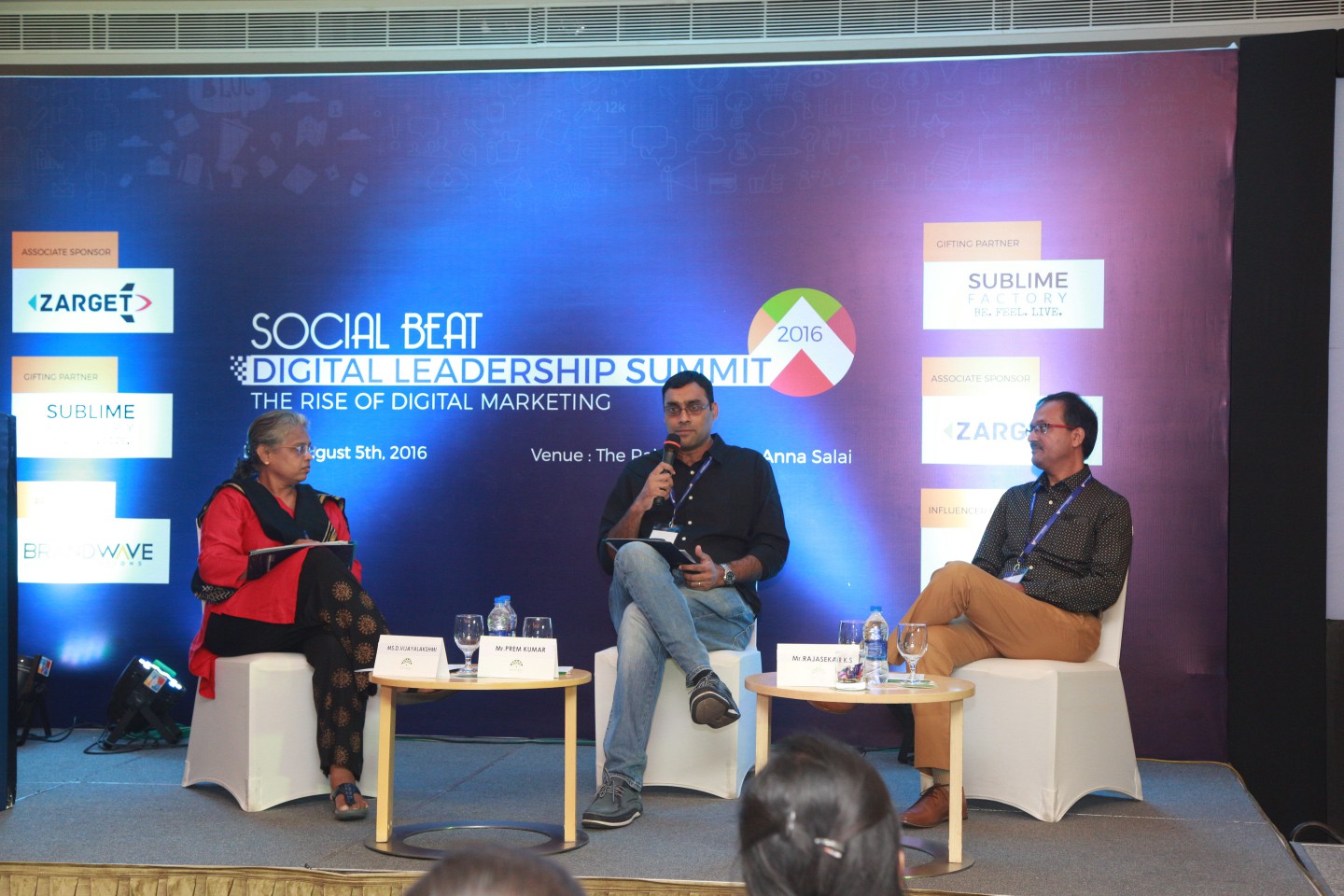
Below is the gist of the panel discussion on Making Content Marketing work for your Brand at the Digital Leadership Summit In Chennai In August 2016. We had two panellists moderated by Mr Prem Kumar Sivakumaran from The Smart CEO Magazine: Ms D Vijayalakhmi – Murugappa Group and Mr Rajasekar KS – matrimony.com.
Content marketing is the current buzz word, and the session started with a discussion on what each of them feels about content marketing. We also have had a Digital Chai Pe Charcha On Content Marketing Success in 2016 andyou Can Read It Here.
Viji from Murugappa Group highlighted that content should be something that is interesting to all readers. Content that makes the reader feel good, look good and do good is a successful content marketing campaign. It should be lesser about the brand and more about the audience. For more detailed steps on creating high quality content check out our blog on 10 Ways To Create 10x Content.
Rajasekar expressed that content marketing is more about content and less about marketing. While most brands believe that it is about amplification, Raj said that it's more about understanding the customer and their problems. He also said that when a company starts talking about customers problem, its business starts and when it starts talking about its business, its problems start. Content should engage the customers; then it can be a successful one.
At Murugappa Group, it is predominantly about the brand itself. Viji spoke about how at Murugappa, they also think of fun and meaningful stories and try and connect with the target audience, even when it is about the B2B brands.
Raj spoke about their initiatives at happymarriages.com, a content marketing initiative set up by BharathMatrimony. He talked about how it was initially tough to create content around it because people were unwilling to talk about their expectations from marriage. So his team set about trying to understand what issues couple would face. After three months of research, they arrived at 500 themes and worked with authors, senior writers and an internal team to write engaging content that the audience could relate to.
While talking about strategies, one of the members of the audience asked an interesting question about with so much content out there, how do to stand out? The panellists agreed that crowdsourcing high-quality content is the answer. They also spoke about examples of organisations such as Amercian Express Bank, GE initiative that has done a great job in standing out. Prem also highlighted using a platform such as curata.com, a platform that curates content, which also enables marketers to scale content marketing to grow leads and revenue.
The panelists both agreed that although you can look at shares and likes, the success can be measured only when you get customer feedback. If a content piece has solved the customer's pain points, then you have succeeded. They also urged any company using content marketing to use this as a metric.
The panellists spoke about how video is the most captivating of all channels, and each of them highlighted how they leveraged video in their organisations. Raj explained how his team went to five cities and interviewed 36 couples. They chatted with customers about relationships and aired these on national TV.
Viji talked about the Murugappa Madras Song. She highlighted how the company found a connect and used that to create a video that went viral. The video was so powerful that even a city-based league team requested the conglomerate to make an anthem for them as well.
The panellists also urged marketers to resist making a viral video for the sake of making one and asked marketers to keep their ears tuned to the customer.
There are a lot of ways in which you can create good quality videos with a low budget. Read our blog to know more.
Whatever be the industry, there is always a way create stories. The key is to understand the audience. Viji mentioned the farmer video that the Murugappa Group made. They asked a simple question, "What is the most important job in the word?" This emotional video stuck a cord with the public and was shared far and wide not only on social media but also on WhatsApp.
The panellists advised startups to leverage PR and stated examples of the ALS Ice Bucket Challenge and how they used their social media campaign to not only gain visibility but also get a lot of PR coverage as well.
Raj also spoke about Richard Branson, CEO of Virgin Airlines jumping off a ten storeyed building and how the media wrote about it. He also asked marketers only to do these crazy stunts if it suits their personality and the brand. PR is the biggest pipe to the audience, and it can get customers. So whatever campaign a marketer does, it is important to leverage PR.
Content marketing is a must-do for all brands, and more brands are willing to spend money on it. Raj also spoke about how any marketing initiative is ultimately boiling down to content and about how marketing cannot exist without content. Content is the only pipe you can sell any product.
Prem also added that the first ever content market initiative was done in the early 1900s by John Deere, the tractor company when they created a magazine ‘Furrow.' So the concept is not new only the term Content Marketing is.
It was an interesting evening spent at MDI Gurgaon with students of Consumer Behaviour. We were talking about the role of Communities, Content & Influencer Marketing on Consumer Behaviour. See the below slide share for details on the discussion we had.
The students had a lot of questions, especially around influencer marketing and its ethics. Many of these can be found in the FAQs of Influencer Marketing here.
Blogs are no longer just an expression of an individual or a platform to share one’s ideas and thoughts. Blogs have started to be one of the most influential and useful tools in the market space. It’s an excellent way to showcase thought leadership as well as keep consumers updated on what’s happening in the company and with the products/services. It is important to note that, in business blogging, the blogs must be related to the key area of the business and needs to be engaging for the readers. That being said, there are still a lot of businesses that are not very active in the blogging in spite of the inherent benefits of blogging. This blog aims to bring out the importance of business blog!
Increases traffic to your website
A website is a great asset to any company and anything that brings traffic to the site only doubles the asset’s value. The traffic on a website is very crucial, which indeed serves in achieving the objective of the site. One of the main reasons why people don’t return to a brand’s website is because it is idle and inactive. Blogs give the internet users a great reason to visit your site and increase the traffic. According to a HubSpot survey, 60% of the brands who have constant blogging on their websites acquire more customers than the others. Blogs help people or potential customers discover your website amongst million others. This happens when the blogs are informational and also related to what users would like to read from your website. It is also said that blogging shows a professional approach for the brand business. By providing useful information, it attracts people to visit the site even repeatedly. Who wouldn’t like more visitors to their website, anyway?
Increases Search Engine traffic
To appear in SERP #1 is a dream! And to get there, you need to really work hard . There are more than 200 aspects which determine your rank in Google. But, nothing like some good content! Blogs are now a vital part of Search Engine Optimization and can be leveraged upon in two ways. One, include it as just an additional index page to your website which Google then identifies and eventually will garner organic search results. Another way is to include targeted keywords and links which will help in increasing the ranking of the site by getting you noticed more in the search results. This exercise becomes easier with the help of SEO plug-ins. By using an SEO plug-in like Yoast which calculates the density of the appearance of the focus keyword in the blog will check whether the right keyword is used on the blog. Research shows blogging increases inbound links by 97 percent, the most important factor in Google’s ranking algorithm. Quality content and regular updates are an indication to Google that the website is active with a routine content flow! Explore some of the latest SEO hacks, here.
Customer Acquisition and Lead generation
The ultimate goal for every business, big or small is to generate revenue and blogs help you do that. Regular blogging, as mentioned earlier increases the traffic to your website. Small businesses with blogs are said to generate more leads by 126%. The increase in traffic will result in more people taking note of your business and eventually exploring the rest of your website where all your business services are listed. This is a great way of acquiring customers without bombarding them with self-promotional content. While creating content you should keep in mind that every person who visits your website has the potential to be a customer. When your target audience finds your blog interesting, they may be more interested in your business than they were before and the chances of conversion are higher.
Content creation for social media platforms
Another reason why blogs are important to your business is that they create a huge content value for Social Media Marketing. It is almost mandatory for brands to have an identity on social media and the only differentiation is content. Content defines your brand identity and helps you stand apart from the rest of the crowd. Creating quality content in the form of blogs and sharing them on the social media channels can help get more reach. The number of likes, shares, retweets will testify for your content. Here’s an interesting and informative blog post that was shared on social media for amplification.There are many other ways to amplify your content online. Click here to read about it.
Helps in building the brand
Branding is the core element to develop your business. Every business is striving hard to create a brand for them and to make people see them as THE BRAND and not just any brand. Blogging is a huge opportunity for you to build a brand for your company. It is, after all, the most organic method of getting people to notice your brand online. The key is to create a blog which adds value and is unique in its content approach and style. By creating specific, targeted content, you may focus more specifically on your target audience leading to increasing your exposure among people. Learn how Content Marketing is one best way to give your brand an image!
Establishes authority and expertise
A good blog always answers a question, solves a problem or gives something valuable for a takeaway. When a brand constantly shares blogs that are useful to the customers, it develops an authoritative image in their minds. For example, for a group of angel investors, blog topics like- Tips for entrepreneurs, How to grow as a startup etc. along with other business strategies are going to be of some value to their readers. The ultimate aim is that when a user reads your blog, he/she should finish it with some value-addition. When people find answers or solutions on our blog, they are more likely to become your follower and they start seeing you as a source of information. Here are 10 ways to create better content for your readers.
Increases customer interaction
It is important for any brand to stay connected with their audience. The underlying factor behind the success of any business is the concern to satisfy the end customer and not just run your firm for money. To do so, brands should establish a good rapport with the customers. To improve on the customer interactions front, brands need to establish higher recall. The question is how do blogs help in this aspect? A higher recall can be established for your brand when you provide knowledge to your consumers and this, in turn, improves the relationship your brand has with the customers. It helps build trust which turns into brand loyalty eventually.
In a world where content speaks for itself and does half the job of a brand, blogs are the most crucial thing to look upon as a marketer. When blogging becomes a strategy in your marketing plan, you get a powerful tool to fight against your online competitors. If your company hasn’t started blogging, this piece is an indicator that it should!
Was this blog useful? Share your thoughts on other reasons you started blogging!
Email Marketing is one of the most actively used marketing channels. But every now then, we get queries that question the effectiveness of email marketing. Many feel its passé while others equate it to spamming. The truth is email marketing has never been more alive than it is today.
The dynamics of emailer marketing is changing fast but basics shall always remain the same – if you share something valuable with your audience, they are likely to engage with your content. Purchasing a database does not work anymore. Brands need to develop their own database of interested customers or potential customers who are more likely to engage with your email. Emails to your curated database is a personal, dependable and a direct way of reaching out to your audience.
'Out of all of the channels I tested as a marketer, email continually outperforms most of them'
- Neil Patel (Co-founder, KISSmetrics)
In this article, we have listed down useful ways in which you can develop your own email marketing database.
Make your email sign-up form visible on relevant pages on your website, more importantly the Blog page. Use either an embedded form or a Call-to-Action for people to click through to a dedicated sign-up page. Make sure that it’s in a prominent spot above the fold. The info about the possibility to sign up for the newsletter can be also placed in a pop-up window.
If you have a sign-up form on your site, make sure it’s easy to fill. Make it straightforward and resist the temptation to collect lots of demographic & lifestyle information at this stage. It will get in the way of collecting those email addresses. Always remember Short and Sweet is the King!
Good email content deepens the connection with your audience – it could be a powerful subject line (which get your messages opened); your unique voice (which gets your messages read); or niche-specific content your subscribers would find useful and shares with others (which inspires referrals and word-of-mouth). What works is “value exchange” — your valuable information for your prospect’s valued time. Your subscribers need to know they can trust you and that you’re not a self-promoting spam-bot.
We all need a little incentive to hand over our email address, but we don’t need too much if we feel an affinity with the brand. Try these…
- Offer a discount off their first purchase
- Explain what they’ll get: special offers, private sales, hints and tips, magazine articles…
- Show them what they’ll get (see our recent articles, news, reader offers etc)
You’ve built the perfect form. Now where to place it? Will more people see it on the ‘Contact’ page or ‘About us’ page? Should you keep the newsletter signup on your homepage? Or put it in the sidebar too? Decisions, decisions! Here are some top places to try placing an email signup form (or two or three) on your site:
Like a lot of other issues when it comes to websites and e-commerce, speed matters because Google says that it matters. On 09 April 2010, Google’s Webmaster Central Blog announced that, “We’ve decided to take site speed into account in our search rankings.” In other words, faster web pages will rank higher on search engine results pages (SERP) than slower sites.
A gated homepage is when a person has to enter their email address on the homepage in order to gain entry to a website’s content. One a person does so, a cookie is kept on their browser so that they don’t have to fill in their email address again to get access. But it is not always appropriate to Gate your homepage. You should have a lot of in-depth content which people are dying to read for them to give their email address. The right time is important too! To find the right moment, you want ‘yes’ answers to questions like:
Your landing pages should focus on one main detail and that’s converting visitors into subscribers. Whether you’re asking for contact details in exchange for a discount, a free webinar or something else that the subscribers would like to have, you are bound to get more to sign up. The Design of the Landing Page has to be exceptional too. Your subscribers are only as great as the landing page that get them.
If you don’t have social sharing buttons there’s a likelihood that your content won’t get shared. Someone might want to share the content with a friend but by the time they open up a new window and sign in to their social network, they will get distracted and forget about it completely. Don’t take the risk. Add share buttons so that blog visitors will stay on your site longer. Support your present subscribers to share and forward your content by including an "Email to a Friend" button. That way, you'll access a fresh network of new people who sign up for your emails. Do not forget to incorporate a "Subscribe" button as well in the footer.
“Subscribe” is up there with “Register” as an Internet no-no! Remove the words “subscription” and “subscribe”. The term implies a commitment and worse, money. Do away with any “Submit” or “Sign up”! Use first-person language instead – Try out phrases like “Sign me up” or “Send me updates.” Tell people exactly what they are getting by subscribing. Hint: It’s not a weekly email.
Online networking and social media marketing are useful tools to improve your online leads from which you can derive the email addresses of your potential subscribers. Build relationships with your target market via some of the popular social media networks such as Facebook, Twitter, and Google Plus.
You can host a Facebook contest or giveaway either on an application tab or on your Facebook timeline. However, if you’re hosting the promotion on your Facebook timeline, it’s next to impossible to collect emails. Hosting your promotion from a Facebook Offers App is the best approach since your target audience will have to fill in their email address to redeem the offer.
A combination of audio and video marketing using rich media can greatly improve the number of subscribers you get. Studies have shown that people like and share content that is mostly Emotional or Funny. You can share the content on your social media pages and drive fans to your website.
Do not miss the opportunity to showcase your website / content links at the right place – for example, your video on YouTube can have your website link in the description. You can also create Cards to drive more traffic. The Subscription part then depends on the last mile conversion on your website.
List Builder by SumoMe is for those individuals who want to seriously build their email list at a fast pace. The List Builder uses an email popup form to invite new visitors to join your email list, thus helping you get more subscribers. List Builder contains many features that help make it to the top of our list of email building tools. It’s A/B testing, no branding policy, fantastic templates, display controls, conversion tracking and multiple-popups will easily help you take your email list to the next level.
Welcome Gate is another great tool for building a list but this one works a bit differently. Why? That’s because it directs every new visitor to a well-designed landing page without showing a popup. Visitors are only redirected to the Welcome Gate page when they go to your home page. So if someone comes straight to a blog post through social media or any other source link, it would not be shown. A cookie keeps a track of this so the visitor will only see the Welcome Gate page once in their lifetime. After quite a lot of testing we came realized this plugin is more effective and powerful than other similar plugins.
ManyContacts is an easy to setup pop-up bar that sits on top of your website and helps to convert visitors into qualified subscribers. It was designed to help owners of all kinds of websites to increase their conversion rate through the collection and qualification of contacts. It also has a platform where you can easily export emails with details of each of your subscriber (email, device used, location, etc.), which you can add to your email archives.
OptinMonster utilizes opt-in forms as a part of an endeavor to transform your visitors into subscribers. The plugin gives out of the box integration with a popular email marketing service which makes the setup exceptionally easy. The business page of the plugin brags a 1 minute setup time and we can definitely acknowledge that. But you will need to spend more on customization and creation of forms based on your site design and goals.
A WordPress plugin that pops up in a place on your blog that grabs the attention of your readers without blocking their view of your content. Your visitors can open and close the pop-up whenever they want. It works well with any WordPress theme and is integrated with all of the popular email services: Mailchimp, Aweber, GetResponse, Office Autopilot and Infusionsoft.
There are probably thousands of visitors that come to your site every year and that never contact you. Increase the chances of gaining a new lead by using live chat to automatically reach out to your potential customers that visit your site. The best part about Zopim is that you don't have to lounge around on the PC throughout the day. By utilizing a programmed trigger, Zopim can naturally send every guest a message following 10 seconds of being on the site saying something like “Hey – do you have any inquiries I can help with?” In the event that they react, they will also be asked for their name and email address which is a win-win situation.
Numerous people have Facebook pages where they engage with fans by posting offers, running contests or uploading photographs. But this can be a pretty can be tedious task for an individual. That is the place an online networking promoting plugin like Woobox can offer assistance and help you take care of all this engagement seamlessly with its page tags. For marketers there is a twofold advantage here. Not just are you enhancing your online networking presence, but you are getting the email address of all those who redeem an offer or take part in a contest.
Digital Marketing Experts around the world have reiterated the effectiveness of emailer marketing. So you should not miss an opportunity to effectively connect with your audience. Get going!
When you are creating your first Adwords campaign, chances are high that you may miss out on some key points and settings. Even if you do create campaigns every day, there are possibilities that you may fail to notice a few things. Here’s a checklist to help you ensure that everything is in place before you take your Adwords campaign live.
1. Campaign type
Ensure you have selected the right campaign type based on your objective.
Choose,
Search Network only – When you want your ads to be displayed on Google search results.
Display Network only – When you want your ads to be shown on websites which your targeted audiences visit. These sites are called “Placements”.
Search Network with Display Select - When you want to ads both on Google search results and other websites.
2. Campaign sub-type
Ensure that the “All features” sub-type is set, so that you get all the advanced options & features like ad scheduling, ad delivery and advanced location settings.
3. Location Targeting
Check that you have selected the right location (country, city, district etc.) where you want your ads to be shown. You need to set the Targeted location if you want your ads to be shown only in certain locations.This ensures you do not receive unnecessary clicks from the locations not relevant to your business.
4. Advanced Location settings
Ensure that you include and exclude locations through Advanced location targeting options, to make your targeting more effective.
Check if your option is set to,
People in my targeted location - If you are focusing the audiences who are living in the targeted location.
People searching for or show interest in my targeted location - if you want to show your ads to people who might not be living in your targeted but are searching for , or showing interest in the targeted location.
People in, searching for or show interest in my targeted location - if you want to target both the audience types listed above.
You also have the options to include or exclude places in the above criteria.
5. Conversion Tracking
Make sure that you copy the conversion code available in the “Tools - conversions” section and paste it in your Thank You or success page. This helps in tracking how productively the ad is being converted into leads. That can be a page sign up, purchase, phone call or app download.
If you are not familiar with how the conversion process works, here's a detailed guide you can refer to.
6. Remarketing
Ensure that you have created a Remarketing list for your campaign to track visitors to your website who you can target ads to later. This can be found in the audiences section under the Shared Library, in the left menu bar, as shown below. You can generate the remarketing code and paste it in all relevant pages of your site.
7. Bidding
To begin with, it is recommended to choose “Automated bidding”, where Adwords sets your bids to help get as many clicks as possible within your budget. After the campaign has run for a few weeks, you can switch bidding to “Manual” and set the Maximum you would be willing to pay per click.
8. Billing
Verify that your billing information - country, billing address, and payment method have been added correctly.
9. Ad Delivery
If you have chosen the “All features” campaign sub-type, you will have two options to deliver your ad.
Ensure your option is set to ,
Standard – if your budget is limited and you want the ad to be evenly shown throughout the day.
Accelerated – if you want the ad to be shown as quickly as possible.
10. Ad Rotation
Make sure you set “Ad Rotation” when you have more than one ad in an ad group. This helps in choosing which ad to show more often. This setting consists of four options, namely,
Optimize for clicks – Ads receiving more clicks are shown often.
Optimize for conversions – Ads receiving more conversions are shown more often.
Rotate evenly – All ads in the ad group are equally shown.
Rotate indefinitely – All ads are shown for an indefinite amount of time.
Check if you have set “Rotate evenly” in the Ad rotation settings, so that you give preference to all ads initially and then change the settings later to either “Optimize for Clicks” or “Optimize for Conversions”, according to the ad performance.
11. Daily budget
Confirm that you have set the default bid and the amount you are willing to spend daily.
12. Auto-tagging:
Verify that the Auto-tagging is turned on, under the “Preferences” section in the Account settings. This helps in tracking which keywords have brought visitors to your website and to which ad group they belong. Google Analytics uses auto-tagging URL and determines the ad performance.
13. Negative keywords
Ensure that you have added all negative keywords, that apply to the account, to a shared list under the “Campaign keywords” section in the Shared Library as shown below.
Confirm that you have applied the list to all the relevant campaigns in the account.
While creating Ad groups, make sure you group together the keywords targeting a particular product or service ie. cluster the keywords in ad groups thematically. Make sure you follow the below mentioned best practices.
14. Number of ads
Check that each ad group has a minimum of two ads, carrying different Ad titles and Descriptions , so that they run alternatively. After evaluating their performance over a period of time, the poorly performing ads can be be paused.
15. Mobile ads
At least one Mobile specific ad must be present in each ad group targeting mobile audience. You may notice certain truncated ads when you use mobile phones. It is because, those ads specifically created for the desktop users appear on mobiles. When you create ads, make sure you also create a copy of the ad and check the “Mobile” in the device preference option.
16. Keywords
Similar keywords should be grouped under each ad group. As a good practice, it is recommended that , each ad group contain no more than 10 to 15 keywords in it.
17. Match type
Ensure that you use relevant keyword match types for optimal ad performance.
Writing a successful text ad is really important to target potential customers. Hence, the text ad should be both compelling as well as relevant to what customers are searching for. Ensure that you follow the below mentioned best practices for ads:
18. Capitalization
Check if the first letter of each word in the ad description is capitalized. This is more for visual purposes. Capitalizing each word increases the visibility of your ad resulting in higher click-through rates and improved quality scores.
19. Period
As far as possible, make sure the First Description line ends with a period (full stop), so that, it moves up to the Headline. This is called an “Extended ad headline”. Most of the ads, with extended ad headlines stand out better on the search results pages resulting in better click-throughs on the ad.
20. Keywords
Confirm that the Ad title, Display URLs, & Description lines contain keywords in them.
21. Landing page
Check if the Destination URLs are directed to the relevant landing pages.
22. Extensions
Make sure you add all the relevant extensions to your ad. When the information in the ad text are not sufficient enough to showcase your product completely, Ad extensions help displaying additional information. Adding extensions also help the ad occupy a larger space in the SERP, which increases its prominence and visibility.
There are seven different ad extensions which can be found in the “Ad extensions” tab under each campaign.
Sitelinks extensions - Direct the users to the specific pages in the website and helps the users to find what they are looking for.
Location extensions - Direct the users to the nearest product store.
Call extensions - Call option making the mobile or tablet users to contact you directly.
App extensions - Take the users to the app store in order to download the product app.
Review extensions - Display positive reviews from various sources.
Call out extensions - Again a descriptive text to the ad, helping the user to explore more about the product.
Structured snippet extensions - Display additional landing page details.
Also, verify that all the extensions are linked to the relevant pages.
23. Repetition of Information
Make sure, no information already present in the Ad Description is repeated in the ad extensions. Remove or change it, if any.
24. Negative Keywords
In order to prevent your ads showing up for irrelevant keywords, make sure you have added negative keywords both at an ad group level and at a campaign level under the “Keywords” section.
25. Call to Action
Last, but not least, ensure that all ads have a Call to Action, which is the ultimate goal of any Ad campaign.
Whenever you create your next adwords campaign, keep this checklist handy to ensure that you don’t miss out on anything important.
Is there any check you carry out that we missed including? Do let us know in the comments below and we will have it included.
The second edition of the Digital Chai Pe Charcha, held at our office on 27th Feb 2016 received a great response with about 25 participants including entrepreneurs, professionals, digital marketers and social media influencers taking active part in the discussion. The topic of discussion was achieving content marketing success in 2016 and beyond.
As a recap for those who attended the session and for the benefit of those who didn’t, here’s a summary of the key takeaways from the session:
Why Content Marketing is essential:
Content marketing is a key part of any marketing strategy and is known to produce business results, as shown by the Hubspot survey below:
Also, as compared to paid media, it has a more sustained long-term impact:
Also, with most users being bombarded with ads from a large number of brands and with the use of ad blocking growing at a rapid pace, inbound marketing through valuable content works better and helps reach out to an audience that paid ads would never reach.
“10x Content” is required to make your content stand out:
With over 27 million pieces of content being produced every day, creating content that is good and unique alone doesn’t work. You need to create content which as defined by Rand Fishkin is “Content that is 10 times better than the best result that can currently be found in the search results for a given keyword phrase or topic.”
Creating 10X Content:
Read your audience’s minds:
The key is to find questions that your target audience is looking for answers to and problems they are looking to solve. Tools and platforms that could help you with this research are:
Combine User-focused content with search engine focused content:
Once you find topics that you could create 10x content on you would also need to check if there is a large enough number of users who are searching for content around those topics. This is where Google Keyword Planner comes into play and helps you figure out which topics you should create content on to get large volumes of organic traffic.
Find the most successful content around the topic:
Once you decide on a topic to create content on, you need to research the topic, do a competitive analysis and find the most successful content around it. This can be done by searching for different keyword variations on Google Search to identify top ranked content or by using a tool like Buzzsumo to find the most shared content on the topic.
Make your content better than any other top content out there:
Ensure your content:
For more detailed steps on creating 10x content check out our blog on 10 ways to create 10x content. Some examples of what 10x content could possibly look like are listed below:
Content Amplification is Key:
Simply ideating, creating and publishing content does not work anymore and content distribution requires as much, if not more, effort as content creation. Some avenues for content amplification that you could use would be:
You could also check out or blogs on 21 SEO Link Building Techniques for 2016 and the 15 Best Social Bookmarking Websites to promote your content. For other useful content amplification strategies, you can also take a look at our slideshare below:
Q & A from the session:
Some of the questions that came up during the discussion with the answers are listed below as well:
Q: Is content marketing the way forward for SEO as well?
A: The focus of SEO has shifted from just keyword optimization and link building to not only producing quality content that addresses users’ needs but also delivering that content to the user with the best experience possible. Content is now the new SEO and creating 10X content is going to be the way forward in 2016.
Q: How do you measure results from Content Marketing?
A: Three metrics would help measure the impact of your content marketing efforts:
Q: How long do content marketing efforts take to start showing tangible business results?
A: There is only one right answer here and that is – it depends. There are multiple factors that will impact your success timelines like your existing domain authority, the time and effort invested in content creation and promotion and the content promotion budgets, if any. Typically content gets indexed in a few days and you can start getting traffic but time period to get business results can vary from 3-4 months all the way up to even a year. For example, when we started our influencer marketing platform, Influencer.in it took us 4 months before we started getting tangible results in the form of enquiries via our content or via google organic traffic.
Q: What tools can be used to create Infographics when one does not have a design team?
A: Piktochart, Infogram and Canva are good tools to help you craft beautiful infographics
Q: Does post regional language content help content marketing efforts?
A: Yes, translating content to regional languages can help reach out to a newer audience, provided that audience is relevant to your business. Regional language content can also help increasing search traffic to your website, as shown in this article on the growth of regional content as well as this case study by Neil Patel.
Q: How do I know my content is 10x?
A: Whether your content is 10x or not is a little subjective - what may appear 10x to you may not look like 10x to someone else. Nevertheless, below are some validation questions to help you figure out if your content is 10x:
Here’s what some of our participants had to say about the session:
Creating content must me with two foci - one us user focus and the other is search engine focus - @r_uttamchandani at #DigitalCPC
Very informative meet @r_uttamchandani .Thank You @socialbeatindia abt #contentmarketing#digitalcpc
targeting the right audience with your content,products & your services #10xcontent#DigitalCPC@socialbeatindiapic.twitter.com/nIX1mo1Yh1
User-focused #ContentMarketing that worked for @PetwishIndia #DigitalCPC @socialbeatindia pic.twitter.com/MP0hXAXEP9
— Krithika Ramani (@krithikaramani3) February 27, 2016
#DigitalCPC Rehashing #content might help to a certain extent but cannot beat original unique content. #contentmarketing
Audience hooked on to interesting insights on #ContentMarketing from @r_uttamchandani#DigitalCPC@socialbeatindiapic.twitter.com/DEyaAQaMbd
Those of you who missed the inaugural edition of the Digital Chai Pe Charcha last month can check out the meeting summary here. You can follow us on Facebook and Twitter or check out the hashtag #DigitalCPC for more details on the next Digital Chai pe Charcha meet.
Are there any digital marketing challenges or problems you face in your organization? Do let us know and we would be happy to include them as discussion topics in upcoming Digital Chai Pe Charcha sessions.
“Page abandonment increases with every second longer it takes for your website to load”
You just created the sleekest website on WordPress that has a super responsive user interface and killer content, but you’re not getting any conversions! It all boils down to page load time at the end of the day. No matter how wonderfully you craft your website, if your page loads slowly, your visitor will navigate away. They’ll navigate to an uglier website with terrible content but that loads quicker. You don’t want that.
Page abandonment increases with every second longer it takes your website to load. All hope is not lost, however. With just a few simple and easy to implement ideas, take your tortoise of a webpage and give it a turbo boost.
First of all, test your website’s load time with this handy tool from Pingdom or pagespeed from Google. Does your website pass the 2-second rule? According to several surveys that a Kissmetric article researched, most web users look for a website that loads within 2 seconds. The longest they’ll wait is 3 seconds! Any longer than that and your page needs heavy optimizing.
Before reading any further make sure you have a good server and has servers based in India (if you are targetting the Indian market. We would recommend Bluehost for a shared Linux hosting or a Wordpress optimised hosting if your site is on Wordpress.
So you’ve run the test for your website and it’s pretty slow. What next? Check out these scientifically-backed tips to improve your website’s speed.
Yes, implement LazyLoad into your website design to improve the amount of time it takes for your site to load. With LazyLoad, you can cut back on the page load time, and allow users to save their bandwidth. Win-win for all!
Images (in sizes) are indirectly proportional to any website speed. Bigger the image, slower the loading, best solution is to compress images without losing quality. You can use free image compression tools like Caesium to compress images without losing much of its sharpness & clarity. In wordpress, there are plugins like Smush.It or Ewww Image Optimizer which use lossless/lossy method to optimize the images. The great thing about these plugins is that they work in the background every time you upload a new image you can also run it retrospectively on all of the images uploaded to your media library. They come with limitations that the base image should not be more than 1mb in size (so Caesium can be used to compress initially).
The WP-Optimize plugin allows you the freedom to optimize your MySQL database with just a click!
Want to be a cache-all master? With the W3 Total Cache, make caching a breeze. This will let your website load at blazing hot speeds, and ultimately lead to better conversions and leads. It can take care of elements like browser caching, Javascript, CSS & HTML Minification, setting expiry headers etc. Be careful in using the tool as it can affect your design & CSS files too.
Are your images, content, Javascript code and CSS in the same location? Consider having them on external files via a Content Delivery Network (CDN) like Cloudflare for the same.
Want a winning idea for speeding up your website? Reduce or get rid of cookies altogether. Your visitor will also be thankful that cookies don’t bog their system down.
Don’t redirect. When you redirect your visitor to another page, you’re only adding an additional HTTP which makes your page load slower.
Outbound and Interruption Marketing is losing its sheen in favor of Content Marketing and Native Advertising. Though they seem similar but there is quite a difference between the two forms of marketing. This article will help you understand the difference between Content Marketing and Native Advertising.
Content Marketing is a marketing approach that involves creating valuable and useful non-promotional content by brands. The important part in the first sentence is “valuable and “useful”. Self-serving and promotional content cannot be placed in the content marketing bucket: Value-add is the only secret.
Goals of Content Marketing:
The goals for content marketing can be broadly categorized as follows:
Different Forms of Content Marketing
Content Marketing can be done in varied formats but some of the key ones are discussed here.
Metrics to track the effectiveness of Content Marketing:
Tips for an effective content marketing strategy:
Native Advertising is a form of paid advertising where the content put out seems similar to the native content of the platform. You would have come across one or the other form of native advertising daily – while reading an e-newspaper, browsing through an ecommerce portal or on your favorite Google Search Engine. According to Business Insider, The global native advertising spend is estimated to cross $21 billion by the year 2018.
Goals of Native Advertising
Different Forms of Native Advertising
Metrics to track in Native Advertising
Tips for Native Advertising
Content is any brand’s most powerful weapon which can be used to fulfill marketing and branding objectives. A strategic approach towards creating and distributing content creatively can attract customers and propel them to take the desired action. While all brand managers are aware of this mantra and are working towards it, how can you differentiate your brand amongst the rest and make it trend?
Here are some interesting content marketing tips to make your brand famous and captivate your audience:
THINK DIFFERENTLY
While most brands that fall under the same industry or category have similar social media strategy, the one who thinks differently always reaps better results. Having a fresh perspective towards generic concepts can help in delivering content that interests the user and eventually improves your organic reach and engagement.
To quote an example, Planet SuperHeroes came up with an infographic on the New Year’s to show its audience how their lives will look like in 2016. Unlike many brands that did run-of-the-mill updates and wishes on this occasion, PSH went ahead with content that’s relevant to its audience. Boy, did this unique approach towards content marketing bring them organic results? See for yourself below!
Here's another example of unique content marketing strategy by the Tamil Nadu's Chief Election Officer, where movie and television references were used to spread awareness about the upcoming State Assembly Elections.
CREATE USER-FOCUSED CONTENT
Instead of just talking about your brand’s product and services, create useful content that interests your audience. This way, understanding your target group’s expectations and behavior can positively impact your social media content strategy. Spend time on public forums and communities to study the relevant topics discussed by your consumers. Create content that your customers are most likely to consume and will come back to you for more such information.
Petwish is an online pet portal brand who published a series of posts on different dog breeds and their lifestyle characteristics – to help customers choose the ideal dog breed for their family. This being an example of a customer-centric content approach, the campaign went viral garnering 42K shares and 20K likes on the page, all organically. Through this campaign, the brand was able to position itself as a knowledge source for its customer base and indirectly boost its branding and marketing efforts.
TAKE PLATFORM-SPECIFIC APPROACH
While planning your content marketing strategy, keep the communication same across platforms but approach them differently. Design your content to suit the language, environment and behaviors on different digital media platforms. While creating unique content is one thing, distributing it thoughtfully across platforms will help get the most value out of it.
Thus, understanding the potential of each platform and taking a channel-specific approach could result in reaching the right audience, the right way.
HIJACK LATEST TRENDS OR TOPICS
Creating content around trending topics or events is an age old technique that many brands have used and succeeded in the past. Spontaneity, messaging and creative presentation are the three important factors to keep in mind while plugging-in your content around a trending event. Use the right hashtags or keywords to make your content easily discoverable. And a tinge of good humour or objective take on a social issue would go a long way in increasing the shareability and making your brand trend along with the topic.
Below are some of the examples of brands that capitalized on the ‘Be like Bill’ meme that took over the Internet few weeks back.
USE HUMOUR, IF RELEVANT
Who doesn’t love humour when it’s appropriate and impressive? With memes and funny illustrations dominating the social media world, humour is undoubtedly the best universal language that brands love to speak.
Witty or good humour bridges the gap between a brand and its customer in so many levels and helps in building a community. Spontaneity coupled with creative humour has resulted in a number of successful brand campaigns in the past and will continue to do so.
MAKE USE OF VISUAL MEDIUM
2016 seems to be year of Visual Marketing with video content and infographics having the best ROI and reception amongst the users. Visual content grabs the audiences’ attention much faster than text and generates more social engagement. According to a recent study by Cisco, video will account for 80 percent of the global internet traffic by 2019. And the numbers have already begun to rise, as more and more brands are gradually moving some of their TV budgets to digital videos.
With the increasing availability of platforms such as YouTube, Vine, Periscope, Blab, Flipagram, etc. and the user community shifting to mobile and social, brand managers should make use of these visually appealing content forms to gain valuable results.
ROPE IN INFLUENCERS TO AMPLIFY CONTENT
If you have great content and are trying to amplify it through impactful sources, look no further. Influencer marketing helps in identifying leaders with a significant follower base, who can deliver your brand’s message to a wider audience and influencer their opinions / purchase decisions. Using influencers for your content campaigns can result in higher reach and engagement, thus giving you more mileage than your competitors.
What are the content marketing efforts that you’ve taken so far to improve your brand’s online presence? Do let us know about your thoughts in the ‘Comments’ section!
Want to maintain a good relationship with your customers and clients? The best way to do that is by constantly keeping in touch and updating them. Email is perhaps the easiest way to do this. Email marketing is the best resource for both start up and established companies, especially e-retail ventures. According to studies, the total number of worldwide email accounts is expected to increase from nearly 3.9 billion accounts to over 4.9 billion accounts by the end of 2017. In a 2015 study from BlueHornet, over 77% of consumers buy products and services from marketing/advertising emails at least once a month or more. So make sure you include email marketing as part of your marketing plan. Here are a few tips to make email marketing work for you. We also have a detailed checklist for emailer marketing.
Personalization increases response rates tremendously. Whatever be your vertical, your customers would rather want an email personalized to them than a bulk mail. Use names in email messages to grab attention. Make sure you spell the names right. You don’t want to send out an email with the wrong spelling. Tools like Mail Chimp make it easy to do this. You can read about their “Merge Tag” feature here.
People get a lot of emails every day and most of it goes unread. In order to get the attention of people, you need to write catchy subject lines. Make sure the subject line is not too long either. As per Marketing Sherpa, subject lines with 9 to 10 words are the most ideal. Mailchimp also has some tips on Subject Lines.
Food Panda, an online food order website/app has mastered this concept well. They promoted a ‘Buy one, Get one free pizza’ in a unique way. The challenge for them was to make people open the same email with the same offer and same creative one day after another. So they used creative subject line such as:
If you have a prospective client or a new client, it is a good idea to send them a welcome mail. Introduce them to your brand and tell your story with the very first email you send them. If you start with sending new customers promotional emails, you won’t develop a lasting relationship with them. It is the first email they receive after subscribing so it is important to make an impression that counts. According to Yourstory.com stats, subscribers who receive a welcome email show, on average, 33% more long-term engagement with that brand.
If you are using wordpress, Gravity Forms can be an effective tool to send out automated emailers to new customers or new leads.
Here is an example of an ecommerce company, Nykaa that got the welcome email right. The brand not only gave all the information required but also personalized every email.
People do not want to read long boring copies on their emails. So open your email with compelling text or some great offer. It is also a good idea to send them useful content from your blog that they might be interested in. Not all the time do your clients want to know about offers and products so make your copy easy to scan by using short sentences, simple language and bulleted lists.
In order for your email marketing to be successful, you need to have a strong database. Build your own consumer database by gaining consumers’ permission through your website. To build this, you can use tools such as SumoMe’s List Builder, which help in converting one-time visitors into lifelong readers and email subscribers.
The biggest problem about email marketing is the risk of spending all that time in creating the mail and it ending up in the spam folder. So before you start sending emails, read up on the SPAM rules. In India, there is no law as such but the closest thing that regulators have come is certain provisions in the IT Act. Under section 79 of the IT Act, Internet intermediaries must take care and diligence with regard to the services they provide, which read together with section 43A of the Act (compensation for failure to protect personal data from theft), can ‘indirectly bring into play a data privacy law’. To know more, read this article, which gives you more details on the dos and don’ts.
When it comes to email marketing no email is complete without a Call To Action. Always include a CTA button in your mailers. Customize the CTA to your audience and provide multiple links throughout the email to make it easy for users to take action. A CTA button will increase click-through rates by making it clear to the reader what the next step they should take is. So while designing, make the CTA button prominent and use enticing words on it to encourage your readers to click
Adding your social media accounts in your emails is a great way to promote your social media platforms. It will give you a chance to expand your community and connect better with your subscribers. Do not stop with just connecting with them; make sure you engage with them actively on social media.
Considering that many users will be opening the email on their mobile devices, you need to make sure that the email is responsive to all devices – similar to your websites. This is a common mistake we see in emailer campaigns where a promotional image is sent out – but these images are not responsive so the text becomes illegible.
Different devices display emails differently. Send a test email to your friends and colleagues with different devices and test it out before you send it. Test reveals design mistakes and can predict whether or not a campaign will get caught in a spam filter. You could even set up accounts with a few different email services for easy testing.
Email service providers are ideal for sending bulk emails. You can build email templates, personalize emails, send and track your campaigns on a larger scale. Here are two most popular service providers in the market that you can use:
MailChimp is the best tool for email marketing campaigns. They have a strong policy against spam and offers strong analytics package, full auto-responder functionality, and makes it easy to build, track, and segment campaigns of any type. Mailchimp accounts start at Free for up to 2000 subscribers.
SendGrid offers tools to make it effortless for developers and marketers to craft, segment, test, and successfully deliver emails. It is a cloud-based email infrastructure that eliminates the need to build and maintain a system in-house.
Email marketing is a vital step in creating the perfect lead nurturing strategy. For more information on how to create a customised lead nurturing plan for your brand, don't forget to check out our in-depth video