Considered one of the biggest property markets in India, Mumbai has many real estate developers trying to reach their target audience online. Digital Marketing is one of the primary channels to connect and engage with customers online and generate quality leads. The best real estate marketing companies in Mumbai have noticed this trend are willing to go the extra mile to help real estate developers tap the online space. Here’s a detailed report on the digital marketing strategies of the top real estate developers in Mumbai.
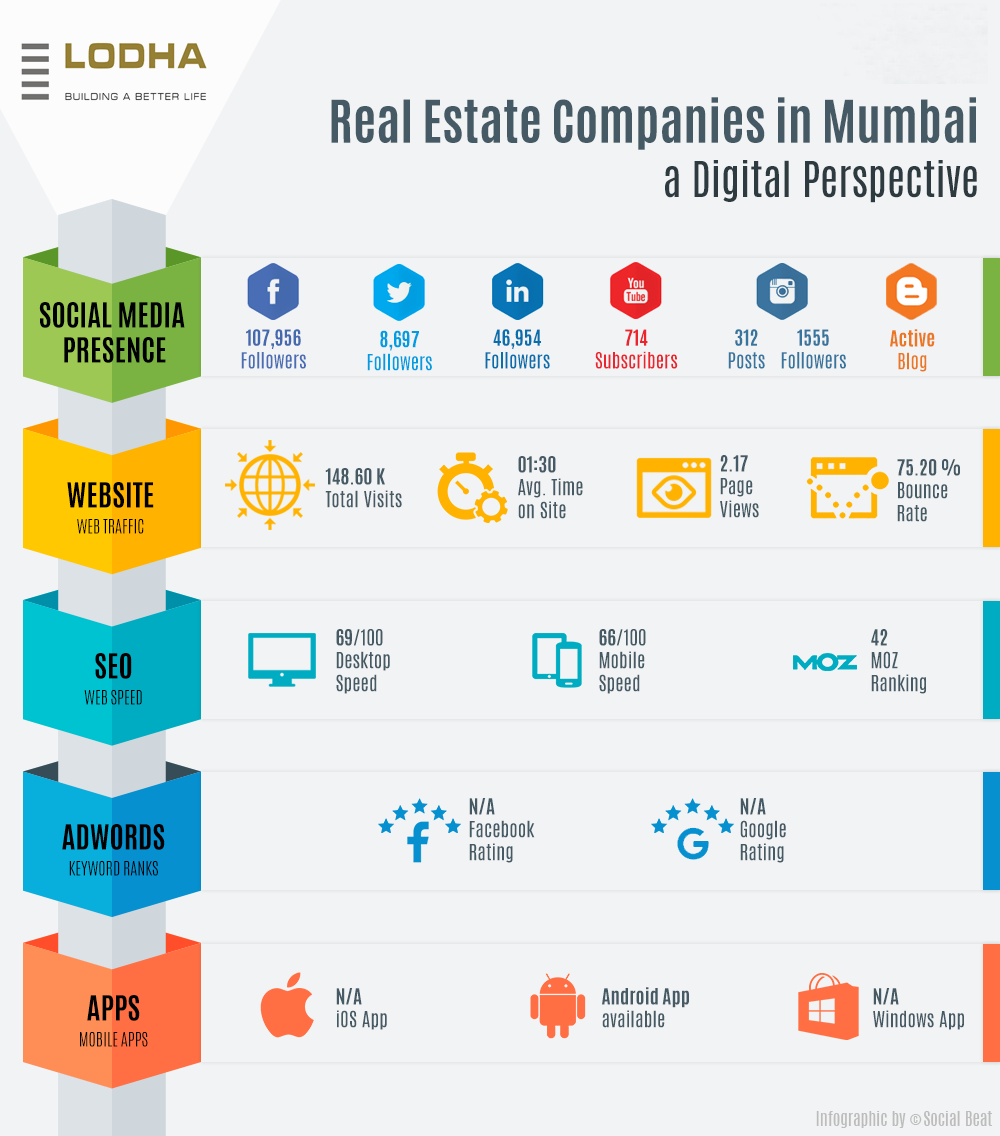
Lodha Group is one of the leading real estate developers in Mumbai and the most profitable players in India. They are known for making landmark developments in residential and commercial spaces and pioneering new trends.
UX Audit:
They have an interesting design of image slider that showcases all the project launches and promotions. The project locator is a nice filter functionality to find project developments. Project page showcases the projects based on their location and has the information about the price too. This leads to the enquiry page with project brief and lead generation form. The website is, however, not mobile-friendly as the text is too small to read and the contents are wider than the screen.
Key Features:
Web Insights:
| Total Visits | Avg. Time on Site | Page Views | Bounce Rate |
| 148.60K | 00:01:30 | 2.17 | 75.20% |
Moz rank: They have a Moz rank 42 for Domain Authority.
Website Speed:
Twitter: They have an active Twitter account with around 8000 followers. They do 20+ tweets a week and have no promoted tweets. They tweet about a wide array of topics ranging from their projects to the general industry based news. In spite of these, engagement is low on tweets.
Facebook: They have an active page with around 100000 followers. The engagement is good, highlighting the use of promoted posts. Their content includes customer testimonials and event invites.
LinkedIn: They are very active on LinkedIn and have around 47000 followers. Below is a recent post about demonetisation, which received a good response
Youtube: They have 720+ subscribers with not-so-engaging videos
Google+: Their Google+ account is active having 35 followers.
Instagram: The account is active and has 1500+ followers.
Content Marketing: Though the blog page is not very attractive, they are posting at least 4 articles per month. They have a live chat option on their blog.
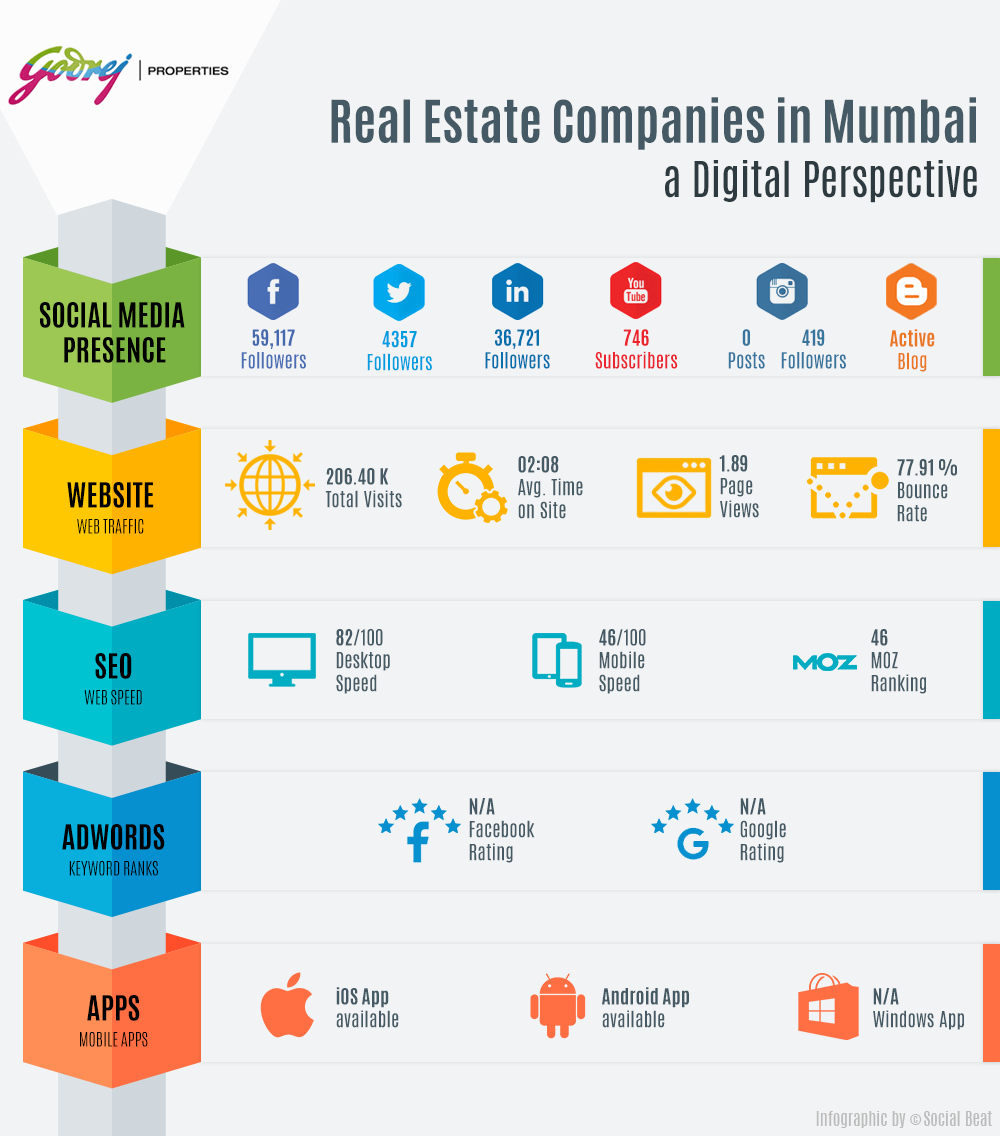
Godrej Properties develops residential, commercial and township projects across 12 cities in India. They provide imaginative and extraordinary spaces keeping customers’ needs in mind, making them one of the top real estate developers in Mumbai.
UX Audit:
They have a well-organised menu catering to different kinds of website users (buyers, investors, NRIs etc.) They also have a nice hierarchy for project menu, leading to different property projects. Individual project pages include features like project overview, highlights and enquiry form. Their page is mobile friendly.
Key Features:
Web Insights:
| Total Visits | Avg. Time on Site | Page Views | Bounce Rate |
| 206.40K | 00:02:08 | 1.89 | 77.91% |
Moz rank: They have a Moz rank 46 for Domain Authority.
Website Speed:
Twitter: They don’t have a twitter account for Godrej Properties.
Facebook: They are not very active on Facebook but they still have around 58000 followers. Below is a recent video post, which has received some responses and views.
LinkedIn: They are active in LinkedIn with around 36000 followers. Compared to other social channels they are more active on LinkedIn.
Youtube: They have 740+ Subscribers and videos in their channel are pretty engaging, having a decent number of views.
Google+: They have an active Google+ account having 474 followers.
Instagram: They have 400+ followers on Instagram.
Content Marketing: They have been blogging since May 2016. They have 15 articles as of now, and they have a separate domain for blogging.
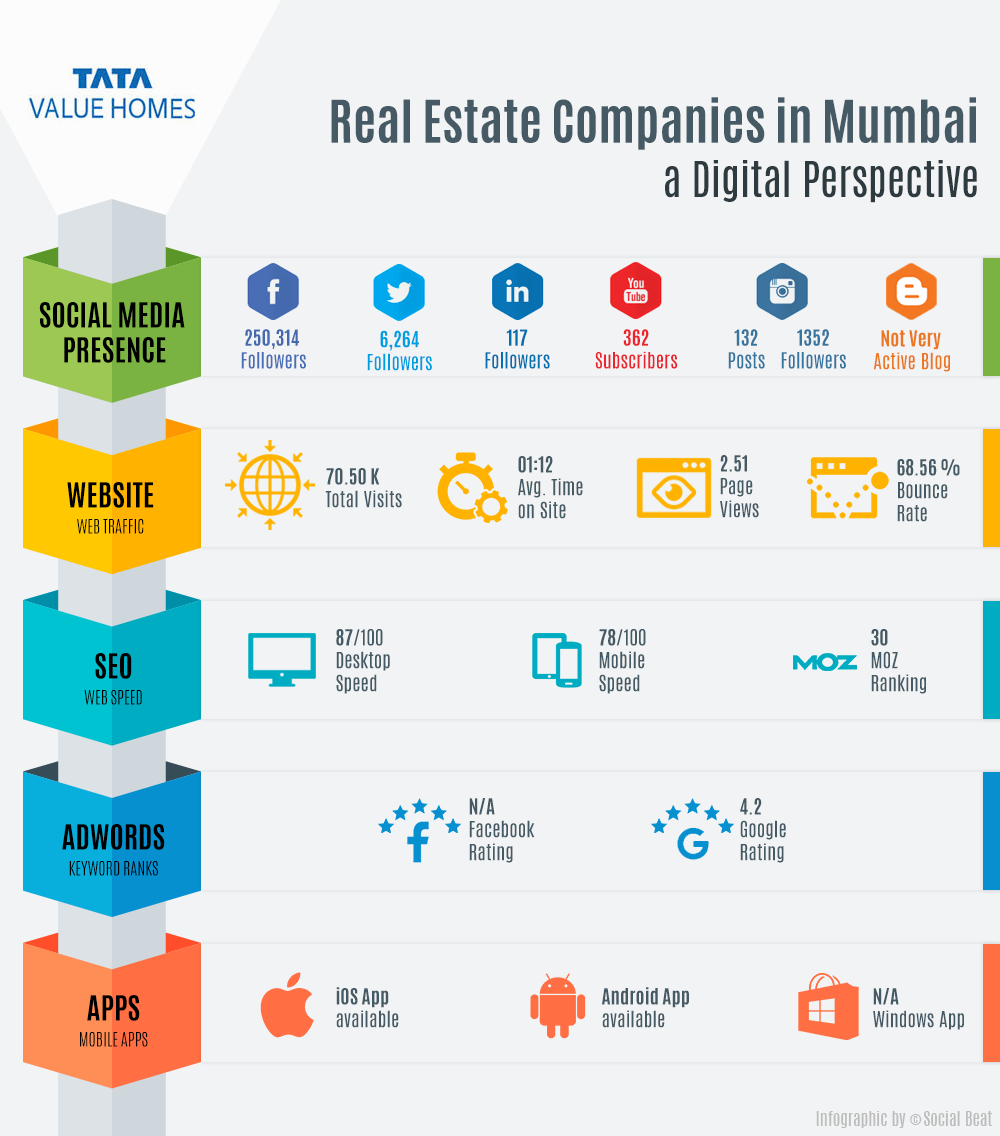
Tata Value Homes is a subsidiary of Tata Housing. It is one of the larger real estate companies that focus on low-cost housing with modern amenities.
UX Audit:
They have allocations to provide a quick filter for the audience based on the city/location of the user. The quick search option leads to a map with property locations highlighted for user convenience. Showcasing their featured projects on the homepage with prominence is an interesting feature. Laying out interesting blogs on the homepage is another noteworthy feature.
Key features:
Web Insights:
| Total Visits | Avg. Time on Site | Page Views | Bounce Rate |
| 70.50K | 00:01:12 | 2.51 | 68.56% |
Moz rank: They have a Moz rank 30 for Domain Authority.
Website Speed:
Twitter: They have around 6000 followers. They aren’t tweeting on a regular basis and they use the same content across social media platforms.
Facebook: They have around 250000 followers and have boosted some posts a few months back, but recently they are not very active. Below is a boosted post shared a few months back which has a large number of likes and responses.
LinkedIn: They have only 110+ followers, and the page has no posts till date.
Youtube: They are current not active. Their last uploaded video was 4 months ago.
Google+: They have an active Google+ account with 85 followers.
Instagram: They are also active on Instagram having 1300+ followers.
Content Marketing: They have posted only 3 blogs in 2016, highlighting the missed opportunity in content marketing.
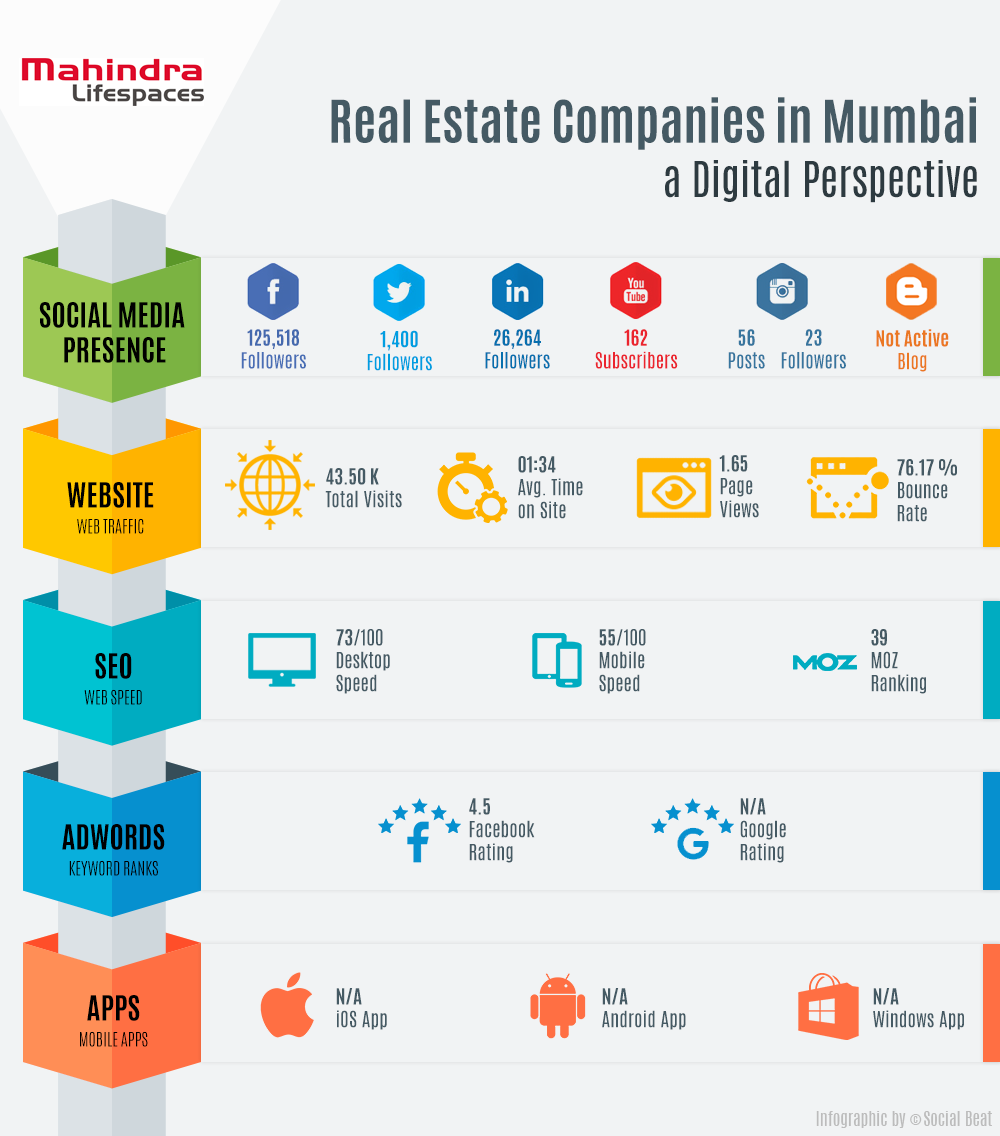
Mahindra Lifespaces is the real estate company of the Mahindra Group. They are one of the top real estate developers in Mumbai and the first Green Home Developer with Green Design & Healthy Living as their main focus across their projects.
UX Audit:
The web page has nice project filter on the home page following the banner. Sticky enquire now button to provide constant CTA is an interesting feature. A section to attract NRI investors is also present. Menu dropdown feature is quite interesting, especially the categorized submenu for projects.
Key features:
Web Insights:
| Total Visits | Avg. Time on Site | Page Views | Bounce Rate |
| 43.50K | 00:01:34 | 1.65 | 76.17% |
Moz rank: They have a Moz rank 39 for Domain Authority.
Website Speed:
Twitter: They are active on twitter with engaging tweets. Below is a public awareness tweet.
Facebook: They are very consistent in boosting posts and are active on Facebook, having around 125000 followers.
LinkedIn: They have an active LinkedIn page, which has around 26000 followers. They are posting engaging contents on a regular basis.
Youtube: They have only 160+ subscribers. They upload two to three videos per month.
Google+: They are not active on Google+ and have only 6 followers
Instagram: They are active on Instagram having 50+ followers.
Content Marketing: They don’t have a company blog.
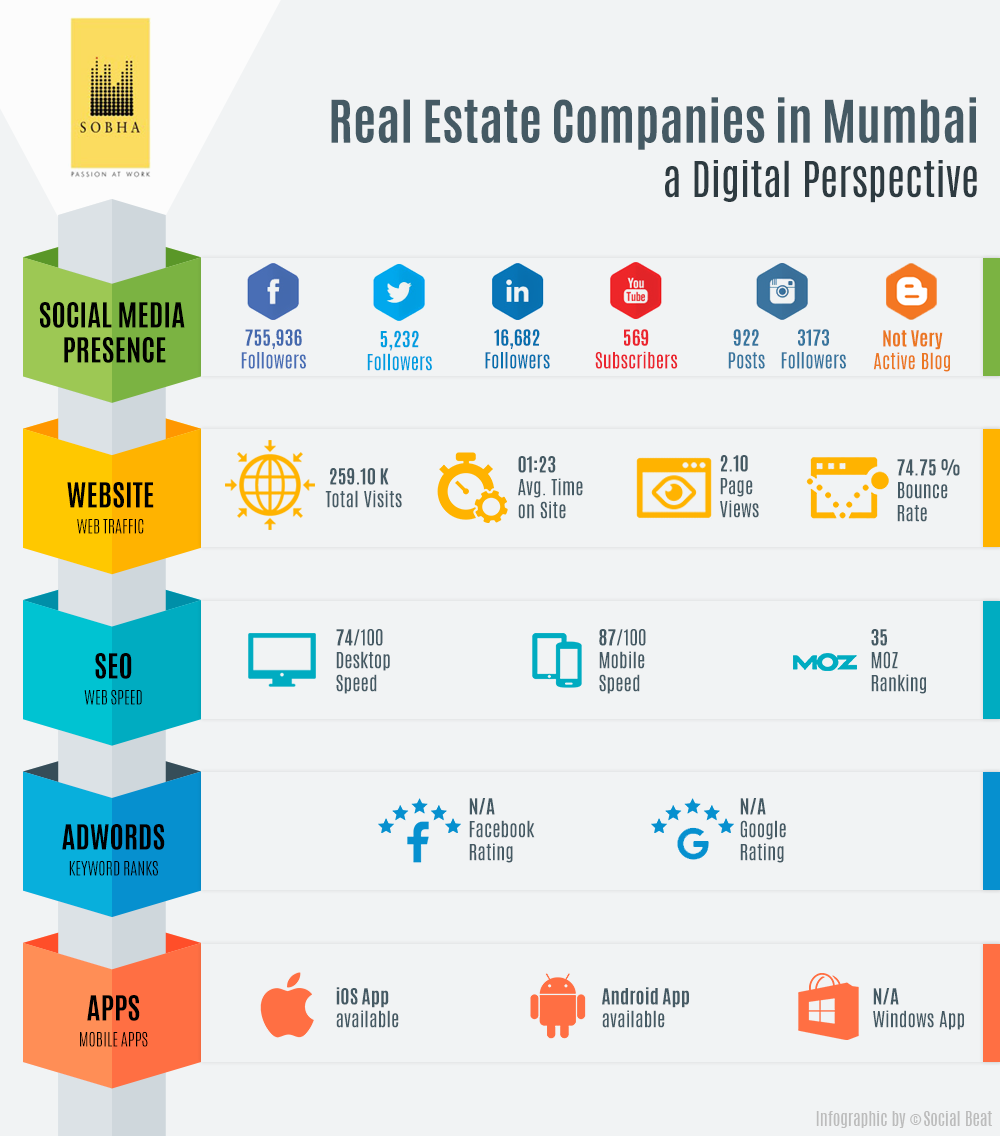
Sobha Group is one of the largest real estate organizations in India and the Middle East. They focus on delivering the highest levels of quality, with no compromise, making them the top real estate developers in Mumbai.
UX Audit:
The premium images rolling in the banner connects the user to the luxury of the brand. The main menu could have been more prominent instead of being placed against the sliding banners. Apart from that, the site has a very nice organization of the project information – presented state-wise and sorted by price.
Key Features:
Web Insights:
| Total Visits | Avg. Time on Site | Page Views | Bounce Rate |
| 259K | 00:01:23 | 2.10 | 74.75% |
Moz rank: They have a Moz rank 35 for Domain Authority.
Website Speed:
Twitter: They are very active in Twitter having around 5000 followers and they do 3 to 6 tweets a day which is a lot compared to other developers. They have a diverse set of tweets ranging from new project launches to general industry based news. Despite these, engagement is low on tweets.
Facebook: They have an active page with around 7 lac followers and they have been posting at least twice a day and the engagement is good. Below is an organic post which had a good response.
LinkedIn: They are very active in LinkedIn having around 16000 followers.
Youtube: They have an Active Youtube account with 570+ subscribers and they have interesting Testimonial videos.
Google+: They have an active Google+ account with 554 followers.
Instagram: They are active on Instagram with 3100+ followers
Content Marketing: They have a blog, which is not active.They do not have any mention about their blog on their website.
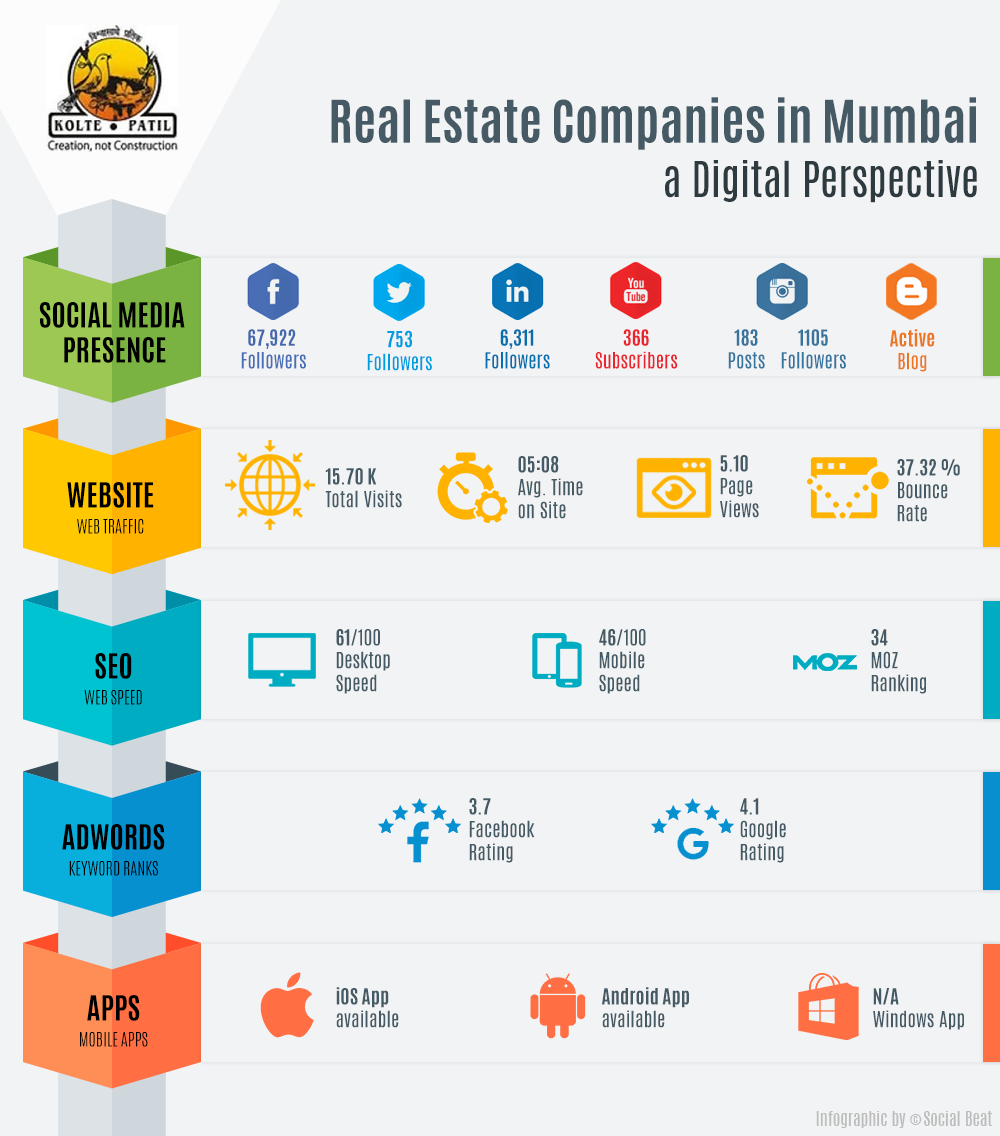
Founded 2 decades ago, Kolte-Patil has built residential, commercial, retail, and integrated township projects till date.
UX Audit:
Interesting zoom in feature on the banner images attracts the users. Well organized menu putting out all the necessary information is a great feature. Book Online page showcases all the projects with the quick facility to book. They also have live chat option in all the pages.
Key Features:
Web Insights:
| Total Visits | Avg. Time on Site | Page Views | Bounce Rate |
| 15.70K | 00:05:08 | 5.1 | 37.32% |
Moz rank: They have a Moz rank 34 for Domain Authority.
Website Speed:
Twitter: They have around 10000 followers and are highly active on Twitter. Their tweets are very engaging.
Facebook: They are having around 67000 followers and post twice a week.
LinkedIn: They have around 6000 followers and are moderately active on LinkedIn with 3 to 4 posts per month. Below is a post, which got pretty good responses.
Youtube: They are not very active and have only 367 Subscribers. Their videos have a decent number of views.
Google+: They are active on Google+ with 114 followers.
Instagram: They are also active on Instagram having 1100+ followers.
Content Marketing: Though they do not have an attractive blog page, they are posting 2 articles every month.
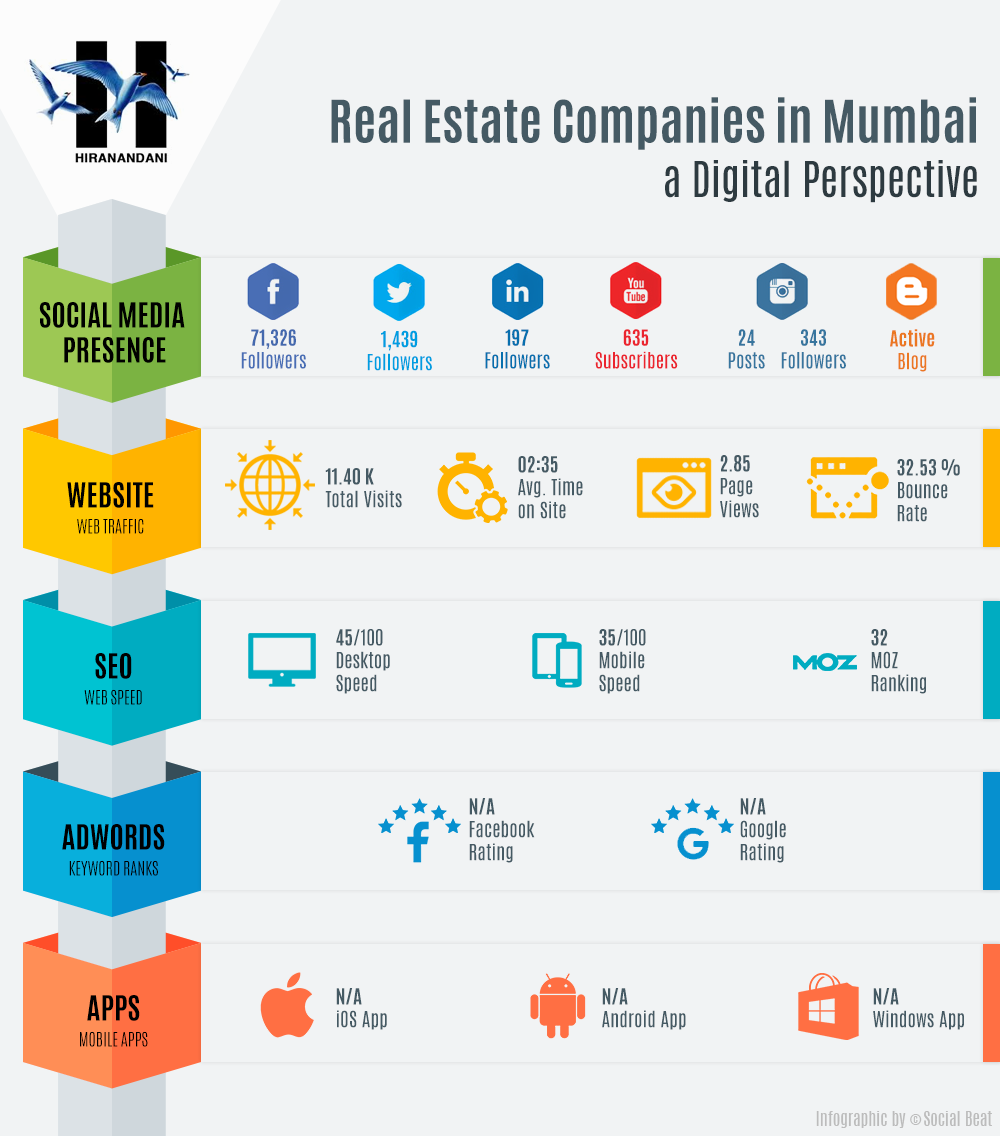
Pioneering new technologies & bold design, Hiranandani Developers have created residential townships & commercial complexes meeting the expectations & lifestyle of the people.
UX Audit:
Their Homepage design focuses on all the launches/promotions. Placement of a common enquiry form across all projects, to make enquiries for the visitor easier is appreciable. The website is mobile friendly.
Key Features:
Web Insights:
| Total Visits | Avg. Time on Site | Page Views | Bounce Rate |
| 11.40K | 00:02:35 | 2.85 | 32.53% |
Moz rank: They have a Moz rank 32 for Domain Authority.
Website Speed:
Twitter: They have around 1400 followers and are highly active on Twitter with at least 4 to 5 tweets every day.
Facebook: They do have an active page with 71000 followers. Below is a Selfie contest post, which was engaging and had good responses.
LinkedIn: They have only 190+ followers in LinkedIn and they haven’t posted anything until now.
Youtube: They have 630+ subscribers on Youtube. Though they are not active on YouTube, they have decent views for their engaging videos.
Google+: They are not active on Google+ and have only 29 followers.
Instagram: They are active in Instagram having 300+ followers.
Content Marketing: They have their blog in Weebly and actively post articles about real estate, their ongoing projects, and latest industry related news.
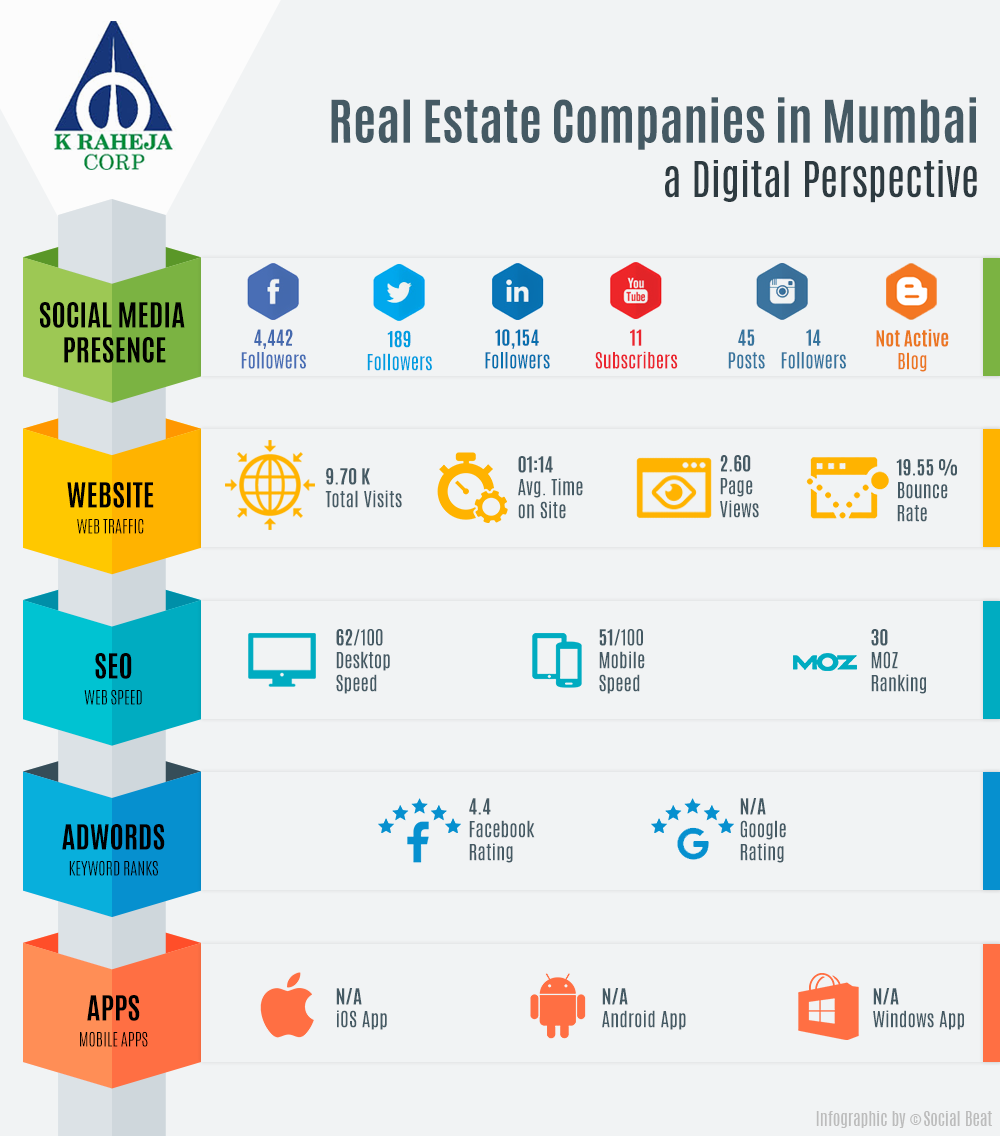
K Raheja is one of the most trusted real estate developers in Mumbai and the Indian subcontinent. From residences to workplaces, hotels to retail destinations, they have made a meaningful impact on the evolution of modern-day living.
UX Audit:
They have a Minimalistic home page with user engagement focussed to the menu. Explore our Projects feature introduces users to all the brands, where each brand project page comes with details of the project and enquiry provision. Their website is not mobile friendly because the text is too small to read and the content is wider than the screen.
Key Features:
Web Insights:
Total Visits |
Avg. Time on Site |
Page Views |
Bounce Rate |
| 9.70K | 00:01:14 | 2.60 | 19.55% |
Moz rank: They have a Moz rank 30 for Domain Authority.
Website Speed:
Twitter: They have only 180+ followers, and they have good quality tweets with no engagement. If they promote their tweets, they can get results.
Facebook: They have 4500 followers on Facebook. They are consistently posting 6 to 7 contents per week all are organic, so they are getting low responses and engagements. Below is an interesting post with not much engagement.
LinkedIn: They are not active on LinkedIn but have around 10000 followers and they haven’t posted anything till now.
Youtube: They are not active on Youtube and have only 11 Subscribers, and their last upload was a year ago.
Google+: They do one post a week in Google+ but still they have only 8 followers.
Instagram: They have only 8 followers in Instagram.
Content Marketing: They don’t have a company blog.
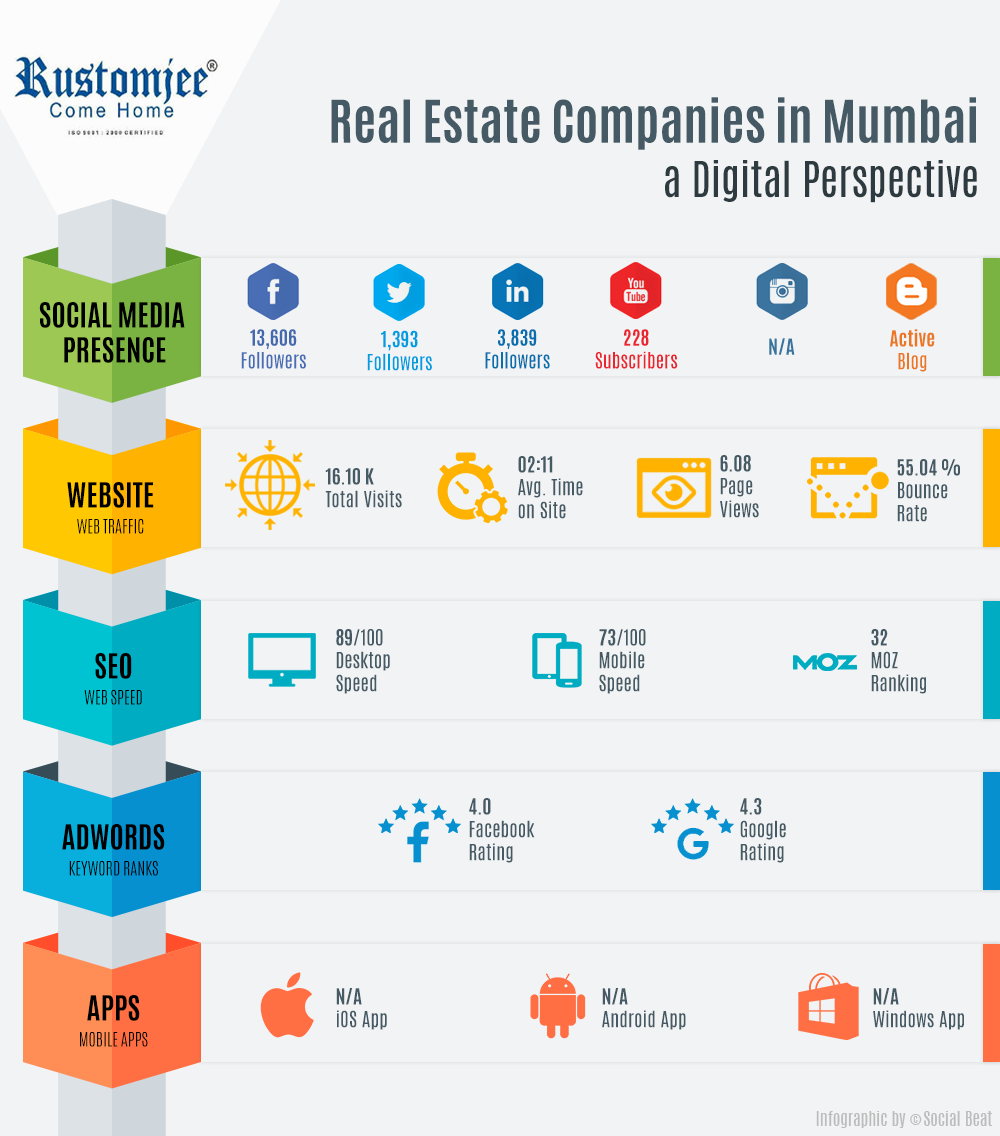
Rustomjee Spaces have transformed 10 million square feet of the city into premium townships, corporate parks, retail spaces, and 8,500+ homes with a special focus on Mumbai Metropolitan Region.
UX Audit:
The web page has a simple banner with prominent CTA and Project locator. There is a showcase of featured properties, and they do have an enquiry form. Project Explorer has filters that would help the user to find properties easily and closer to their choice and their website is mobile friendly.
Key Features:
Web Insights:
| Total Visits | Avg. Time on Site | Page Views | Bounce Rate |
| 16.10K | 00:02:11 | 6.08 | 55.04% |
Moz rank: They have a Moz rank 32 for Domain Authority.
Website Speed:
Twitter: They are active having 1400 followers on Twitter, and they have been consistently tweeting 6 to 9 tweets per week. They have no promoted tweets so there is only little responses. Below is an interesting tweet with little engagement.
Facebook: They have around 13000 followers posting 5 to 6 times per week with little response. All their posts are organic. They might get good engagements if they boost their quality posts.
LinkedIn: They aren’t active past 3 months, but they have decent engagements in their previous posts.
Youtube: They have 220+ subscribers, and they are uploading 3 to 4 videos per month. They have decent views. All the videos are real estate Industry related.
Google+: They are not active on Google+ for the past 2 years.
Instagram: They do not have an Instagram account.
Content Marketing: They are maintaining 2 blogs and have been posting their project related and educative articles at least once per month.
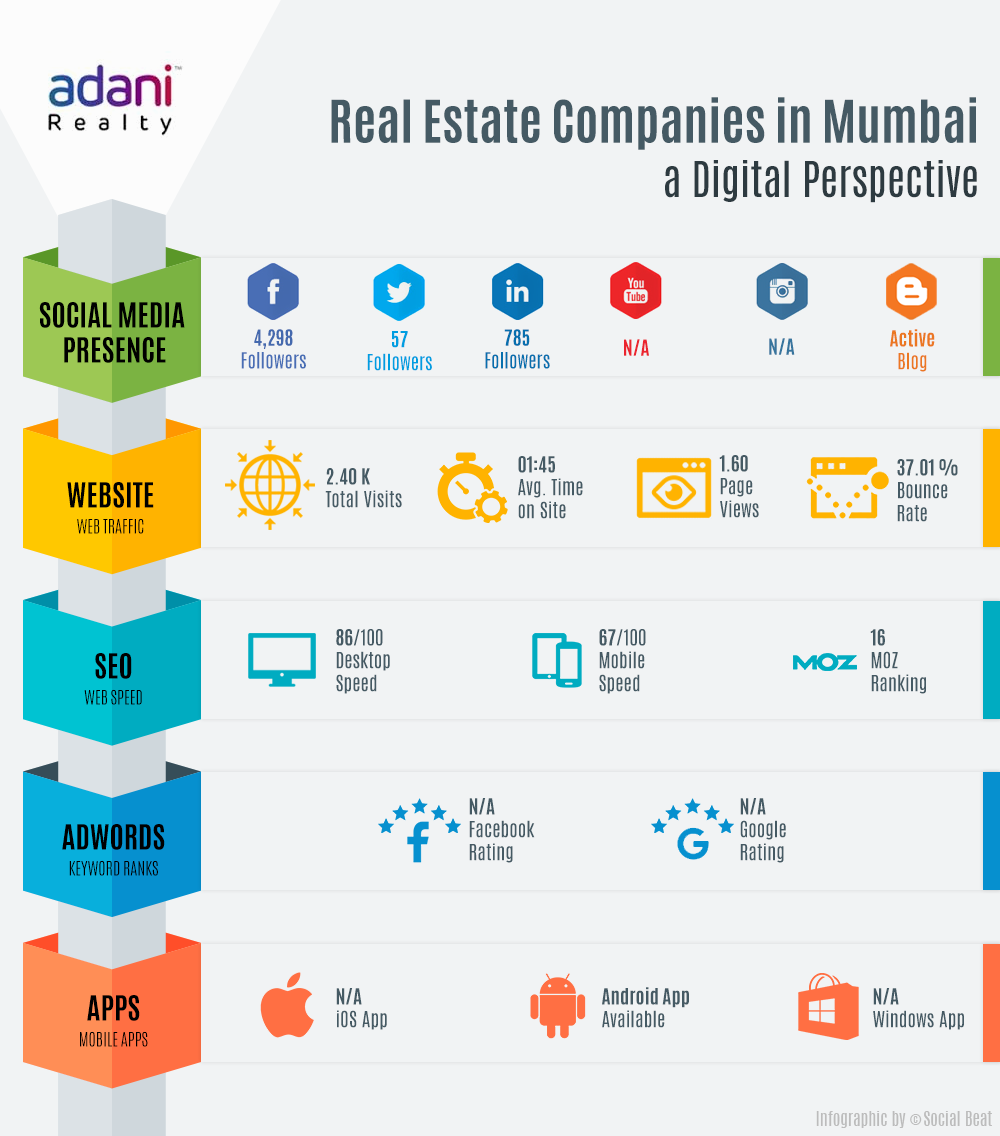
Adani Realty has been developing residential, commercial and social club projects across Ahmedabad, Mumbai, Gurgaon, Kochi & Mundra.
UX Audit:
Their web page has an interesting single scroll homepage design, which focuses on two utilities - one showcasing all their launches and promotions and the other leading the visitor directly to projects/gallery/other information via the menu. Elegant project showcase with the project overview and CTA's leading to individual project websites are some of the noteworthy features.
Key Features:
Web Insights:
| Total Visits | Avg. Time on Site | Page Views | Bounce Rate |
| 2.40K | 00:01:45 | 1.6 | 37.01% |
Moz rank: They have a Moz rank 16 for Domain Authority.
Website Speed:
Twitter: They have 50+ Followers in Twitter and are moderately active. They do 4 tweets per month. Below is an interesting post having low engagement.
Facebook: They are active in Facebook having around 4k followers, and they do at least one post per day and have boosted a contest campaign, which had a good response
LinkedIn: They have 785+ followers and are not that active. They do 4 posts per month and the engagement is low.
Youtube: They don’t have a Youtube channel.
Google+: They are not active in Google+
Instagram: They are not active on Instagram
Content Marketing: They have an active blog in their website itself, and there are around 300 articles.
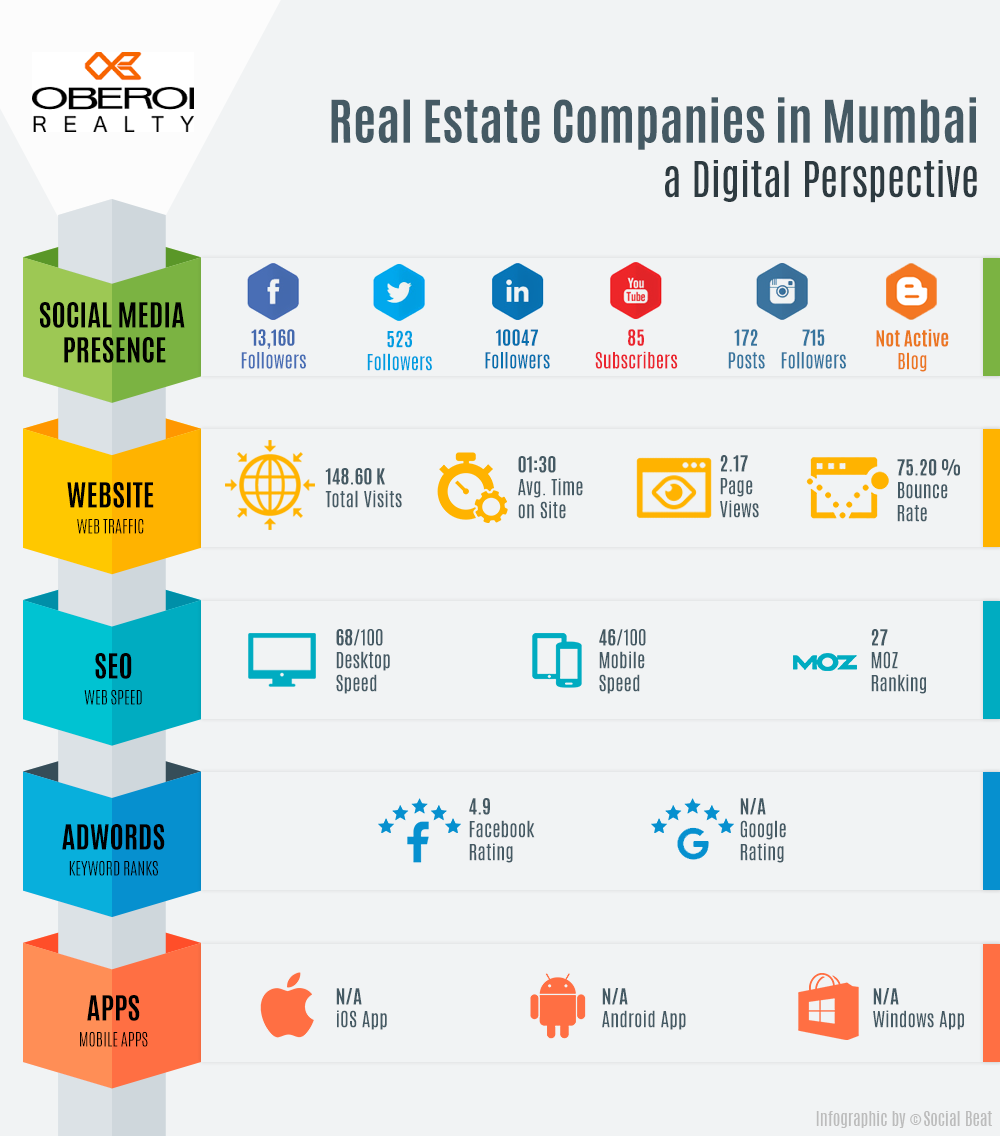
Oberoi Realty has developed over 39 projects at strategic locations across the Mumbai skyline. Over the past three decades, they have been consistently providing high-design and quality residential, commercial, and retail spaces.
UX Audit:
The banners and featured projects provide prominent information to the audience coming to their site. Individual project pages are organized state/city wise to make the navigation easier for the users. Schedule a visit is a useful provision for interested buyers/investors.
Key Features:
Web Insights:
| Total Visits | Avg. Time on Site | Page Views | Bounce Rate |
| 148.60K | 00:01:30 | 2.17 | 75.20% |
Moz rank: They have a Moz rank 27 for Domain Authority.
Website Speed:
Twitter: They are moderately active having only 50+ followers, and they do 2 to 3 tweets per day mostly about their ongoing projects.
Facebook: They are active on Facebook with around 13000 followers posting 3 to 4 times a week. Their posts are organic and have decent engagements. Below is an interesting post about their project.
LinkedIn: They are moderately active with around 10000 followers. They do post 3 to 4 times per month, and the posts are engaging with good responses.
Youtube: They are not active this month but have 80+ subscribers. They have many testimonial videos which are having a good number of views and response.
Google+: They are not active on Google+.
Instagram: They are highly active on Instagram having 700+ followers.
Content Marketing: They don’t have a company blog.
There is no doubt that the best real estate marketing companies in Mumbai are on the lookout to help leading real estate developers leverage the power of going digital. Make sure you read through our blog on Digital Marketing by Real Estate Developers in Bangalore and our detailed Case Study of How a Real Estate Company grew via Digital Marketing for better insights.
You can also check out our blog on how Casagrand generated a record 190 crores in revenue via Facebook for a detailed understanding of digital marketing for real estate.
The Advertising Week 2017, held in the fast-paced city of New York, was as insightful event throwing light on the relevant, upcoming trends in the advertising and marketing world. Held during the last week of September, the conference had a series of seminars, discussions and workshops hosted by the pioneers in marketing and advertising from around the globe. Read on to get a closer insight into the keynotes we took back home from the eventful week and how they can be utilized to build a successful brand.
Howard Schulz of Starbucks, Jessica Alba of Honest Company, Neil from Warby Parker and more - there were so many amazing brand creators who shared their insights on how they conceptualized the brand and how they built it step by step into successful brands. These inspiring stories do instil confidence on how amazing product combined with honest and creative advertising can build brands.
One of the central themes that were discussed at the Ad Week was how creativity is enhanced with the power of data and analytics. Using consumer behaviour data and analytics from advertising campaigns it’s possible to create more powerful brand campaigns. For example, Dominoes presented how they listened to their consumers and realized that many of them were not happy with the way the pizza was reaching them because there was a huge discrepancy on how pizza brand videos were made and how it actually looked. So Dominoes did a series of video which shows how food photography and food videography can be deceptive. Then decided to crowdsource images from customers to see how they received their pizzas and about 25,000 customers submitted their pizzas to “Show Us Your Pizza”. While most of them were happy with their pizzas, some weren't. So their CEO apologised to the customers and started implementing internal processes to avoid it again. Moreover, they gave a refund a free pizza to unsatisfied customers. Their honesty in advertising combined with the creative campaign helped them tremendously with growth in market share in the USA.
ChatBots have already begun creating a rage in the digital marketing space and Advertising Week 2017 left no stone unturned in letting us know that. The Facebook Messenger Bot leads the bot universe with advanced customer service that helps consumers reach the solution faster. This, in turn, helps in an enhanced lead generation. Furthermore, experts have also noticed an emerging trend of voice-based devices entering the digital market.
It is said that interacting with a bot is sometimes more effective than visiting a mobile site as it provides more customised and personalised engagement. For example, the bot designed by KLM Airlines can address numerous queries from travel information to a flight change. This makes the entire digital experience of the consumer more convenient and hassle-free. However, it is advisable to use existing apps, like the Facebook Messenger, to reach your target group instead of building native apps.
With Google Home, Alexa and others launching intelligent assistants it’s become an exciting space to watch out from an advertising perspective. With 40% of searches in the USA being voice searches, it is likely to change the fundamental business model of Google. While assistants still have slow adoption in India it’s a space to watch out for.
With users accessing websites, apps and content from multiple devices and some devices with no screens (i.e. assistants like Google Home), attribution is getting harder. The initial days of Advertising Week 2017 introduced us to the concept of split funnel advertising to help measure attribution for enhanced sales and lead generation. The model helped us understand consumer behaviour and figure out which touch points of the consumer need attribution. To begin with, the seminars held on smart attribution made us familiar to the fact that most funnel models highlight which channel is the most useful to increase conversions but do not explain why the consumer converted in the first place. It also helped us understand that consumer behaviour is critical to attribution and the only way we can understand consumers is by adding a twist of creativity to the marketing funnel.
Additionally, the workshop focused on how the marketing funnel model can be made even more efficient by gathering data from different fields and adding in multiple channels that generate guaranteed results. To achieve this, it is important to figure out which channel generates long-term revenue. Channels that add a lifetime value to the marketing funnel have the potential to change the attribution piece completely, especially when complex channels like that of TV and other non-digital aspects are involved.
Google recently launched a new tool called Attribution, which allows for data-driven attribution powered by Google’s AI. It brings your marketing data together to give you a complete view of your performance and insights you can use to optimize your marketing across channels and across devices. It will allow you to:
We just started testing it out and will share more insights shortly.
Digital out-of-home taps the concept of traditional advertising by adding a digital twist to it. It utilizes the conventional channel of outdoor banners, billboards and digital screens in public spaces to showcase a product to consumers. Since people are noted to be outside their homes 70% of the time, this mode of advertising helps in a more integrated targeting.
Viewers are not interrupted by digital ads on their personal screens but on the screens, they are exposed to on a daily basis. Additionally, digital out-of-home ads cannot be fast-forwarded, skipped or blocked, giving brands the added edge of reaching out to their audience. Apart from merely detecting the GPS location and retargeting consumers, these ads can also be triggered by other factors, like weather conditions, to showcase a refreshing product on the screens during a hot sunny day. Furthermore, digital out-of-home ads can also be customized for security cameras located up to 1000 feet away, making it a clear channel for providing data.
This digital OOH is still in a very nascent stage in India, the convergence of the physical and digital world is indeed exciting.
The Advertising Week was coupled with the Google Partner Summit held on September 28th, 2017. The summit presented us with an array of interesting Google product updates to fuel the branding and advertising industry for the upcoming year, apart from the basic digital marketing trends to expect in 2017. Listed below are few of the key product updates that are guaranteed to create a huge positive impact on your firm’s digital marketing plans.
AMP for Adwords landing pages: Gone are the days when AMP was available only for content-heavy sites. Google has noticed the importance of an ad to load faster for higher lead generation and introduced AMP for landing pages. While AMP has already been an important SEO factor, we have now started leveraging it even for paid advertising.
In-market audiences for search: Google has introduced in-market audiences for the search engine so brands can now showcase their products to those who are actively searching for it.
Brand Planner: Though still in the development stage, Google is planning to introduce Brand Planner – a tool similar to Google Trends – to track audience insights and to give brands more actionable insights.
Location extensions for TrueView ads: Brands can now showcase their location in YouTube TrueView ads to increase traffic to their showrooms.
YouTube Ad Sequencing: Brands can also sequence their ads on YouTube as per the viewing of the visitors.
Consumer patterns and life events in Gmail ads: Gmail Ads can be customised based on consumer data like marriage, graduation and birth.
YouTube Insights for search: Viewers can now watch ads that are customized based on the content consumed by them.
Local inventory listed on Google: Brands can get their inventories listed on Google Maps for increased footfall. They can also retrieve the data of the number of people who have visited their stores through these listings from across 19 countries and get a better understanding of how mobile search can help offline retailers in India.
Cross-device data for analytics: Brands can study consumer behaviour through data from advanced social media analytics retrieved from all digital devices – from a handy smartphone to a smart TV.
After getting enlisted as a premier Google partner and attending the Google Partner Summit 2016 in San Francisco, Advertising Week 2017 was a much-anticipated event for us. It provided us with glorious insights and practices of the international digital marketing industry. It is time you start implying these practices in your marketing strategies to take your business to the next level. We know we are!
If you are running a business online, you should know by now that generating leads is everything. Lead generation is the single most important aspect of digital marketing that helps your business grow.
If you are looking to capture more targeted leads through digital media, one of the main things that you would need is a well optimised, highly targeted landing page. Still not convinced? Here’s an example!
Conversion Rate Experts, world's leading agency for conversion rate optimisation (CRO), helped Moz, then SEOmoz, generate $1,000,000 million with just one landing page that had an alluring call to action. What's more? This revenue was generated by the fantastic landing page and few emails within four months.
You can read the complete case study here.
One of the takeaways from the above case study is that improved user experience helps in lead generation.
So, are you looking to improve the user experience of your landing pages and, in turn, increase your lead generation? Read on!
Designing and managing the perfect landing page
Consider your landing page as a system that will convince your page visitors to become your customers. A well-designed landing page, by itself, can help increase lead generation and conversion. Here are some tips to create an appealing landing page.
Instead of a typical headline, which screams "buy me," use an enchanting headline that would garner your visitors' attention.
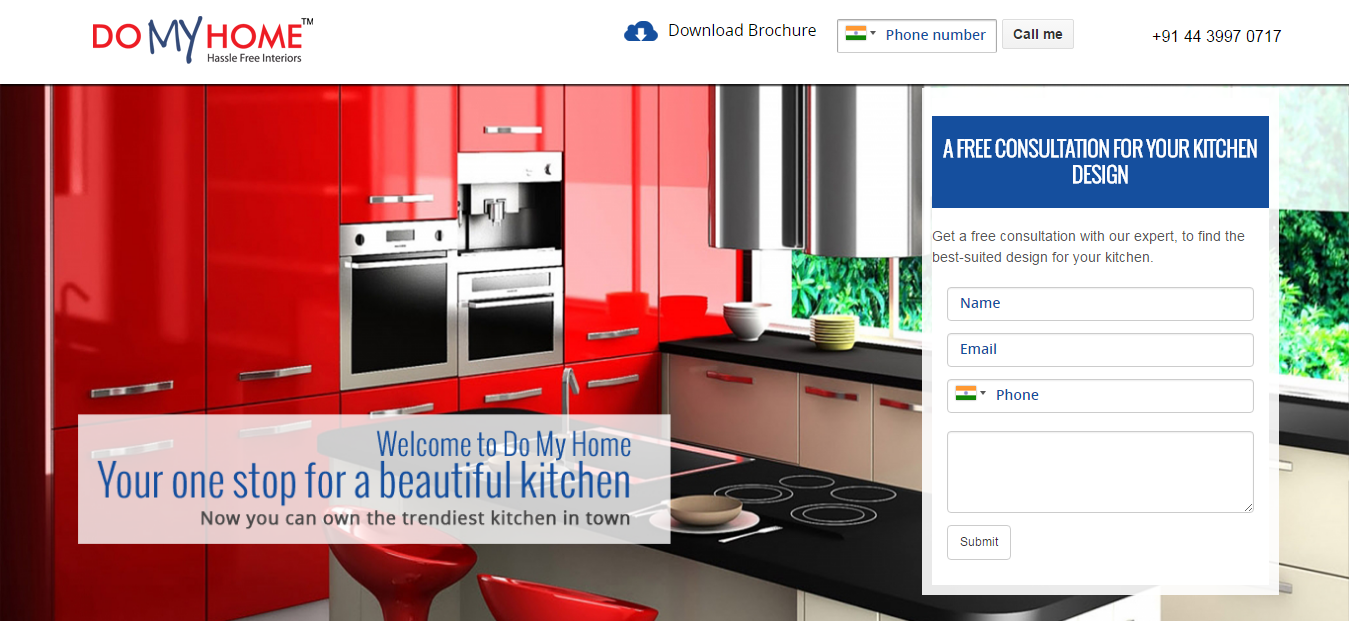
For example, a landing page headline like this – Your One Stop for a Beautiful Kitchen – would interest the visitors a lot more than headlines that talk only about selling.
This is easier said than done. How can you possibly understand someone whom you hardly know? However, understanding your prospective audience and designing the page keeping them in mind is absolutely necessary.
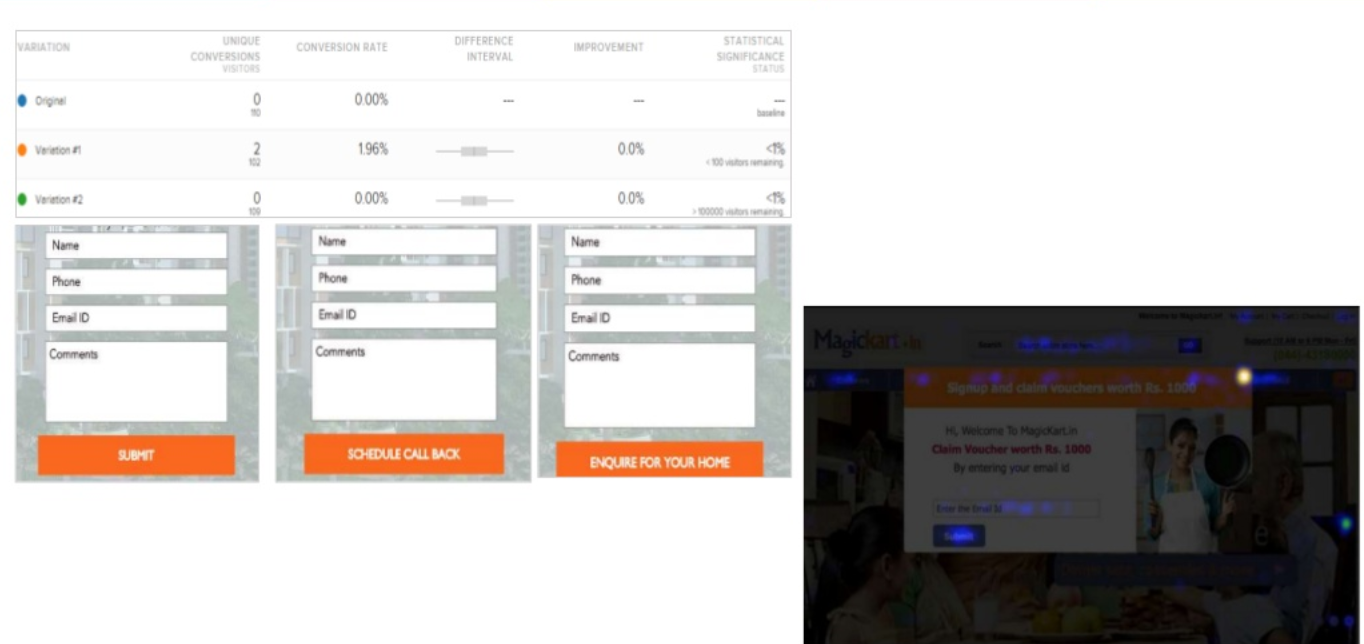
In terms of design, a good idea would be to have a quick A/B testing done and experiment with heat maps on your site. Analyse the results and rework on the design perspective if necessary.
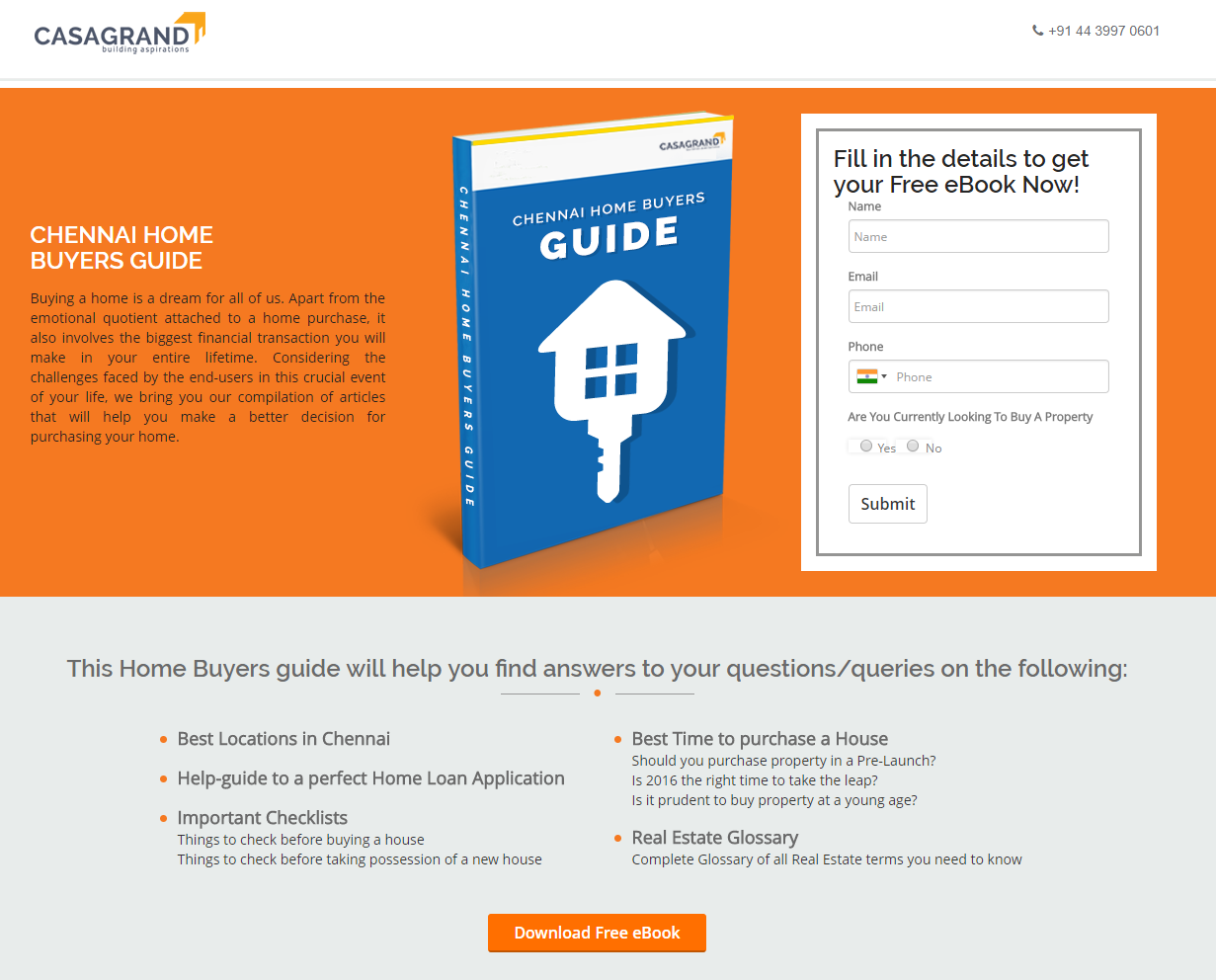
If you are creating a landing page to get your visitors to download your content, one way to do that is to research on what people are searching for in your domain and offer them that. Keeping the target audience in mind, we built a landing page for one of our esteemed clients, Casagrand. Casagrand is one of Chennai’s leading real estate developers with premium projects completed in and around the city. Since their target audience mainly consisted of potential home buyers, we created a handy e-book titled, “Chennai Home Buyers Guide” which consisted of useful tips and suggestions to make the process of buying a home easy and hassle-free. We created a landing page in which visitors had to fill in their details for a free copy of the e-book. This strategy was a win-win for both the customers and our client as the customers walked away with a detailed e-book on buying a home and Casagrand just got a lead of a potential home buyer who is looking for projects to invest in.
You might be tempted to put all the information you have on the landing page. However, you must understand that the landing page design has only one purpose to serve - to get users to click on your call-to-action (CTA).
When you overload the page with too much information, it might have an adverse effect as it might become daunting to someone reading it for the first time. Understand that most users are going to read your landing page content and see the design for the first time. They must be able to grab the information they are looking for from the website. That’s when they will become potential customers for your business.
Furthermore, highlight the major benefits of your service or product on the landing page in a significant and striking manner. This will appeal to visitors and persuade them to become your customers.
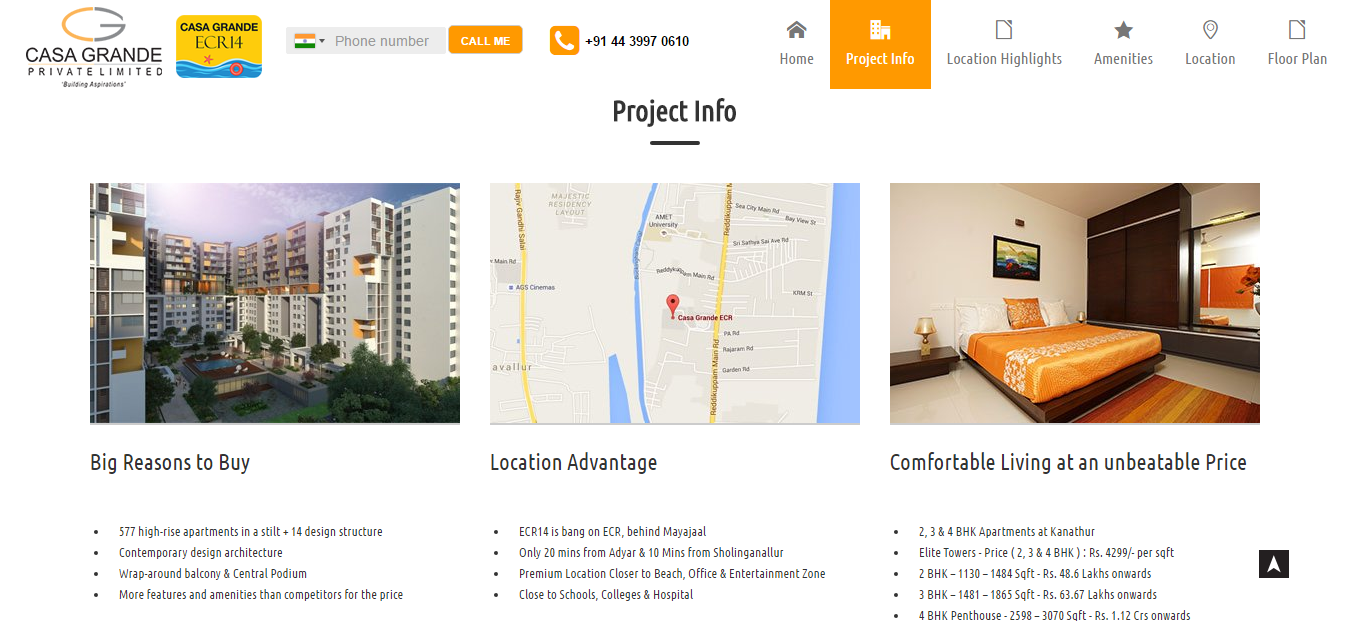
Here’s an example of a landing page that is to the point.
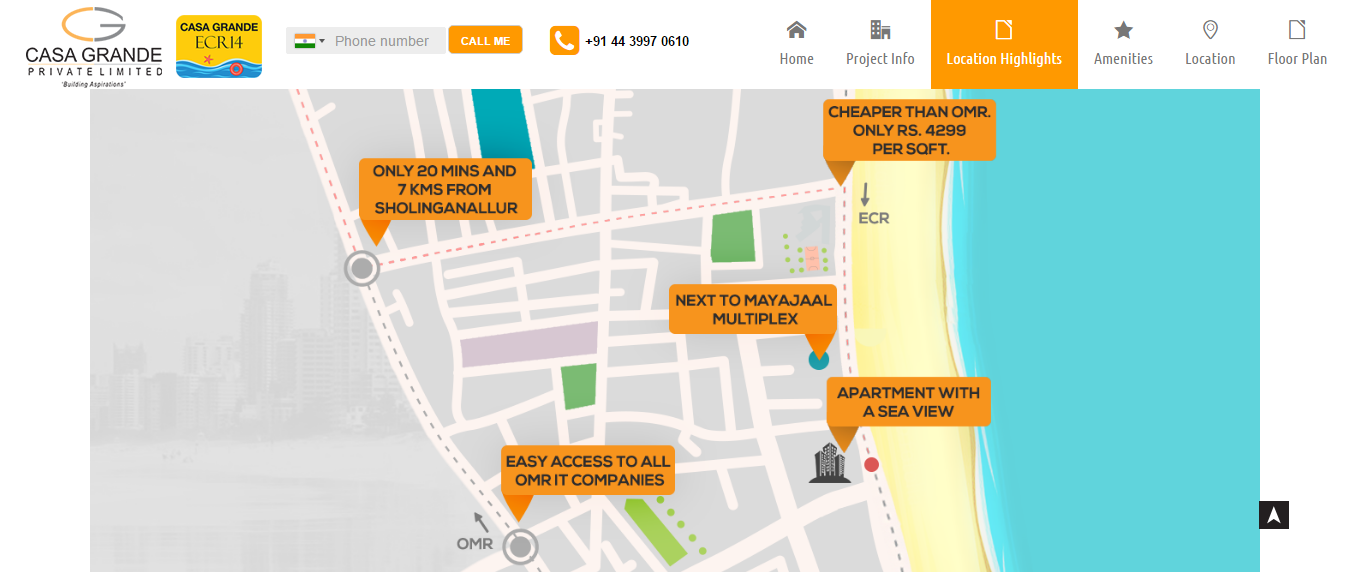
This landing page scrolls through six sections with each section describing information that users would like to know. In the image shown above, the section project info has listed all the efficient and important project information in the form of bullets; this would be easy for people to read and understand quickly.
To accomplish a task efficiently, you must use the right tool. As the good old saying goes, “You can use a screwdriver to pound in nails, but it's a lot harder.” You don’t have to do it the hard way always. Understand that sometimes the right way can be easy too.
There are lots of simple landing page creation tools out there, and each one is unique. You must analyse and pick the right tools for you. Some of the tools that we recommend are:
Instapage – it’s a simple, hassle-free landing page tool. It’s a drag-and-drop software tool that has a lot of professional web design templates.
Unbounce – This is another drag-and-drop software tool. It’s quite simple and recommended for beginners.
LeadPages – One of the most well-known landing page creator tools available online is LeadPages. Most top bloggers and businesses use this tool.
“A picture is worth a thousand words” – This good old saying holds good, especially while creating high-converting landing pages.
Imagine reading the below-mentioned blog page with zero visuals! Tough, isn't it? Even a blog needs images and other forms of visual support, so landing pages must definitely be visually intense.
It is always a good idea to use images, videos, 360-degree photos/videos, infographics, maps, etc. Visuals help users to understand your page quicker. Additionally, having an image or video on your landing page leaves a more enduring impression on users’ minds than written content. Check out our blog on the type of content your target audience will find engaging for a detailed understanding of how content marketing can make your brand trend.
Another visual element that matters a lot is the font that you use; use fonts that are catchy and don’t come across as too overpowering.
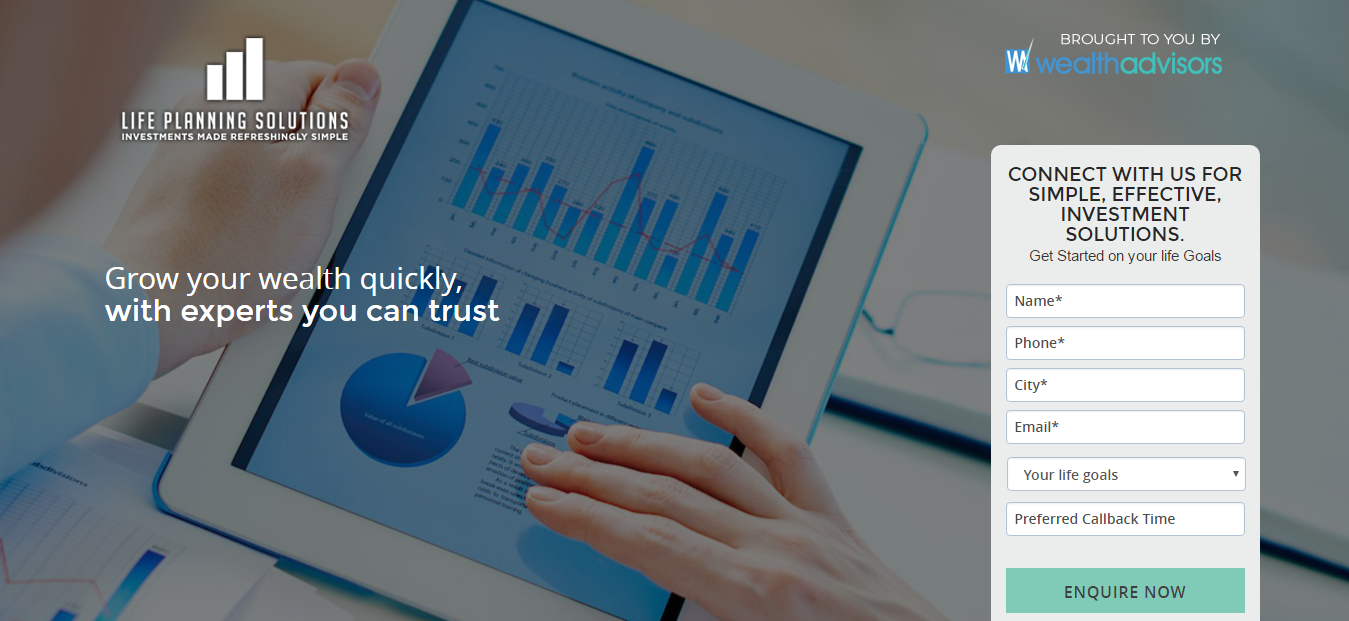
If you think that you can simply use some opt-in or CTA form and gain leads, you are absolutely wrong. The type of information you put in your CTA form and the way you design it play a major role in increasing conversions. For example, instead of simply asking someone to sign up to your page, you can ask them to sign up to get newsletters or sign up to get daily tips. Also, captions like “connect with us for…” may work well in increasing sign-ups and conversions.
Using real-time customer testimonials is a great way to increase the credibility of your business. Reviews by customers will definitely create a positive image about your business to first-time visitors of your page, and this might, in turn, help in converting them into your customers. It's a proven fact that customer testimonials improve sales. This option could be left out, for the time being, if you are a new business.
Last but not the least, following up with your leads or subscribers is important. Once you have designed a landing page by keeping all these aspects in your mind, you can definitely expect quite a significant number of leads generated from the landing page. Once that happens, the next step is to convert your subscribers into customers. One way of doing that is to call them up on the numbers provided and talk to them about your business. A subtle way is to send them emails.
However, while sending emails, you must not restrict to sending promotional emails or regular newsletters. Alternatively, it is advisable to send your subscribers a series of crafted emails that will appeal to them. At times, include details about deals and offers, but don't make this a practice. For more insights, check out our blog on the different ways email marketing can work for you.
Never be afraid of sending more emails. However, refrain yourself from sending emails that follow a standard template. The more you send personalised or crafty emails, the more are the chances of converting your subscribers into customers.
Managing your business and marketing it digitally consumes equal, or at times, even more, time, money, and energy when compared to its traditional counterpart. By creating an influential and captivating landing page, you are investing in a driving force to convert your visitors to potential clients.
For every real estate developer, selling their property is the only focus. From offline to online advertising, brands are willing to try anything to generate leads and reach out to the potential buyers. In our experience, for most real estate developers, the digital medium works extremely well. We have seen that for some developers, over 1/3rd of their sales come from the digital medium.
Most developers, until recently have been using the offline medium for marketing. Developing from a large offline presence to online lead generation has its implications. Most real estate Developers do not know where to start the digital journey. Transitioning from generating sales via the traditional methods of cold calling to intensive integrated marketing campaigns, The Biggest Challenge Real Estate Developers’ Face in Mumbai is determining what Digital Business Strategy guarantees a boost in high ROI?
Another key challenge faced by many property developers is the fact that amid the fast-paced digital shift, how does one choose the right digital channels or Online Advertising Strategy to drive toward the best quality lead that contributes to increasing their sales?
The real estate industry is forming a shift in the space and like every other competitor most real estate players do not clearly define the boundaries of what makes a good marketing strategy.
In digital marketing, Real Estate in Digital Marketing terms means lead generation and this means implementing The Latest Digital Marketing Trends to capture that valuable lead that matters to your business. Effectively understanding which platform works to drive those very valuable leads is a strategic process which requires deep in-depth knowledge of gaining higher conversion rates that in turn Add Higher ROI to Your Business. This can vary right from understanding the campaigns to the various targeting options to driving the right audiences through a filtered lens to quantify which lead will ultimately have a higher impact to convertibility.
This is exactly what we do for our real estate clients:
The Results
What did we do that was different?
Yes, you heard that right! In real estate, having an effective landing page is the key that opens the door to a variety of potential leads.
Having a static landing page that captures the basic information like name, number and Email isn’t enough. Driving the leads to a call to action ensures that you grab their attention and ensure that the purpose of running all your ad campaigns is put to maximum use by getting them onto your landing page.
The landing page has to be highly optimized to ensure:
After all, optimizing the landing page is the only way to determine how those higher but better quality leads are driven!
What’s new?
Lighter Landing Pages
Less is indeed more! Having key information yet with a minimalistic approach works better. This version of landing pages downloads faster doesn’t have too many distractions and is to the point. In short, if you are trying to weave a story about your real estate project, then this landing page version is the moral of the story and that’s it!
With the rising growth of hundreds of various ad platforms, the digital marketing mix becomes even more complex with what metrics actually matter and how the importance of Tracking Your Advertising Campaign can drastically make or break the deal!
Tracking everything is an entire process which not only requires the metric objectives but becomes a game changer when you align those very metrics with the objectives of the brand strategy through the campaign.
So, one arises to the rock bottom question? What ads drive better conversions?
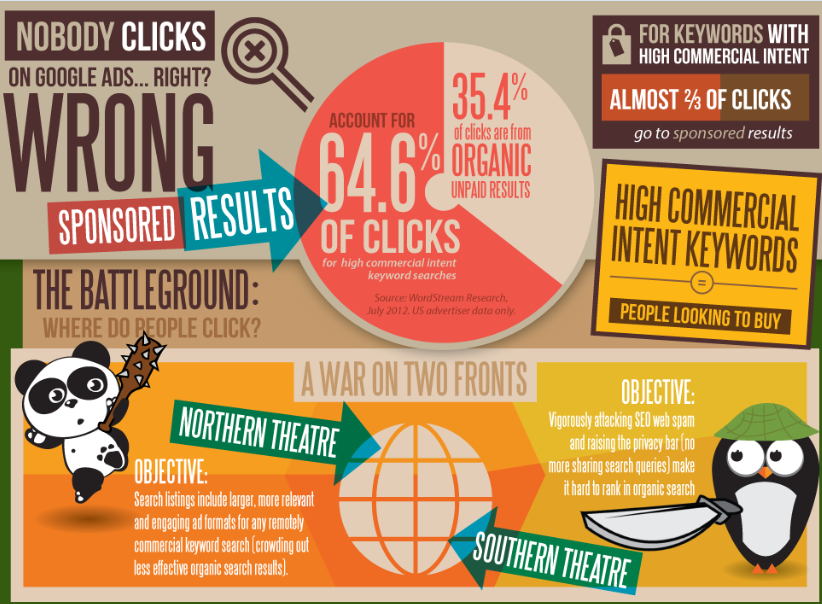
The infographic below summarizes every aspect of what one can expect from paid advertising including the pros and the cons:
What’s new?
Vernacular Ads
If the probability is that everyone is Clicking on the Ads, why not make the content appeal in all languages that reaches a wider mass market to catch the attention on a native level. According to research, regional content does better online than English.
Using vernacular content in your advertising strategy makes perfect sense to target a broader Pan- India audience, especially those in tier II and tier III cities.
The key takeaway is to resonate with the local market with a message or call-to-action that urges them to your landing page (which can be curated to the local language as well) to drive them from consideration to conversion!
The Philosophy of Lead Generation
Yes, everyone is doing many things across the known platforms such as Facebook, Google, Yahoo and Columbia but what next?
Investing in other unknown territories and trying out various tools only help drive conversions up to a certain point.
Instead of looking outward, why not focus on driving the main tool (The Landing Page) into a multi-channelled function that serves many purposes with a multi-project landing page!
It’s simple, cost-effective and solves the problem of repetition and monotony across landing pages.
(Sample Multi project Landing Page)
Having emerged from a generating leads for a stand-alone project to delivering results across multiple projects both on the domestic market and international market, we have successfully driven hundreds of sales spending vast amounts of money to churn around 10 times the growth revenue than any other digital agency can deliver attributing to only 1% of the sale value, the cost per leads has been crucially optimized to deliver better results than ever before!
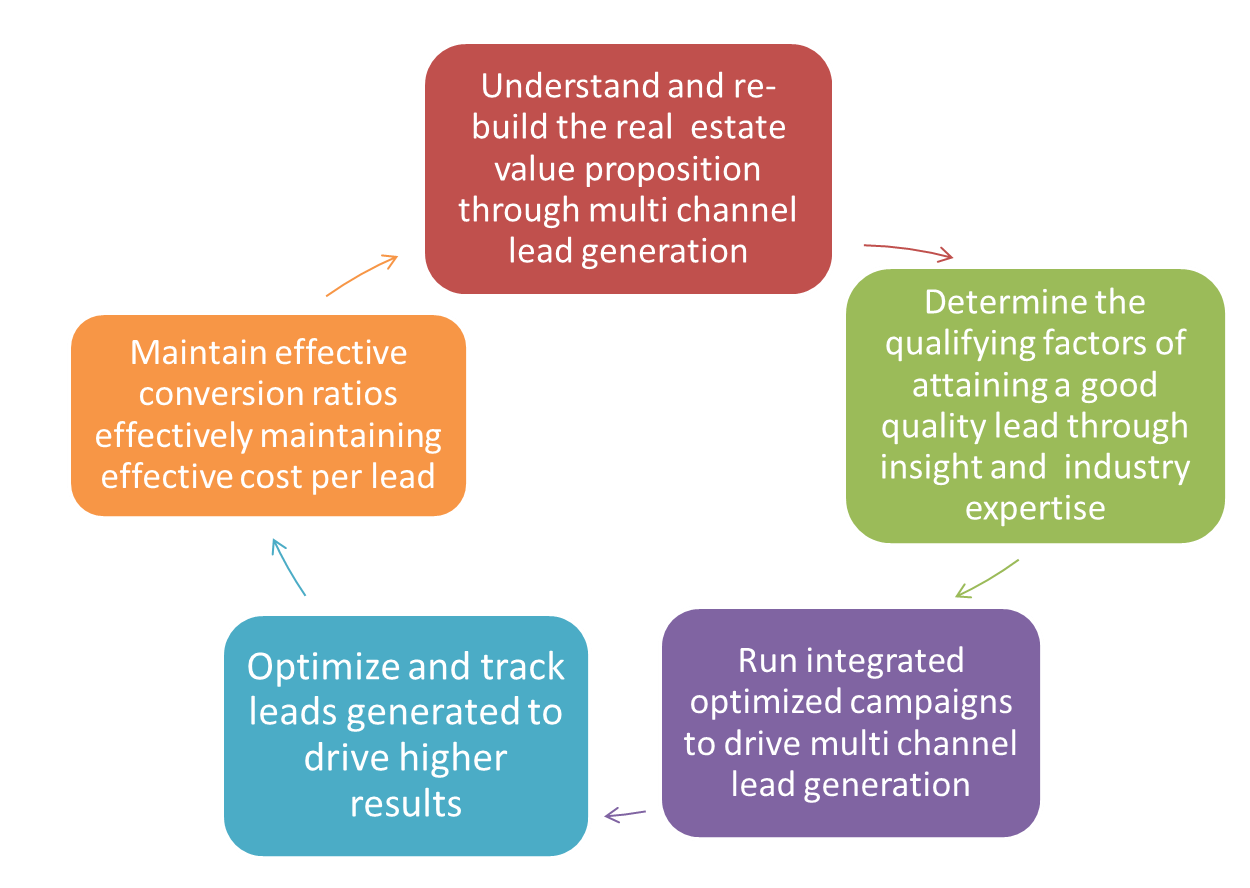
Our approach to driving an Integrated Lead Generation Strategy is to constantly re-evaluate the ‘go-to-market’ strategy rebuilding the value proposition each time.
If you are looking for the best strategies for digital marketing, read our blog on the complete guide for digital marketing for real estate.
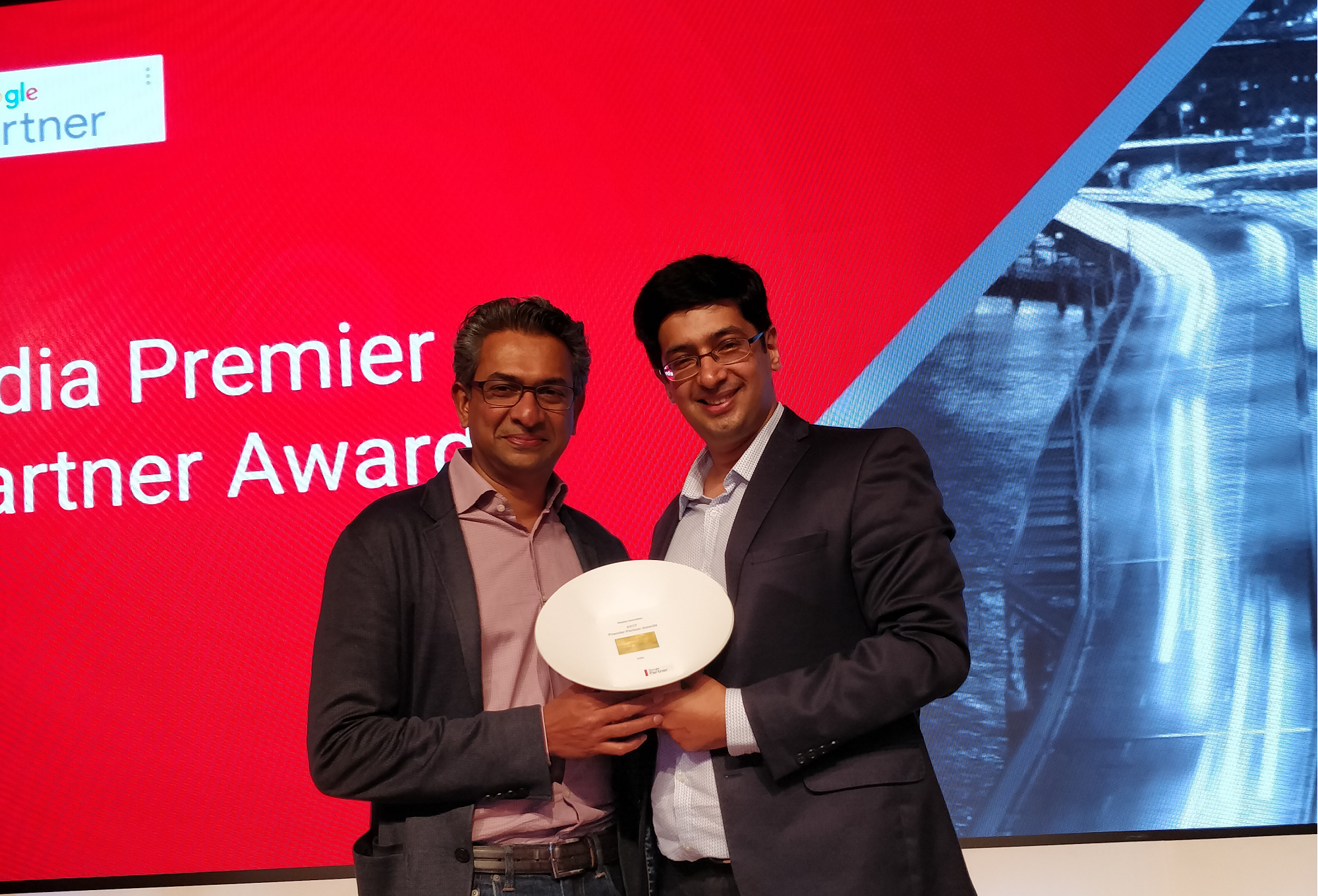
Since becoming a Google Premier Partner a year ago, we have constantly pushed the bar up to leverage Google AdWords and other advertising channels to deliver the best ROI. We are happy to announce that Social Beat has been awarded for Innovation in Display Advertising at the recently concluded Google Premier Partner awards in Mumbai. We were the only agency in India shortlisted for both Search Innovation & Display Innovation category.
The award is a testimony to the fabulous team at Social beat, which constantly pushes the bar to deliver results for clients. There are only 65 Google Premier Partners in India of which 13 were shortlisted for the awards and 5 won them.
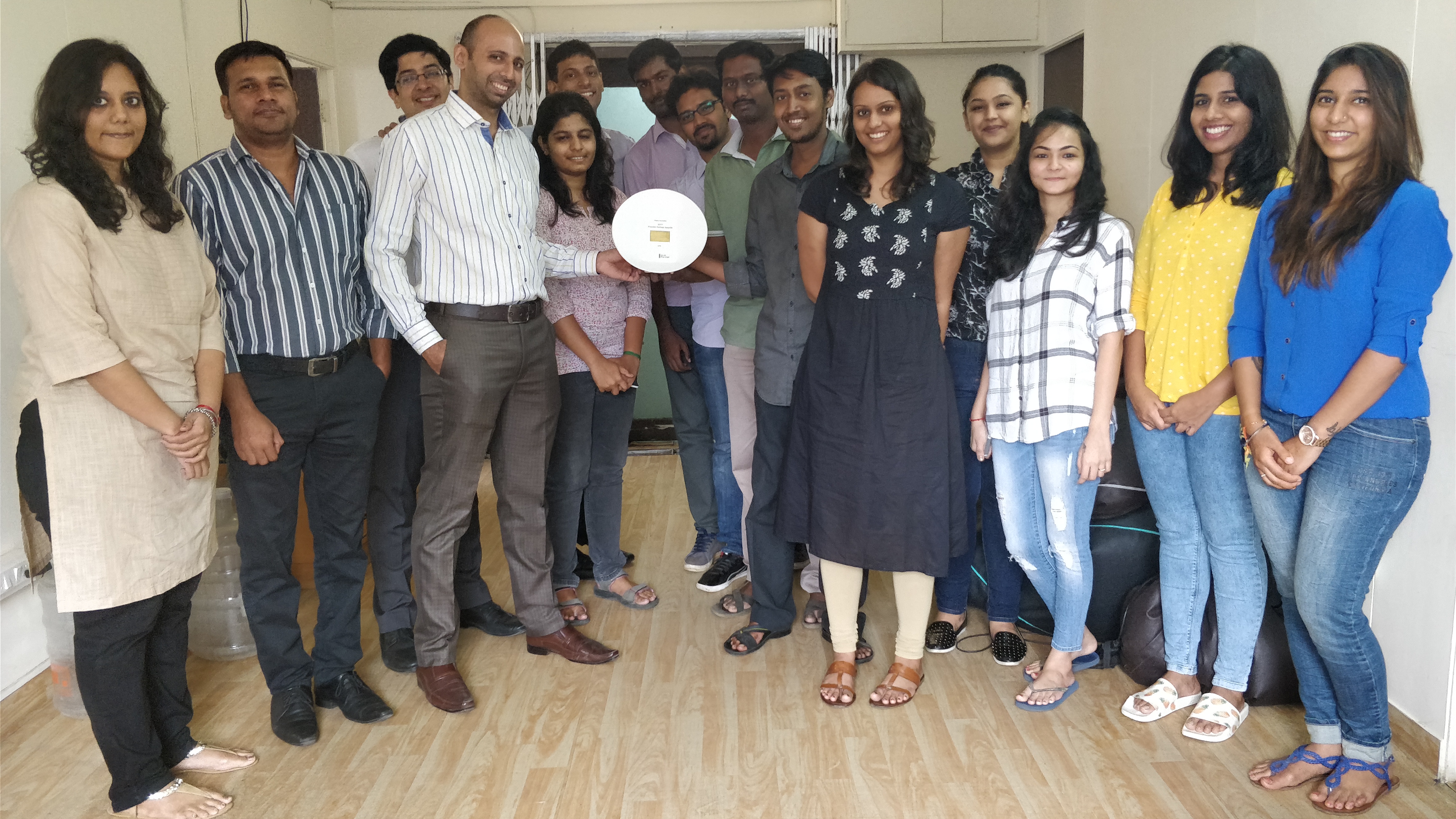
Above is a picture of Vikas Chawla collecting the award on behalf of the team, from Rajan Anand, Vice President, South East Asia and India of Google India and below is a picture of the team that made it happen.
To learn about the innovation we do for our clients, please visit our blog showcasing the case studies.
The Google Display Network is a vast network in the digital world. It helps not only by displaying ads to people who are looking for your brand but also to people who might be interested in your brand and are occupied currently with some other work like browsing another website, watching a video on YouTube, checking their mail, reading reviews or using their mobile apps.
Google display network offers umpteen ways of targeting your ad but finding the best targeting might seem to be a tough job at times. For this reason, Google has made it easy and has introduced smart display campaigns where our job is just to provide ad assets and set a target CPA, and Google does its best to drive as many as conversions as possible. The ad’s adaptability allows you to expand your reach without you having to create dozens of ads in all the combinations of ad types and sizes.
In these types of campaigns, Google sets its target audience and placements which it feels is worth spending for. Smart display campaigns are used when the advertiser wants to target additional customers beyond the manually targeted audience. As per google, the daily budget should be 10-15 times the target CPA bid.
Unfortunately, smart display ad option may not be open for all the accounts. The advertisers have to check if they are capable of running a smart display ad before they plan. There is a passing criterion of at least 50 conversions on the display network and 100 conversions on the search network in the past 30 days without which running the ad might not be possible.
Creating a smart display campaign is very simple. The process is similar to that of a display ad creation. When you promote the ad, click on “Marketing objective radio button.” In the drive action objective, select an appropriate option which then lets us know if our account is eligible to create a smart display campaign.
Once you have created the campaign, set the campaign budget, and the target CPA goal.
We provide only the ad assets, Google then scans your website and selects appropriate images with which it creates a series of responsive ads to be tested.
Be aware of your asset size restrictions before you start, so you have all your ducks in a row before you start creating your SDC.
Automated bidding
The smart display bids are based on target CPA where the performance data suggests the highest likelihood of conversion occurrence. The bid is automatically set higher, and when there is a minimum probability of conversion, it is set lower. The campaign should start optimising in two weeks or after 50 conversions, whichever comes first.
Note: Google does not guarantee to stick to the target CPA, it may vary according to various factors.
Automated targeting
As the name suggests, the targeting is based on tracking which demographics, locations, etc. help in more number of conversions for the ad.
Smart display campaigns cover two targeting methods; automated remarketing where ads are targeted to the website visitors and automated targeting where people just above the buying phase of the marketing funnel are targeted.
If a remarketing campaign is already created in another campaign, the ad with higher relevance shows up.
Apart from these, site category exclusions can also be specified.
Note: Avoid going for smart display campaigns if you have a very specific target audience in mind.
Automated Ad creation
This feature is similar to that of a responsive ad. We enter the ad copies, images, logos, etc. and google assembles it into various types, sizes and shapes based on where the ad appears on the google display network.
Also, read our blog on the most definitive guide to optimising your AdWords campaign.
Have you created your smart display campaign? Do share your learnings and experience with us in the comments section below
Since becoming a Google Premier Partner a year ago, we have constantly pushed the bar up to leverage Google AdWords and other advertising channels to deliver the best ROI. We are happy to announce that Social Beat is the only agency in India that is shortlisted for the Google Premier Partner awards for both Search Innovation & Display Innovation category. Below are two case studies showcasing some of the work we have done.
We work with Notionpress, India’s leading self-publishing company and our goal was to increase the number of leads by reaching out to potential and budding authors. The publishing space is an extremely competitive space, we used Google Search campaigns a key channel to achieve this goal. Right from creating a structured AdWords campaign to daily optimisation of the campaigns, we experimented with every feature that Google offers such as
Understanding that the people who already know us and have interacted with us through the website have the highest potential to convert as a lead, we used the RSLA feature to do just that. This feature helped us target the website visitors to convert them into potential leads. This audience, however, was from different categories and their search queries were different and we couldn't show them the same ad. The messaging needed to change and utilising the “IF Function”, we were able to dynamically change ad copies to RLSA audiences where we created a sense of urgency, which helped in increasing the conversion numbers.
The self-publishing industry in India is not only a competitive one but also a fairly new industry. In order to understand the market and deliver the best results, we had to constantly think of something new and experiment with different strategies. As part of this strategy, we used keywords of different match types to engage with our target audiences to the maximum extent. This process gave us a broad list of keywords to target and understand what exactly people are searching for and gave us a 3X increase in lead flow.
When we tried out keywords of different match types, not only did we identify many more keywords to target but also found certain irrelevant ones. These keywords were not ideal for our client so we constantly managed and added them to the negative keywords list so that it does not affect the quality of our leads. Over 6000 such words were identified and managed and this list continues to grow every day.
Targeting a wide variety of keywords from different categories meant that the ad copies cannot be constant. It needed change depending on what people are searching for. Using the dynamic keywords insertion, we were able to dynamically change the ad copies based on the search query and connect with our target audiences very well, thus contributing to increase in conversions.
We explored the CPA bidding mode to optimise the bids automatically and moved most of the campaigns to this. We started focussing on other aspects such as changing the bids based on devices, hour, time and day of the week and so on.
We used Dynamic Search Ads, which is normally used for e-commerce business as DSA provides additional text on the headlines which is not possible through the expanded text ads. This unique method helped us expand our keyword base, thereby helping us get more conversions.
We also worked on creative writing and focused on engaging ad copies in increasing the number of leads.
With the help of search campaigns, we were able to achieve a whopping 561% increase in the number of conversions, and 154% increase in CTR with optimal CPA. We also had a weekly check in with the client on the quality of leads. With this effort, we were able to reduce the % of qualified leads and improved the final conversion of leads to sales.
Casa Grande, a leader in the real estate space in South India, came to us with the objective of driving sales to their properties through Google Display advertising. With the help of every functionality that Google offers, such as responsive ads, similar audiences and smart display ads, we were able to drastically increase the number of site visits and conversions for the brand.
In India, vernacular content via digital has been growing at a fast pace in India. Of the literate 74%, only 10% read English while the rest consume content in the vernacular medium. In fact, according to statistics, Hindi Internet users (at 201 million) are said to outnumber those accessing the web in English at 199 million by 2021. Keeping this in mind, we used vernacular language as part of our advertising strategy as well as a part of our overall digital media strategy. For a real estate company such as Casa Grande, the audience is spread across Tier I, II and III cities and are not just restricted to the metro cities. It is also true that some of the metro city audiences are more comfortable with the regional language.
Purchasing a property not only involves a lot of money but is also an emotional decision so it is highly essential to talk to them in a language they are comfortable in. We tried out display ads in Tamil, which not only helped us reach a varied set of target audience but also played a substantial role in generating high-quality leads.
When Google Adwords stopped language targeting in Tamil, we quickly turned to Doubleclick and got a license to use the platform. With the help of Doubleclick Bid Manager, we were able to explore placements outside of Hindi language, which helped us achieve great success for Casa Grande, whose target audience is predominantly non-Hindi speakers.
In order to always keep a track of the latest trends in advertising, we contacted our Google support team to get us whitelisted and try out new features in the beta stage itself. Our client was delighted with the huge jump in ROI generated with a visible increase in conversions.
When the concept of similar audiences was introduced, we immediately tried it out for some of our clients and realised the huge potential it has. We’ve also executed new features such as similar audiences to generate sales and help our clients broaden their reach.
Knowing the source of the leads generated from various platforms is highly essential. This helps us to identify which campaigns, placements, topics, and audiences are driving qualified leads in order to improve our quality and quantity of leads. Using this, we are able to understand which platform and source are working better, thereby knowing exactly where to put our money to achieve better results.
No advertising works well without knowing what the target audience exactly wants. Keeping this in mind, we constantly test and refine our landing pages in order to improve the % and quality of conversions that we get. We use Crazy Egg, Zarget and Optimizely for the same. From the designs to the call to action, our team proactively uses heat maps and test various permutations and combinations to understand the consumer better and give them exactly what they want. For example, we did this exercise for our Casa Grande and understood that most of the target audience is looking for floor plans and brochures when they click on the ad. So, the landing pages were optimised to give them just that. This increased our lead flow massively.
The publishing industry being a highly competitive one with reputed and well-established players such as Amazon, we not only need to keep trying something new but also keep a track on the competitors. We use SEMRush and Ahrefs to explore the activities of our competitors to stay ahead of them in our campaigns. We also get new Campaign/Ad Group/Keyword ideas by analysing the competition.
As a team, we are constantly on the lookout to do more in less time and deliver big for our clients. In order to automate the day to day tasks, we use scripts and third party tools, to expand and optimise the campaigns. This process saves us a lot of time and cuts down monitoring simple monotonous processes, which in turn helps us focus on other aspects of optimizing the ad campaigns. It also helps in keeping a close track of the Google Adwords Account Health Score to optimise the campaigns.
We use advanced audience insights to understand our customer and target them. It also helps us with creating smart remarketing lists and use it for RLSA to get better conversions and results out of our advertising efforts.
One of the key reasons that we were able to produce such results is due to our ROI driven focus. To ensure that we push our boundaries and achieve the set targets for our clients, our team relies heavily on knowledge sharing and staying up to date on the new trends. We look forward to continuing pushing boundaries for our clients.
Banking on a series of successful editions of Digital Chai Pe Charcha in Chennai and Bangalore, we conducted the first edition of Digital Chai Pe Charcha in Mumbai. We had close to 30 participants comprising of entrepreneurs and marketers from across industries. The topic of discussion was getting ROI from Digital Marketing.
Below is the presentation that was discussed during the session which will provide you with more information on the above points:
With more customers making their purchases online, startups have now begun shifting their businesses online to make use of the large community around the world with ready buying power. To sell your own product or sell somebody else’s – you need to decide; and how, when, where – we’ll help you with that. Acquiring a customer might be difficult, especially if you have just begun your journey of selling online. So it is a good idea to go to a platform that has already established themselves.
Amazon is the right place to start selling your products. Amazon India with over 200 million (20 crore) monthly active users on the platform is a leader in the online retail space. We have put together a guide on selling your very first product on Amazon India with the effective and efficient transaction. Amazon India provides a comprehensive platform for sellers from remote cities in India to reach pan-India.
Step 1: Create your Amazon Seller Account
Creating your seller account is simple. All you need to do is enter your Business Entity Name, address, phone number, VAT or CST registration information and all the necessary bank account details.
Step 2: List your products on Amazon
Now that you have your account ready, make a note of all the items you’d like to sell on Amazon and list it.
Amazon has millions of existing catalogues categorising goods in the name of the material, size, colour, product variation, etc. and if your product falls into one of these categories, you can directly list your products in that respective catalogue. However, if your product is entirely new and doesn’t have an existing catalogue, you will then need to create a new product listing.
Amazon has a highly efficient team who will help you create a high-quality catalogue to ensure your products have the right description, user-friendly language and easy reach so that you have a valid transaction.
Also, if you are very confident with your line of products, go ahead and advertise on Amazon using ‘Amazon Sponsored Products’. This is very similar to what digital advertising agencies do – they look for what people are searching for, and with the help of SEO and Google AdWords, they make sure the user ends up looking at your products and purchasing it.
Step 3: Take your products live
Congratulations! Your first product is now live on Amazon. Crores of customers can now view, add it to their wish list and purchase your product. Sometimes, your products might not receive the expected number of clicks or impressions, and one of the reasons might be because of the broken descriptions that go along with your product. No worries, you can always go back to your dashboard and make as many edits you like and publish it again.
You can always have a close look at your dashboard to create more product listing, promote the same, manage/ship your orders and at the end of every week or month; you could analyse and make sure your business is on track.
Step 4: Amazon does all the work, sit back and relax
Amazon makes a note of all your orders though your already powered Amazon Easy Ship facility. They pick up and ship your products and take care of logistics and customer service. Quite cool, eh? It is an end-to-end delivery service for sellers. You can just focus on your business while Amazon does all the heavy lifting.
he service includes –
Amazon has also introduced FBA (Fulfillment By Amazon), which lets you store your products, then pick, pack and ship your products across India. This FBA service helps you gain all the storage and fulfillment facilities, fast delivery options and trustworthy customer service. There is no startup fee for this service and just a flexible ‘Pay as you go’ scheme depending on your usage.
Amazon has a Prime account for sellers too and this feature allows you to ship your products to your customers quickly. Once you enroll for FBA, you are automatically eligible to become an Amazon Prime seller without extra charges.
Step 5: Grow your business with Amazon
Amazon deposits your payments into your bank account within a week (7 days) from the date of delivery, only after the sale is made and you receive the payment from your customer.
There are a number of fees that the seller has to pay Amazon – referral fee starting from 3% (this particular fee differs from city to city in India), fixed closing fee starting from Rs. 10 per unit sold (this fee varies by category and price), shipping fee starting from Rs. 30 per unit shipped (this fee varies by distance and volume of the unit) and delivery service fee of 1.25% per item.
Amazon cares about your business and they send custmoised tips and trick to improve your business for better performance. They have an inbuilt team who keeps a track of your dashboard and send you a customized report periodically to boost your performance as well.
How digital marketing can help build the brand and send traffic to amazon
Yes, selling on Amazon is great and easy. However, Amazon is a crowded place and it is always a good idea to promote your Amazon listing as much as you would promote your online store. Use Facebook ads, Google ads or even blogs with links that would drive your potential customer back to the products on Amazon.
For example, if you are selling jewellery, you can run Facebook Carousel ads with high quality images of the product and link them to the various Amazon listings. This will drive traffic to the listing and has the potential to reach a larger target audience.
Unlike developing your very own ecommerce website and selling on it, selling on Amazon India has a lot of advantages. Right from the development, optimization and maintenance of your marketplace to logistics, customer service and easy transactions, everything is taken care of by Amazon India. Instead of making a foolproof plan on everything and anything before launching your product out in the market, it is much better to start selling online first, test the waters and then take it forward from there.
There’s an app for everything these days. If you are a heavy user, you probably have numerous apps installed on your smartphone. Each app in your phone serves a purpose, giving you a good reason to use when required. Only thing is, there are too many apps that share similar features and functionality, so you need to come up with ingenious ways to make your app stand out.
At present, there are more than 4 million apps in Google’s Play Store and Apple’s App Store combined, and these numbers are increasing at a huge rate. To stand out in this overflowing marketplace, your app needs powerful marketing and promotion. Here’s a quick guide on the many ways you can market your newly launched mobile app.
Even before you begin marketing your app, you need to be 100 percent sure it is prepped and ready for displaying on a selected app store. Little things like the app icon, software updates, and app descriptions play a big role in your app’s awareness and life cycle in a store. Keep a cheat sheet for app store optimisation next to you throughout the development and marketing of your app.
A lot of apps launching today are really just an extension of a product or service that already has a strong presence on the web. If you’re going the reverse way, you still need some sort of website presence that can be used as a promotive platform. The best option is a landing page, which can be used to promote your app organically. Let’s say you’re writing an informative blog article that centres around your app-based product or people search for the product you offer on Google; if the first point of communication is a landing page, there’s a big chance that searchers get converted into a user of your app.
Make the most you can out of the freedom of expression offered on the landing page. You can provide detailed information about your product and even create a mock version of your app to give users a taste of what to expect.
Human, a fitness initiative, launched as an app to inspire people of all ages to get active for a minimum of 30 minutes every day. To boost awareness for the app, a landing page was created that explained in detail the various features and benefits of using the app. The landing page included app screenshots, a simulator that showed real-time statistics of the app’s usage and various testimonials. Installs of Human hit the 1 million mark and the app was also rated amongst the best of 2014
Advertising is the fastest way to create awareness about a product and the same can be said for your app. There are a number of third party services that enable you to create and promote app install ads, so keep your finances in check and work out the best possible deals for advertising your app.
Facebook and Google’s app install campaigns are the best to start with. Here are the steps:
If shelling out money for advertising isn’t a good option for you, try the alternative route with social media promotions. Blogging, hashtagging, and page posts are some of the many techniques you can utilise on social media. Audience engagement helps build trust and value for your app and works wonders in the long run, provided you have patience and perseverance when using this marketing method.
One of the quickest ways to increase app installs is to request current users to write reviews and rate your app. App Store algorithms calculate app popularity through user reviews and number of downloads, which ultimately push your app to the Top Charts. You can implement the review and rating feature in your app via a number of unique ways; asking for reviews after multiple usages of the app or providing additional app features after a review or rating is done.
Just like Google’s numerous tools that help keep track of a website’s performance or the number of views and clicks on an ad, Mobile App Tracking tools help you track the number of times your app installed. Even when you promote your app through paid advertising, you can use app tracker tools to see from which method of promotion your app is benefiting most. Doing so helps in managing your ad expenses as well as gives you some pointers on what needs to change to enhance your app’s user experience.
Do you know any other interesting tricks of the app marketing trade? Share your ideas in the comments below.
This article was originally published on BusinessLine on Campus