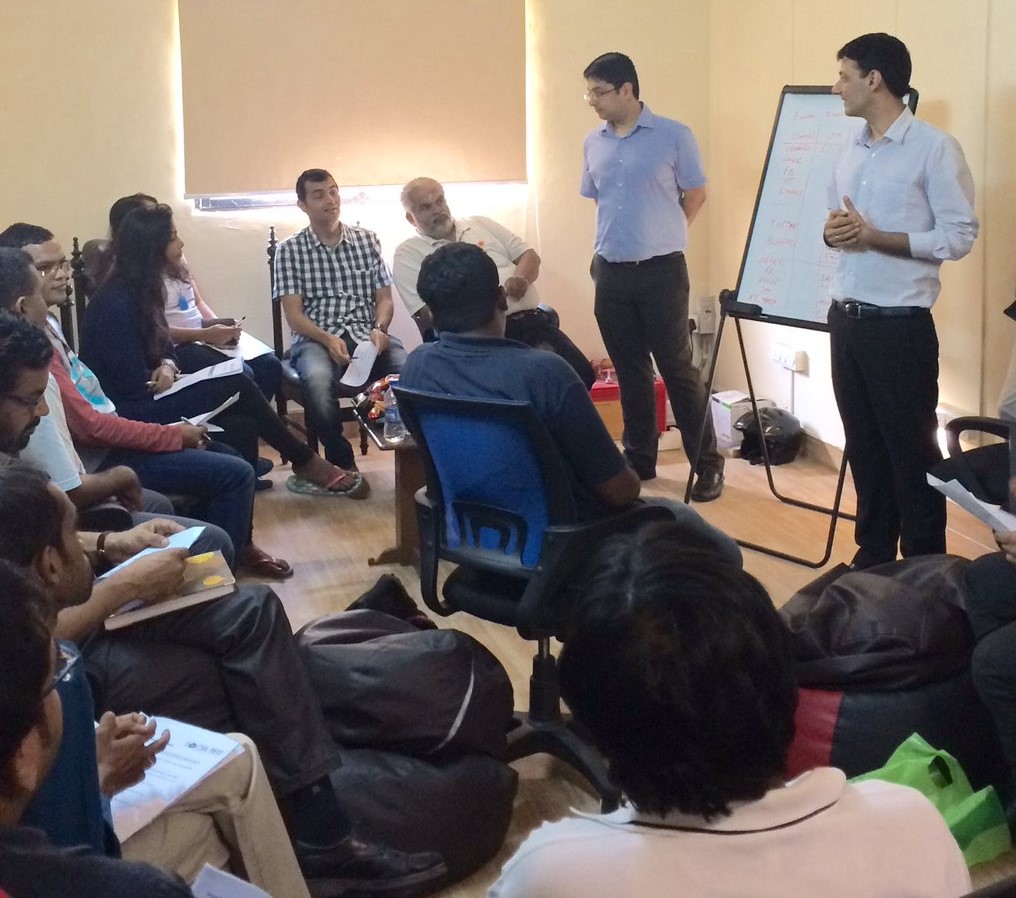
The third edition of the Digital Chai Pe Charcha, held at our office on 23rd April 2016 received a wonderful response with about 25 participants including entrepreneurs, professionals, digital marketers and social media influencers taking active part in the discussion. The topic of discussion, led by Social Beat co-founder Suneil Chawla, was the effective use of digital advertising for customer acquisition and business growth.
As a recap for those who attended the session and for the benefit of those who didn’t, here’s a summary of the key takeaways from the session:
Digital Advertising Terminology:
For those who are new to the world of digital advertising, there was a brief introduction to the terms that are used in the space:
Cost per Click (CPC): How much an advertiser pays, on average, for each ad click. CPC is calculated by dividing the total amount spent on a campaign by the number of clicks generated.
Cost per Mille (Thousand Impressions) (CPM): Metric that shows how much it costs to serve 1,000 ad impressions. Also used as a standard measure for buying display ads, as inventory is generally sold on a CPM basis.
Cost per Lead (CPL): How much an advertiser pays, on average, for each ad click that results in a lead conversion. CPL is calculated by dividing the total amount spent on a campaign by the number of leads generated.
Cost per action (CPA): A pricing method which calculates cost based on the number of times a user takes action based on an ad (conversions).
Click-through rate (CTR): The percentage of impressions that results in a click through.
Digital Advertising Industry Benchmarks:
Following a brief discussion on how attendees were using digital advertising for their business, there was a discussion on the CTR, CPC, CPA and CPL benchmarks one can expect to see for different industries, based on the years of experience Social Beat has in the space. The table with the industry benchmarks is below:
Digital Advertising Exercises:
Event attendees then made four teams and brainstormed on a digital advertising exercise – Two teams worked on increasing the number of orders for an ecommerce client while two worked on expanding the business for a retail chain to 100+ stores across two Indian states.
The ecommerce exercise can be downloaded here and the retail chain exercise can be downloaded here.
Key takeaways from the exercises:
Those of you who missed the first two editions of the Digital Chai Pe Charcha can check them out below:
Edition 1 - Challenges faced in marketing a startup
Edition 2 - Content Marketing Success in 2016
You can follow us on Facebook and Twitter or check out the hashtag #DigitalCPC for more details on the next Digital Chai Pe Charcha meet.
Are there any challenges you face when it comes to digital advertising for your brand? Do let us know in the comments below and we will be happy to help you out.
Not so long ago, Facebook took a plunge into uncharted territories by launching Carousel Ads. Though this ad type was initially meant to showcase multiple products in one ad, Facebook crafted a strategy for the Carousel Ads to tease e-commerce clients and make them buy more ads on the platform. But the Carousel Ads slowly moved across verticals, towards becoming one of the advanced Facebook Advertising techniques that is extremely engaging in promoting businesses.
According to a recent survey conducted by Kinetic Social, Carousel Ads can render up to 10 times more traffic to a business’ website, than static sponsored posts on Facebook. LOVOO found that they got a 72% higher click-through rate versus single image mobile app ads. Mirroring the effectiveness of interactive cover pictures on Facebook Pages, it appears quite clearly that these ads can be extremely effective, but how can you maximize their potential? Here are 3 simple ways to use carousel ads that can nail your targets with a bull’s-eye!
1). Showcase products in detail
Carousel Ads allow you to place up to 5 cards with images that can communicate messages effectively. If it’s a single product that you are highlighting, it would be prudent to describe its features in detail, keeping the CTR on an inclined angle. A ballet shoe manufacturer made effective use of showcasing a product, where each card of the ad focused on one distinct feature. They also used the headline copy to provide defined context to each image.
2). Tour your product
It always sums up to be a perfect formula when you try to deliver a good idea of what customers can expect from your offering. This will improve the quality of enquiries/leads, thereby increasing the probability of sales through Facebook. An automobile giant promoted one of its newly launched Coupé by creating an expressive Carousel Ad campaign that displayed features that made the car stand out from its competitors. The cards highlighted the key specs and of model and attracted genuine customers to engage with the carousel ad.
3). Tell a story
Stories are an incredibly effective way for branding, talking to customers, and engaging with them. A popular western airline company created an effective carousal ad campaign to market their vacation packages to The Grand Canyon. They infused a panorama of the location to tell a story that triggered people to book their air tickets to visit the location.
The Monetary Game
Can Carousel Ads be used as a solution to drive clicks to the website? We conducted a small experiment to test the hypothesis on the Clicks to Website Ads, for a glass manufacturing giant. Here’s how the results panned out:
In our view, with a little bit of testing and optimization to avoid common mistakes, the effectiveness of the Carousel Ads in driving clicks to URL destinations, is very cost effective. Have you experimented with Carousel Ads as a way to drive clicks to your business? We love to hear your thoughts and experiences in the comments below this post.
Every business big or small, belonging to any category is using digital marketing to help their business grow and reach the masses. Internet marketers know that Google Adwords is an excellent way to drive traffic to a website. Setting up an Adwords campaign is not just about making ads and running them but also getting the best results for the amount invested.
So, how are the best results obtained?
The best results are obtained when the campaign is setup properly (check out our definitive adwords campaign launch checklist) and optimized properly on a regular basis. Therefore, optimizing Adwords campaign is important, else if not managed properly, it can prove to be expensive for the business.
Optimizing an Adwords campaign is the most complex task, as every aspect of the account like click through rate, poor performing ads, using correct keywords, avg. cost and much more, needs to be analyzed. The optimizing process is continual and will have to be paid constant attention to, in order to maximise revenue and gather sufficient data about the account performance.
Here are a few tips to optimize your Google Adwords Account at different levels of the account.
1. Checking on bid adjustments: Bid adjustments allow you to show your ads more or less frequently based on when, where and how people search. Bid adjustments are set by percentages which can be either increased or decreased.
2. Search v/s Search partner networks: Check how ads are performing on the other search network partners with Google. If conversions are less you can always go to the all settings tab and chose to not show ads on other Google search networks. By clicking on that option your ads will not show on other Google networks.
3. Top v/s others: By selecting the top v/s others option under the segment tab, a table with statistics appear showing where your ads appeared on the Google search top (above the organic search) and otherwise (below the organic search).
The below image depicts that conversions are higher when the ads are on top, so to always remain above the organic search one can increase their CPC and get higher conversions.
Similarly, sometimes being below organic search i.e. “Google search other” shows higher conversions than Google search top. In this case you do not bother about increasing your bids to be on the top.
4. Ad Schedule: By adjusting the ad scheduling bid you can show your ads on specific days and also at specific times. At the campaign click on the dimensions option and see which day ads conversions are higher, based on this data adjust your ad bids.
The below report show that conversions are higher on Saturday, Sunday and Monday. Based on which the ad schedule bid adjustments have been increased so that ads appear more number of times on those days leading to higher conversions.
And it’s done! Those were few tips to optimize your Google Adwords campaign in a profitable manner. If there are any other Adwords optimization techniques you use that are not mentioned, then do let us know in the comments below.
In the age of WhatsApp and Facebook Messenger, Google is taking significant steps to ensure that emails remain a relevant mode of communication. It has not only succeeded till now but seem well set to revolutionize email communication across the world- Inbox by Gmail makes emails not just communication messages, rather a personal assistant of sorts.
The Inbox by Gmail is your personal assistant to help you manage your emails (read work) better. Here's what is there in store for you:
Smart Reply
The Smart Reply feature, which was rolled out for the Inbox App in November last year, has recently made its way to the Web version. Under this, Gmail would suggest three quick reply options. The reply options are dynamically generated based on the content and nature or the received email. The options selected by you are fed into the system to improve future response suggestions similar to the Spam filters.
Bundles
Inbox scans your incoming emails and sorts them into different buckets. All seemingly important mails go into your inbox while others get placed into different bundles or folders: Trips, Social, Finance, Updates, Forums, Promos and Low Priority. You have the option of deleting the entire bundle at once or mark as Done.
Snooze
You can use this feature to snooze the message to a particular date and time when you intend to work or action the message. You just have to open the message and tap the snooze option it gives a pop up to select the scheduled time for the message to reappear.
Smart Reminders
Are you into the habit of maintaining unread emails in your inbox just to remind you to do a particular thing? Now say goodbye to those unread emails. You just need to tap the Remember To field before the email subject line and type in the reminder. Based on the content in the email, Inbox also suggests the reminder options.
Pin It
You can pin the messages on top of your inbox even after it's placed into a folder or bundle. This will act as a reminder to reply to the mail or action the point.
Undo
Now you don't need to regret accidently clicking the Send option Inbox gives you the option to Undo the sent mail. The only catch is that you have got a 15 sec window for the same.
With all the handy features waiting to be explored, Inbox does have its own limitations:
Inbox by Gmail as a concept is built entirely on the premise of Artificial Intelligence & Machine Learning. For new users, it seems to be a regular app they use but in hindsight, this is an experiment that will govern how people communicate in 2025. Right from smart replies to email sorting, every single concept is geared towards making Inbox do the hard work for you. That will mark the transition of Gmail from an email service to a full-fledged Personal Assistant. It's worth taking a look at its potential impact for marketers.
The foundation to leverage on any social media tool is to ask yourself, ‘’Is this tool right for my business?’’ The answer to this question should not be driven by your competitor or market ally, who has plunged into using the tool, to aid his business. Are you a small business pondering your thoughts upon selecting LinkedIn as a platform for lead generation? Well, the dilemmas can be swept aside as LinkedIn will act as a lifeline to stay in front of your customers and also help you reach out to new prospects.
In digital marketing, your network is everything. Publishing a brilliant article on your website with 1,00,000 flares can make your feel ecstatic and boost your credibility. But it won’t matter if you aren’t speaking to the right audience. That’s where LinkedIn has stepped into the arena. It has become a prime channel where brands share content. This makes it easier for small business to connect with brand advocates, potential customers, and industry influencers, all at the same place. While content is one of the dual weapons, LinkedIn gears your business with, lead generation is the other ammunition. With access to over 400 million members on the world’s largest professional network, LinkedIn enables sales lead generation by allowing sales professionals to easily and quickly find the right prospects. Here are some of the most successful lead generation strategies that your business can leverage on, for generating leads.
Make an Effective Debut
There is nothing like effectively introducing yourself as a business to create an impact on users. Take care to optimise your profile and pay attention to your feed and website descriptions. Being descriptive builds trust and captures the eye of prospects more efficiently. Using the necessary keywords will help your business get captured during filtered searches.
Make Connections
Nothing works like direct one-on-one networking. Invest in a couple of minutes each working day, clicking the "connect" button on the "People You May Know" list that LinkedIn displays on your feed. Through time you will broaden your network and will become someone known for doing so. Remember that everyone you talk to about business or meet during the course of a business day is a potential LinkedIn connection.
Capitalize on LinkedIn Applications
The platform gives you the option to add interesting apps that will improve the experience people have on your LinkedIn page. You can add blog posts, let people know what you are reading, and even set up polls to find out what’s on the minds of your customers and prospects. For example, your business can use SlideShare to display a webinar or use a PowerPoint deck of how your business helps in solving a customer’s problem.
Rendezvous on LinkedIn Groups
Participating in LinkedIn Groups is the one of the key moves to generate leads. If you are a member of the same group as another user, you can bypass the need to be a first degree connection in order to message them. In addition to this, group members can also view the profiles of other members of the same group without being connected. Take some time to search for groups to join where your targeted buyers are likely to be members. Start by contributing to conversations, be helpful in answering questions, and provide links to assets you have on your site that might help members of the group. Put your most valuable assets behind a short form on your site to capture LinkedIn visitor’s details. And voila, you now have a new lead! Alternatively, joining groups that are outside your industry that might help you grow your business too. Stretching out a little bit, helps your business expand its reach. For example: If you’re an Social Media Specialist, you don’t want to just join an Social Media Professionals Group - you’ll want to join groups for Digital Marketing, Startups, App Marketing, and other groups outside of your immediate circle.
Sponsored Updates + Valuable Content
Many small businesses have started to run LinkedIn Sponsored Update campaigns to generate leads for their business. While regular updates can be a hit or miss in terms of impressions; using sponsored updates allows you to share updates that don’t appear as ads, at first glance. Start by generating a whole lot of original content (blogs). Then trial with creating 20 sponsored updates over the space of two months to promote it to your target audience. It’s a lot of work, but it pays off! NewsCred ran a series of sponsored update campaigns that netted them 288 new followers and 71 leads, over a span of 2 months. The company also found the campaign to be 75% less expensive than the Google AdWords lead gen campaigns they were running in parallel. It is to be noted that research has revealed leads collected via LinkedIn are three times more likely to convert into customers than leads collected via any other digital advertising platform.
Priming LinkedIn Direct Ads (Text Ads)
LinkedIn’s advertising platform can be used to drive new prospects to your landing page, LinkedIn group or other destination. The ads work the same way Google paid search ads work. You simply write a headline, add some copy and create a destination link. Then you bid on how much you’ll pay LinkedIn every time someone clicks on the ad. If you pay Rs.100 to LinkedIn for a click, and it takes 50 clicks before you convert a customer, then you’ve just spent Rs.500 for 1 customer. If your product sells for Rs.5000 each, investing Rs.500 to generate Rs.5000 is not a bad return-on-investment. In our experience, text ads deliver high impressions but fail to capture leads effectively, when compared to the sponsored updates.
For more information on how you can leverage LinkedIn for your B2C or B2B brands, take a look at what Ishan Gupta of LinkedIn has to say.
When you are creating your first Adwords campaign, chances are high that you may miss out on some key points and settings. Even if you do create campaigns every day, there are possibilities that you may fail to notice a few things. Here’s a checklist to help you ensure that everything is in place before you take your Adwords campaign live.
1. Campaign type
Ensure you have selected the right campaign type based on your objective.
Choose,
Search Network only – When you want your ads to be displayed on Google search results.
Display Network only – When you want your ads to be shown on websites which your targeted audiences visit. These sites are called “Placements”.
Search Network with Display Select - When you want to ads both on Google search results and other websites.
2. Campaign sub-type
Ensure that the “All features” sub-type is set, so that you get all the advanced options & features like ad scheduling, ad delivery and advanced location settings.
3. Location Targeting
Check that you have selected the right location (country, city, district etc.) where you want your ads to be shown. You need to set the Targeted location if you want your ads to be shown only in certain locations.This ensures you do not receive unnecessary clicks from the locations not relevant to your business.
4. Advanced Location settings
Ensure that you include and exclude locations through Advanced location targeting options, to make your targeting more effective.
Check if your option is set to,
People in my targeted location - If you are focusing the audiences who are living in the targeted location.
People searching for or show interest in my targeted location - if you want to show your ads to people who might not be living in your targeted but are searching for , or showing interest in the targeted location.
People in, searching for or show interest in my targeted location - if you want to target both the audience types listed above.
You also have the options to include or exclude places in the above criteria.
5. Conversion Tracking
Make sure that you copy the conversion code available in the “Tools - conversions” section and paste it in your Thank You or success page. This helps in tracking how productively the ad is being converted into leads. That can be a page sign up, purchase, phone call or app download.
If you are not familiar with how the conversion process works, here's a detailed guide you can refer to.
6. Remarketing
Ensure that you have created a Remarketing list for your campaign to track visitors to your website who you can target ads to later. This can be found in the audiences section under the Shared Library, in the left menu bar, as shown below. You can generate the remarketing code and paste it in all relevant pages of your site.
7. Bidding
To begin with, it is recommended to choose “Automated bidding”, where Adwords sets your bids to help get as many clicks as possible within your budget. After the campaign has run for a few weeks, you can switch bidding to “Manual” and set the Maximum you would be willing to pay per click.
8. Billing
Verify that your billing information - country, billing address, and payment method have been added correctly.
9. Ad Delivery
If you have chosen the “All features” campaign sub-type, you will have two options to deliver your ad.
Ensure your option is set to ,
Standard – if your budget is limited and you want the ad to be evenly shown throughout the day.
Accelerated – if you want the ad to be shown as quickly as possible.
10. Ad Rotation
Make sure you set “Ad Rotation” when you have more than one ad in an ad group. This helps in choosing which ad to show more often. This setting consists of four options, namely,
Optimize for clicks – Ads receiving more clicks are shown often.
Optimize for conversions – Ads receiving more conversions are shown more often.
Rotate evenly – All ads in the ad group are equally shown.
Rotate indefinitely – All ads are shown for an indefinite amount of time.
Check if you have set “Rotate evenly” in the Ad rotation settings, so that you give preference to all ads initially and then change the settings later to either “Optimize for Clicks” or “Optimize for Conversions”, according to the ad performance.
11. Daily budget
Confirm that you have set the default bid and the amount you are willing to spend daily.
12. Auto-tagging:
Verify that the Auto-tagging is turned on, under the “Preferences” section in the Account settings. This helps in tracking which keywords have brought visitors to your website and to which ad group they belong. Google Analytics uses auto-tagging URL and determines the ad performance.
13. Negative keywords
Ensure that you have added all negative keywords, that apply to the account, to a shared list under the “Campaign keywords” section in the Shared Library as shown below.
Confirm that you have applied the list to all the relevant campaigns in the account.
While creating Ad groups, make sure you group together the keywords targeting a particular product or service ie. cluster the keywords in ad groups thematically. Make sure you follow the below mentioned best practices.
14. Number of ads
Check that each ad group has a minimum of two ads, carrying different Ad titles and Descriptions , so that they run alternatively. After evaluating their performance over a period of time, the poorly performing ads can be be paused.
15. Mobile ads
At least one Mobile specific ad must be present in each ad group targeting mobile audience. You may notice certain truncated ads when you use mobile phones. It is because, those ads specifically created for the desktop users appear on mobiles. When you create ads, make sure you also create a copy of the ad and check the “Mobile” in the device preference option.
16. Keywords
Similar keywords should be grouped under each ad group. As a good practice, it is recommended that , each ad group contain no more than 10 to 15 keywords in it.
17. Match type
Ensure that you use relevant keyword match types for optimal ad performance.
Writing a successful text ad is really important to target potential customers. Hence, the text ad should be both compelling as well as relevant to what customers are searching for. Ensure that you follow the below mentioned best practices for ads:
18. Capitalization
Check if the first letter of each word in the ad description is capitalized. This is more for visual purposes. Capitalizing each word increases the visibility of your ad resulting in higher click-through rates and improved quality scores.
19. Period
As far as possible, make sure the First Description line ends with a period (full stop), so that, it moves up to the Headline. This is called an “Extended ad headline”. Most of the ads, with extended ad headlines stand out better on the search results pages resulting in better click-throughs on the ad.
20. Keywords
Confirm that the Ad title, Display URLs, & Description lines contain keywords in them.
21. Landing page
Check if the Destination URLs are directed to the relevant landing pages.
22. Extensions
Make sure you add all the relevant extensions to your ad. When the information in the ad text are not sufficient enough to showcase your product completely, Ad extensions help displaying additional information. Adding extensions also help the ad occupy a larger space in the SERP, which increases its prominence and visibility.
There are seven different ad extensions which can be found in the “Ad extensions” tab under each campaign.
Sitelinks extensions - Direct the users to the specific pages in the website and helps the users to find what they are looking for.
Location extensions - Direct the users to the nearest product store.
Call extensions - Call option making the mobile or tablet users to contact you directly.
App extensions - Take the users to the app store in order to download the product app.
Review extensions - Display positive reviews from various sources.
Call out extensions - Again a descriptive text to the ad, helping the user to explore more about the product.
Structured snippet extensions - Display additional landing page details.
Also, verify that all the extensions are linked to the relevant pages.
23. Repetition of Information
Make sure, no information already present in the Ad Description is repeated in the ad extensions. Remove or change it, if any.
24. Negative Keywords
In order to prevent your ads showing up for irrelevant keywords, make sure you have added negative keywords both at an ad group level and at a campaign level under the “Keywords” section.
25. Call to Action
Last, but not least, ensure that all ads have a Call to Action, which is the ultimate goal of any Ad campaign.
Whenever you create your next adwords campaign, keep this checklist handy to ensure that you don’t miss out on anything important.
Is there any check you carry out that we missed including? Do let us know in the comments below and we will have it included.
The Boston Consulting Group (BCG) in association with the Retailers Association of India, recently published a report that highlights the trends in Indian retail. As the world’s leading advisor on retail strategy, BCG has evaluated India’s high-value opportunities in the retail market. Partnering with RAI, the unified voice of Indian Retailers, the report aims at formulating solutions to key challenges faced in the market. The following is a brief summary on the findings.
The Scenario
Retail in India has taken a remarkable transformation over the last two decades. Rising income levels, urbanization, and changing consumer behaviour has given an optimistic outlook to the retail sector, promising an undoubted growth in the future. The digital medium has influenced retail with a powerful strike, reshaping customer behaviour and expectations. To summarize, retail business are in a constant need to retrospect their strengths, reinvent their offerings across the purchase pathway, and rewrite their approach of retail economics.
Trends
Based on research and some stringent analysis of data, the report captured key trends across the following broad categories.
1). Certainty of Growth
A promising growth forecast is one of the primary findings made from the study. The Indian retail sector is projected to double from $600 Billion to $1 Trillion, by 2020. This rapid growth will be determined by factors such as Income Growth, Urbanization, Nuclearization, and Attitudinal Shifts. Modern trade is also expected to grow 3 times, with Rapid Consumer Evolution, Supply-side Evolution, and Positive Regulatory Environment, being the drivers that will materialize this growth. As a key implication from this finding, Indian retailers should sharply identify the emerging opportunities and customer segments and be clear about what to not go after. Retailers should also re-adjust propositions to remain relevant and also allow room for experimentation, though it might not always turn out to be successful.
2). Reality of Digital
The E-commerce market in India is expected to quadruple to $70 Billion, over the next 5 years. With the rapid increase of smartphone users, competitive costs for connectivity, and expanded reach, internet users are expected to reach a mark of ~600 Million. Customers are attracted to superior value propositions like broader assortment, higher discounts and greater convenience. Indian retailers should conceptualize digital strategies with clarity and leverage on social media to create brand awareness. They are also expected to deploy a seamless and connected customer journey, as shoppers migrate across channels. It will also be a lot more seamless for e-retailers to sell across multiple offline & e-commerce market places.
In our view, digital will increasingly drive offline retail sales as well. It is already easy to track phone calls to the store or to track the number of people looking for store directions. Retailers will become more sophisticated (along with measurement tools from platforms like Google, Facebook, etc.) to attribute offline sales to a specific digital marketing effort.
3). Challenge of Capability
Omni-channel business is becoming increasing relevant. Customers expect a seamless experience and do not tend to distinguish between online and physical channels, while shopping. Traditional strengths are insufficient here. In addition to being omni-channel, a well conceptualized talent management strategy is critical. It has been noticed that retail businesses suffer from high attrition rates and limited capabilities in the middle and top management, as a result of inadequate specialized training and experience in the sector. Supply chain also needs an evolution, as the market is viral with long lead response times and infrastructure challenges. It’s high time that Indian retail businesses develop a comprehensive omni-channel offering and adopt a targeted approach to employee training, appraisal, and retention. It is also very vital for businesses to build a demand-driven supply chain that is equipped with a real time flow of information.
4). Importance of Economics
Several economic challenges plague Indian modern trade. Please find them listed below.
On the demand side:
- The level of processing is not high enough, as the Indian consumer gets used to modern trade.
- Pricing and promotions are poorly executed , not leveraging on customer willingness and purchasing power.
On the supply side:
- Inflating costs of real estate and rentals.
- Increasing costs due to low bargaining power with suppliers due to limited scale.
- High cost incurring supply chain due to poor connectivity, excess and deficit inventory.
- As an immediate implicative measure, the throughput problem should be address first. The other cost and margin issue will fall subsequently.
5). Need for Transformation
Fundamental transformation is the need of the hour. Businesses should avail the growth opportunity and serve digitally empowered consumers. As mentioned earlier, they should also build capabilities in quality omni-channel experience, talent management, and supply chain optimizations. This requires working on four pillars simultaneously. They are as follows.
Fund the journey – Generate quick cash from existing operations by relooking at the core of the business.
Win the medium term – Identify the winning consumer proposition formula for the next 6-8 years.
Take measured bets - Invest in emerging but important trends.
Enable the transformation – Invest in people and technology to improve efficiency, productivity, and morale.
Leadership Perspectives
The latter part of the report is its most credible engine, bringing perspectives from over 20 CEOs of top retailers in India. Some of the most thought-sparking lines have been quoted below.
“In times when the economy is tight, we face the brunt of lower discretionary spend. But right now, we are feeling very positive about the future and our industry.” - Ajay Kaul, CEO, Jubilant
“There is some form of a lack of supplier assistance to modern trade: somewhere they will have to accept that this is the way forward.” – Randall Guttery, CEO, Reliance Retail
The future of retail will compose of 3Ds: Daulat (wealth sharing within the retail ecosystem), Depth (in channels and category execution) and Digital (significant part of the operating model).” – Shailesh Chaturvedi, CEO, Tommy Hilfiger
The full report on Indian Retail 2020 can be found here.
In Dec 2015, we had an idea of creating a platform and open community for discussing challenges faced in marketing a startup – and this was the birth of “Digital Chai pe Charcha”. It got off to flying start in its first edition at our office on 8th January 2016. With limited promotion, we had a full house with 30 participants. The open discussion threw up interesting questions and insights from the diverse community comprising first-time entrepreneurs, seasoned professionals, digital marketers, journalists, PR professionals to social media influencers.
We discussed 7 broad topics and have summarized them below:
Startups do not have big pockets for marketing activities. In the face of budget constraints, how can they build a brand and acquire customers? Some ideas discussed were:
There is a whole host of tools out there that can be leveraged to help you amplify your marketing efforts. Some tools you can explore are:
Here's what some of the participants had to say:
Based on the suggestions from the participants, we are going to make this a monthly initiative with each month having a focused topic. You can check out the hashtag #DigitalCPC for more details on the next Digital Chai pe Charcha meet.
Please feel free to comment below or tweet to us, in case you would like to add to the existing list of pointers for startups. We would love to add them in the article.
In a space as dynamic as digital marketing where things change rapidly (Google, for example, updates its search algorithm 500 to 600 times a year), it is fairly difficult to predict with certainty how things will turn out in a year. Nevertheless, digital marketing is all about catching the best trends early and leveraging them. Here are eight key trends that we think would be ones to watch out for in 2016:
The mobile web will continue to grow rapidly
Mobile has already seen massive growth in 2014 and 2015. With Google announcing this year that mobile traffic has surpassed desktop traffic and also releasing its mobile-friendly update (Mobilegeddon), mobile-first has already gone from being a “nice to have” to an absolutely “must-have”. Also, despite the mobile web accounting for only 20% of the time spent on mobile (80% of the time spent is in apps), mobile browser traffic is twice the traffic from mobile apps. With mobile apps facing a massive challenge on the user retention front and the mobile web growing rapidly, mobile marketing strategy is where marketers are going to be strongly focused in 2016.
Newer channels like Instagram will continue to gain rapid ground
With a large number of marketers swarming the three most popular social media marketing channels - Facebook, Twitter and LinkedIn (93% of marketers use Facebook!), there’s a great deal of competition for any audience you would want to target. Relatively new and upcoming channels like Instagram (only 36% of marketers currently use Instagram), Snapchat (a meagre 2% of marketers currently use Snapchat) and Periscope, on the other hand, are fairly untapped and unlike Facebook, have seen a growth in organic reach over the last few years, as illustrated below. Early adopters to these channels are already seeing results and adoption will continue gain ground in the year to come.
[caption id="attachment_18103" align="aligncenter" width="745"]
Influencer marketing will become mainstream
With organic reach of brand pages dropping across most channels, customers trusting social influencers more than brands and the growing use of ad blockers, influencer marketing seems to one of the most viable options for brands to reach out to their target consumers. The savvy early-adopter brands have already started adopting influencer marketing in 2015 and 2016 is when mass adoption will begin.
Spends on Programmatic buying and Real-Time-Bidding will rise
Programmatic buying uses the power of data to ensure the right kind of ads are served to the right kind of people in the most meaningful way, thereby increasing the effectiveness of the ads and the return on ad spends. An increasing number of advertisers are expected to allocate larger spends to programmatic in the next few years.
[caption id="attachment_18105" align="aligncenter" width="325"]
Video will explode:
Video is no newcomer to the digital space but its consumption trends have seen a massive bump in 2015, especially with Facebook allowing auto-play of videos in the newsfeed. An increasing number of brands will direct a larger percentage of their marketing spends towards creation and promotion of video content. If you haven’t embraced video as a marketer yet, the time is now!
[caption id="attachment_18111" align="aligncenter" width="545"]
Follower counts are dead, focus will be on ROI-driven marketing
With most social media channels cutting down on their organic reach, the concept of building a fan or follower base which a brand can reach out to for free is almost dead. Fan and follower counts have turned into pure vanity metrics with little business value. The focus in 2015 has already been on marketing that can drive direct return-on-investment in terms of measurable metrics like traffic and sales growth and this focus is only going to be stronger in 2016.
The popularity of Native Ads will increase
The popularity of ad blockers has seen a substantial increase in 2015 and Apple announced this year that its new mobile operating system, iOS 9 will allow ad blocking as well. In this scenario, native advertising, where ads merge into the platform on which they are displayed and do not seem outrightly promotional, is bound to see a huge spike in popularity. If you haven’t explored native advertising channels yet, now is the time to get started.
[caption id="attachment_18113" align="aligncenter" width="745"]
10X Content will be the new SEO
The focus of SEO has shifted from just keyword optimization and link building to not only producing quality content that addresses users’ needs but also delivering that content to the user with the best experience possible. Content is now the new SEO. But, with large swathes of content being generated every day, only content that is not just the best content out there, but 10 times the best, will stand out. Creating this 10X content is going to be the way forward in 2016.
What are the other trends that you think brands and marketers must pay close attention to in 2016? Do share them with us in the comments section below!
Contextf
At the beginning of 2015, we had spoken about how social media analytics is going to change in 2015, especially for ecommerce companies. Since then we have seen significant strides in multiple aspects. Each of the social media channels, their targeting and analytics has become a lot more powerful. In terms of integrated CRMs to build a single view of the customer we have seen lots of new products such as BetaOut which have made advanced personalization tools available to even SMEs and mid-sized businesses. In terms of content creation and using analytics, there are tools like BuzzSumo which help understand what kind of content is trending and being shared.
Introduction to the ISB Programme
2016 is going to be an even more exciting year for such advancements & we hope to see a lot more interesting tools being launched. With so many advancements, one needs to be abreast with the new trends and how to effectively integrate it into a singular approach. In this context, we came across the programme on Marketing & Analytics for Ecommerce Industry by Indian School of Business (ISB), Hyderabad. We have a list of digital marketing courses in India and this programme is an essential addition to it. This is a 5 day programme and ideal for CMOs, Digital Marketing Strategists, Ecommerce entrepreneurs. With faculty from ISB & Emory University, the programme is designed to give a strategic and hands-on perspective of cutting edge topics in eCommerce & mCommerce marketing.
The programme gives a holistic approach to omni channel retailers who are leveraging the ecommerce market place model and brick & mortar stores. Aspects like the purchase funnel and lifetime value of the customer are essential for an e-business and the programme focuses on how return on investment can be optimized for such businesses.
Analytics is key to success
Website/app analytics and social media analytics is also a key element of the programme and that is absolutely essential for ecommerce startups. By using tools like Google Analytics or Omniture for websites or MixPanel for apps, companies can get a lot of structured data in terms of which channels of acquisition are working, what content & messaging is getting better results and as to which demographics of users are converting. At the same there is a lot of unstructured data because still a lot of startups don’t have a single view of the consumer – there are emailing tools like MailChimp, On Site engagement tools like WebEngage, Intercom & HelloBar and ofcourse the ecommerce platforms like Magento, WooCommerce. All these tools don’t talk to each other yet and tools like BetaOut are trying to fix the issue. There are also a lot of conversations & comments across social media channels and it can be challenging to manage this and to decipher meaningful insights because it’s unstructured data.
Cost effective Customer Acquisition & Customer Retention is the only way to make it sustainable
Experimenting with different channels, messaging & audiences is an essential way to optimize customer acquisition cost. Granular targeting & advertising has never been easier to accomplish and each of the tools – be it Facebook, Google Search, Twitter or even Native Advertising, the tools are getting better at segmenting the audience and their interests. To add to this complexity users have multiple touch points with an app or ecommerce site – across multiple devices, multiple locations and gaps during their interactions. So attribution becomes a challenge as the last touch point cannot be attributed just to the last touch point. Zarget or Improvely are great tools to set this right where it captures each touchpoint of the user so that attribution can be made appropriately. This allows for optimization of marketing spends in the right channel. With immense competition in ecommerce with each company vying to retain the customer, retention strategies and personalized messaging is key to success.
Optimising your website and especially optimizing the product pages is critical to effective cost per acquisition (CPA). As Neil Patel points out in the above article, product pages is where visitors become customers and that should be the page that needs to be made persuasive, not just the homepage. Tools such as Zarget, CrazyEgg and Inspectlet help you understand how users are behaving on the site and how it can be optimized to get better conversions at lower costs.
The programme at ISB has a key component to understand how this structured & unstructured data can be used to get actionable insights on acquisition, retention and conversion optimisation. Usage of many of the advanced tools will also be covered. The ISB Programme is from 4th to 8th Jan at Hyderabad and would be a great opportunity to get practical insights into the above aspects and to also cross learn from other specialists who will be attending the programme too.
ISB has also introduced a new program on Digital & Social Media Marketing Strategies, and the first batch of the same is going to take place from May 22 -25th, 2016. More details can be see at ISB Centre for Executive Education.