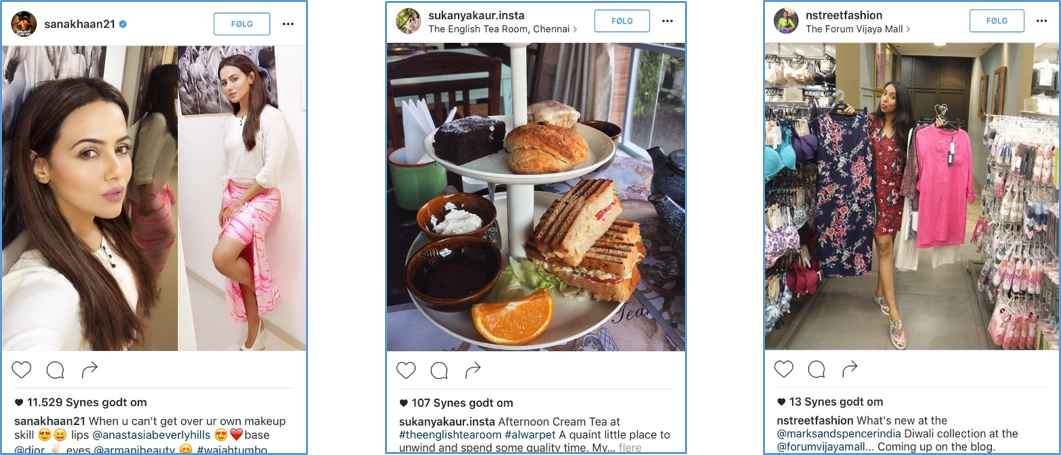
By now, everyone knows what Instagram is – the social media platform that enable its users to take pictures and short videos and share them in the app (and on multiple other platforms as well, but that is a completely different blog for another day). Nevertheless, a new day is on the rise… Instagram is not only hashtags and pretty pictures. Over the last few years, the app has evolved from a teenage forum where girls would hit like when their BFF uploaded yet another selfie, to becoming a platform of huge potential revenue when it comes to all sorts of business.
As of now, Instagram drives sales with a high average in orders, and according to Shopify, Instagram referrals actually results in an average order value of $65, which is second only to Polyvore’s $66.75. Even though most visits will not end up resulting in a purchase, the ones that do, will result in considerably higher revenue than other social networks –take for example YouTube’s $37.63 average order value. Another major piece of the puzzle is the number of active users, and seeing as the user base for Instagram in India alone is estimated to be almost 6 million active mobile users every month the question should no longer be “should your company have an Instagram Handle”, but rather “how do you maximize your income through your Instagram”? E-commerce, Fashion, Real Estate, Hospitality, Medical Care… you name it, every single industry can profit from Instagram, when used correctly. Read on, and we will make sure that you are fully prepared to dive into the ocean of endless possibilities by teaching you how to leverage Instagram to build relations that ultimately can help to drive conversion with this unique social media platform.
Just like the key to any good fairy tale is to start it off with “once upon a time” and end it with “and they lived happily ever after”, the key to crack the Instagram code, is your pictures. They are easier to digest than text, and they are more effective for evoking emotions, which will enhance the chances that your message will be remembered. When it comes to visuals on social, Instagram is supreme. You want to use images that drives sales, and studies show the first real data on Instagram’s capability to drive sales and perhaps more important, the essentials of a picture that boosts sales conversions. The University of Wisconsin conducted a study and learned valuable insights, which we are more than happy to share with you. Here follows a list, in random order, of what their study showed was important when it comes to what type of pictures that drives sales:
This knowledge can be seen as somewhat of a hurdle for some, since the elements that used to inspire engagement (likes and comments) are not the same as the ones that now trigger sales conversions. No need to worry though, this simply means that one must now use a mix of criteria when creating Instagram photos.
You can use multiple tools for Instagram including some focussed on e-commerce.
Posting user generated content is one of the most powerful ways to boost the credibility of your company. As consumers, we tend to perceive content originating from our peers as being authentic, because we trust that the everyday community has less of a vested interest in making a corporation look god compared to its employees. Keep in mind that consumer decision making is not always driven by price or quality, but in fact, a lot of consumers choose brands they associate with a lifestyle that sits well with them.
For example, if you buy a BMW, you are not just buying a car, you are buying into a lifestyle. Visual user generated content, which basically is the foundation Instagram is built on, is all the more impactful, as it allows us to see products being used in real-life situations, which again makes it easier for us to imagine ourselves using these products or services. So re-post your followers content if it aligns with yours, because not only does this help to create a bond with the consumer through shared interests, it also portraits the product in real life. The emotional bond that is created when using UGC is exactly why ads with this content converts better on Instagram than the refined studio shots created by professionals.
Another very important tool to use is to leverage the reach of influencers on instagram. It is a known fact that consumers are more likely to trust a recommendation from friends and family as opposed to a brand or a vendor. This is why it is good business for companies to use social media Influencers and user generated content to get the word out about their product, offer, service or whatever they wish to convey to their online audience. Influencer marketing has the power to drive sales, sign ups and app installs by using links and promotion codes which can be tracked. Tracking and analysing the data and ‘Call Per Click’ are numbers that are going to help you modify your spend in order to generate revenue from Instagram. Instagram also its own analytics tool now.
Determine what metrics you care to track and make sure you keep a weekly or maybe a monthly report to monitor your progress. You also have to take advantage of targeting since Instagram now has the same targeting, creative and measurement abilities as Facebook. It is up to you to use the features and get the best possible results from your Instagram ads and campaigns.
Brands are excited about the success they have seen with website conversion ads on Instagram and the potential the platform has to offer –and quite frankly, so are we! Tell us what has been your experience in using Instagram. Click here to continue reading blog articles around Instagram.
Facebook Marketing has become an integral part of any digital marketing strategy and it has revolutionized the way we look at the online marketing industry. Over the last 12 years, Facebook has seen a 360-degree shift, transforming from a simple social networking site to the face of a multi-billion dollar company allowing brands to find new customers, increase their sales, create brand awareness and much more. When we ran an industry survey amongst CMOs and Brand Heads across India we found that close to 90% Brands in India are already leveraging Facebook. Advertisers are spending more money than ever before on Facebook as it has emerged as one of the biggest platforms to engage with their target audience. Keeping this in mind, new features are being regularly added to Facebook and marketers have to constantly make alterations to their strategies to ensure their content is still reaching its target audience. Below are a few points that have been gathered keeping in mind the recent changes which may give us clues as to what 2017 will hold for both consumers and businesses. You may also find it interesting to read our book on Digital Marketing Insights for 2017, which can be purchased on Amazon.
Following the decrease in the organic reach of Facebook page posts last year, Locowise conducted a small study to analyze how page posting frequency impacts reach, engagement and negative feedback.
The study reveals that pages that posted once a week or less on their official page reached an average of 15% of the audience who liked their page per post. Interestingly, pages that posted two to four times a week reached only 10% of the page audience and pages that posted once a day reached a lower average of 8.42% per post. This means that organic reach drops with an increase in the number of posts, and over posting content is a common mistake marketers tend to make on FB. This also means that the quality of content and FB posts needs to be extremely high and we are likely to see many brands evolving into fewer but highly engaging posts.
Another study by social@ogilvy reveals that for large pages with more than 5,00,000 Likes, the organic reach has seen a remarkable decline when compared to other smaller pages. It is believed that marketing managers can expect the organic reach to further approach zero in the future. The detailed analysis and data interpretations along with the recommendations are available to read here in the full white paper.
The number of users on Facebook has doubled from 845 million to 1654 million over the last five years. There are more brands than ever who are joining the bandwagon of Facebook marketing and these brands are posting multiple posts every day. All of this creates more noise and unimaginable amounts of content that will simply be filtered out and never reach the news feed of a specific user. With so much information to be filtered, Facebook uses complex algorithms to pick and show content to users they are most relevant to them and those that they are most likely to engage with.So it can be assumed that increased brand post frequency is aiding in the drop of organic reach.
However, the only exception to this organic reach debate was seen in the news & media industry. The organic reach of news publishers seems to remain steady, even with a higher posting frequency. Here’s the result of analysis of 3,318 profiles, by Sotrender.
Videos are the next step in the social media evolution and will most likely dominate the online advertising and marketing industry. As per the stats by Facebook, users watch an average of 100 million hours of video every day and most of these are on their mobile devices. Daily views have increased from 1 billion to 8 billion in the last one year. These stats are proof that users have started consuming more of video content and it is essential that brands leverage this in their favor to engage with the potential customers. Video content is the best medium for storytelling and is a great opportunity for brands to connect with their audience.
Live videos were one of the major updates announced earlier this year by Facebook. This gave live videos prime placement in the Facebook app and also adds new ways to find, create, share, and react to them. This move efficiently makes live videos one of the central features of Facebook. Live videos offer a new way to interact on a platform that can feel so familiar that it risks feeling stale. Broadcasting live to your social circle gives you a certain thrill or even just watching a friend’s live broadcast, can bring in a fresh feeling of excitement and make you want to interact on the same old platform in a new way. On an average, Facebook says people are commenting 10 times more on live videos than they do on regular videos. This clearly means that brands must explore Live videos over recorded videos as this would help drive higher engagement levels with the audience. Facebook also rolled out an update where advertisers could add a video element for FB Carousel Ads. The shift towards video as a tool for marketing is evident and is definitely here to stay.
We also have an interesting blog on how to create low cost videos to tell your brand story – in case you are creating videos for the first time.
The fact that a business needs to have a mobile-friendly website is much talked about and is not a new concept. Last year, Google announced that, for the first time mobile searches surpassed desktop searches. This eventually led to a new situation where Google’s algorithm started to penalize sites that were not optimized for mobile devices. For the last few years, marketing experts have been stressing on the fact that there is an obvious need for businesses to optimize the sites for the ever-increasing number of mobile users. Facebook Inc announced that it has over 142 million users in India, of which about 133 million access the social network via their mobile devices. This means that a staggering 90% of users are using facebook on their phones in India. It is essential that marketers who are trying to engage with and attract potential customers in order to redirect them to their website, ensure that their website is mobile optimized and are able to leverage every micro moment of Indian consumers. In today’s Smartphone era, mobile-optimization is the norm and an essential item that can no longer be placed on the back burner to address later.
A few years ago, advertising on social media platforms was a very niche concept with not too many players in the market. In this new age of online marketing, many brands have become aware of the importance of ads across various social media channels, especially Facebook. Today, with the various targeting and advertising options on Facebook, we can reach out to millions of potential customers in any part of the world. Facebook advertising is a strong tool that can be used by brands to meet their marketing objectives.
Facebook ads allow you to choose from a wide range of possible adverts including but not restricted to Page Post Engagement, Clicks to a website, Conversions on Website, App Installs, Video Views, Lead Ads etc. Over the last few years, Facebook has evolved into a paid marketing platform more than an organic one so it is essential for marketers to leverage the power of the various adverts available. You can read our detailed guide on measuring ROI from social media.
In an attempt to make it easier for brands to reach out to potential customers and drive sales on mobile devices Facebook has started rolling out the Shop section in phases. This section allows a brand to list out their products and let consumers browse through the catalog and purchase products that they like from within Facebook. The social network does not charge you to add a shop section to your Page nor does it take any percentage of the money you make through it. In the upcoming year, more businesses will start selling stuff directly from Facebook as this new section is set to change the way we look at e-commerce and social selling. Ofcourse it also has had Product Ads for E-commerce companies for a long time now – these can be also be leveraged parallely.
We have left out Instagram Marketing from this conversation, as it warrants its own blog. We are also seeing some interesting developments around Instagram analytics and Instagram targeting going forward.
Do let us know what other features you expect FB to evolve in the coming months.
Not so long ago, Facebook took a plunge into uncharted territories by launching Carousel Ads. Though this ad type was initially meant to showcase multiple products in one ad, Facebook crafted a strategy for the Carousel Ads to tease e-commerce clients and make them buy more ads on the platform. But the Carousel Ads slowly moved across verticals, towards becoming one of the advanced Facebook Advertising techniques that is extremely engaging in promoting businesses.
According to a recent survey conducted by Kinetic Social, Carousel Ads can render up to 10 times more traffic to a business’ website, than static sponsored posts on Facebook. LOVOO found that they got a 72% higher click-through rate versus single image mobile app ads. Mirroring the effectiveness of interactive cover pictures on Facebook Pages, it appears quite clearly that these ads can be extremely effective, but how can you maximize their potential? Here are 3 simple ways to use carousel ads that can nail your targets with a bull’s-eye!
1). Showcase products in detail
Carousel Ads allow you to place up to 5 cards with images that can communicate messages effectively. If it’s a single product that you are highlighting, it would be prudent to describe its features in detail, keeping the CTR on an inclined angle. A ballet shoe manufacturer made effective use of showcasing a product, where each card of the ad focused on one distinct feature. They also used the headline copy to provide defined context to each image.
2). Tour your product
It always sums up to be a perfect formula when you try to deliver a good idea of what customers can expect from your offering. This will improve the quality of enquiries/leads, thereby increasing the probability of sales through Facebook. An automobile giant promoted one of its newly launched Coupé by creating an expressive Carousel Ad campaign that displayed features that made the car stand out from its competitors. The cards highlighted the key specs and of model and attracted genuine customers to engage with the carousel ad.
3). Tell a story
Stories are an incredibly effective way for branding, talking to customers, and engaging with them. A popular western airline company created an effective carousal ad campaign to market their vacation packages to The Grand Canyon. They infused a panorama of the location to tell a story that triggered people to book their air tickets to visit the location.
The Monetary Game
Can Carousel Ads be used as a solution to drive clicks to the website? We conducted a small experiment to test the hypothesis on the Clicks to Website Ads, for a glass manufacturing giant. Here’s how the results panned out:
In our view, with a little bit of testing and optimization to avoid common mistakes, the effectiveness of the Carousel Ads in driving clicks to URL destinations, is very cost effective. Have you experimented with Carousel Ads as a way to drive clicks to your business? We love to hear your thoughts and experiences in the comments below this post.
Facebook has announced that they will shortly be introducing product ads, wherein advertisers can showcase and promote multiple products and even entire product catalogs through ads on the social network. This seems to be great news for advertisers, especially for ecommerce companies as this will enable more products to be shown to a wider audience.
[caption id="attachment_16798" align="aligncenter" width="619"]
Quoting from the announcement,
“Product ads can be customized for use throughout the customer journey, from discovery/awareness through purchase. Here are some options:
Advertisers can automatically reach people who visited their website/app (via Custom Audiences), or reach people based on specific interests, locations, etc.
Advertisers can curate ads as they see fit. For instance, they can highlight products that were viewed on their website/mobile app or showcase best selling products. Or they can create a multi-product ad that highlights the different benefits of a single product.”
Advertisers can upload entire product catalogs and then use advanced Facebook Ads targeting techniques to reach the right customers who would be interested in those products.
We can’t wait to try out this new feature and share our experience on the results acheived. Do share your experience with it as well.
With Facebook deploying constant tweaks to its news feed algorithm, the reach of organic Facebook Page posts have dramatically dropped over the last 6-8 months and is going to drop further in 2015, as per Facebook’s announcement on the News Feed.
What this means is that Business Pages will need to constantly innovate to provide interesting and engaging content to their users in order to reach their News Feed. That being said, advertising and boosting posts is going to be a more significant aspect of every brand that wants to leverage FB. To aid in battling this scenario, we have compiled a list of lessons learnt that includes certain targeting techniques which can help you make the most of your ad campaigns, reaching more number of potential audiences with relevant messaging.
Building Custom Audience
Using a Landing Page to run Website Conversion Ads
Behaviour
Demographics
Interests
Creative / Images used in the Facebook Ad / Post
The digital space has seen a lot of discoveries recently, Real-Time Covers or Live Covers for Facebook being one of them. LiveCover.com is one of the first few companies to formally provide this interesting service to the brands that are present online. They offer a brand an auto-updating live Facebook cover that is based on some trigger. It is literally like bringing your Facebook Cover to life with live content & images, automatic refresh, dynamic & customized content and have it updated as often as every 1 minute! Fascinating isn’t it?
We certainly did find this service useful & interesting and ended up using it for one of our clients’ Facebook page which reached a milestone of 1,00,000 fans on Facebook. The idea was to showcase a Superhero on the cover image which would keep getting charged on receiving new likes.
This is how it looked in the beginning –
The trigger for the Facebook cover to update on its own was set at 200 likes. So every 200 likes, there was a new cover with the Superhero charging all the way up to achieving 1 Lac likes.
The idea behind using these live covers was to do something different for the fans and it was well-received by the audiences. The likes increased at a 2x rate and within 24 hours we were able to reach the mark of 1 Lac.
Live Cover served as a fruitful discovery for garnering attention from the audiences and also engaging them. In these times where every minute, there is a new digital trend, it becomes important to stay in the race and updated with these trends to unlock new parameters for brand building & extension.
According to a recent study by eMarketer, India records the highest social networking growth as the number of active social network users in the country has grown by 37.4 percent in 2013. Even though the overall internet penetration is low in India, the number of active social media users in urban India is expected to cross 80 million this year, as opposed to 63 million in 2013. From being online platforms solely used for social interactions, to becoming a significant part of the marketing strategy for brands today, the growth of social media networks like Facebook & Twitter has been tremendous.
Twitter joins Facebook in offering “Buy” button to directly buy on these platforms
As the pressure is mounting on these social media networks to prove that they are successful sales channels, they are constantly making efforts to modify & introduce new advertising options. The latest buzz is that Twitter is following the footsteps of Facebook in testing a ‘Buy’ button that will now let users shop from their social media sites itself, without having to navigate to the retailer’s website.
Facebook’s Buy Button – Convenience or Clutter?
Facebook officially announced in July about the testing of a ‘Buy’ button that would appear in newsfeed ads and page posts. As of now, it is only being tested with a few small and medium-sized businesses in the U.S.
This is not Facebook’ first attempt to crack e-commerce as they previously introduced the ‘Gifts’ feature which was shut down within a year. Even though the earlier attempts were unsuccessful, the team is keen on working on other commercial purchase features within Facebook, with ‘Buy’ button being the recent result of it.
This button is expected to provide an added level of convenience for online shoppers to buy products from merchants within the Facebook framework itself. The customer can use his credit card on file with Facebook and make purchases directly. The option to save your payment details or just checkout without saving is also available. However, Facebook claims that the entire functionality has robust safety & privacy options and won’t pass on the payment details to any of its other advertisers.
The main objective of introducing this functionality is to increase the conversion rates and the return on investments for its advertisers. Not to forget that this new development will put them in direct competition with e-commerce sites like Amazon, also providing a new avenue for Facebook to gain some revenues through sales and payment processing.
Will Twitter Commerce reveal your identity?
Two months after the announcement from Facebook, Twitter revealed about testing its own “Buy’ button to facilitate sales & increase revenue. This facility to make purchases directly from tweets is available only to a small set of consumers in the U.S as of now. It is now being experimented with selling limited edition merchandises, charities, and concert tickets and is expected to grow with more product options based on the initial testing feedback.
Launching on the mobile platform first, Twitter says the purchase process will only have few simple steps & is completely secure. The user can simply click on the buy button, enter product details, choose payment option, enter shipping details and make a purchase. This payment data used by the user can also help in revealing the real names & details of its anonymous Twitter profiles, a move that can be greatly beneficial for marketers. However, Twitter denied the possibility of this and emphasized on working with Stripe to make the entire transaction completely safe & private.
Here’s how the marketers can benefit
The previous attempts made by these social media platforms to explore e-commerce have not been so successful. Pinterest, the only platform to have topped Facebook in driving referral traffic to retailer sites has made promising developments, but still lags behind when it comes to investment & adoption. If the ‘Buy’ option proves to be highly beneficial for Facebook & Twitter, brands that focus on time-limited offers and on-off promotions have chances of getting high investment returns. However, the performance of direct ‘Buy’ button when it comes to high value products & the ones that need more research & time is uncertain.
Will privacy be a concern for the buyers?
Social media platforms have been playing a major role in influencing the decision making process of its users. These networking sites possess large amounts of data about their consumer preferences which helps them to come up with tailor made posts and promoted ads. The ‘Buy’ option to be introduced will facilitate the quick shift from a promoted post or tweet to a shopping cart which saves a lot of time & effort for its customers. However, privacy & security around financial data is something that these social networking sites are constantly trying to assure its consumers.
Future of Online Shopping is here
For both retailers and social media sites, the objective is to successfully merge online commerce with mobile & social activity of people, without obstructing their user experience with unwanted targeted ads filling their timelines. Hence, if the testing of ‘Buy’ button turns out to be successful, it would open a whole new avenue for these platforms to not only influence our social life, but our shopping patterns too.
While you are reading this blog, there are millions of people liking, sharing or commenting on Facebook. If you are a business entity who wants to build a brand, convey a unique message, propel your business to greater heights you got to know things you should avoid while marketing on Facebook.
The most common mistakes Facebook Marketers do that one should avoid are as follows:
F - Fail to completely fill the brand page
When you are creating a brand page, ensure you fill up all details like address, cover photo & contact information that is easily accessible by the visitor. If you are expanding to newer locations, ensure you enlist them in your page or best to create separate pages for each location branch. You also get brownie points if you share similar URLs for Facebook, Web & your twitter handle. You should not change the URL/Facebook page that maybe misleading.
A - Advertisement Budget Constraints
Unfortunately many businesses fail to leverage Facebook as a powerful & effective medium of advertising due to budget constraints. The tools are sophistically designed to track which ad is performing better over a period of time. Using particular & relevant keywords you can target the right audience and ensure. A creative ad should have high brand recall, influence buying decisions & be rewarding like (price discount) to ensure higher engagement and conversion.
C - Cover photo
A cover photo encapsulates the essence of the brand – the look and feel & what the brand conveys. While it should be attractive & relevant, you should take care to refresh it from time to time. What’s pivotal in designing your cover page is that you should abide by the Facebook guidelines. It should not contain –
a). The contact information like mailing address, contact number, email ID or web URL.
b). A call-to-action button asking them to “like”, “share”, “comment”, “invite your friends”; it is to be strictly avoided.
c). This is commonly seen among e-commerce client - Showcasing price discounts like “30% off on purchase of Rs.1000 & above”.
E – Elaborate Text
Research proves that posts with about 150 characters get about 50% more likes & traction in comparison to those long posts with 200 characters or more. So keep it short to get better engagement, by breaking the barrier. People like visuals better than content. Be conversational – ask questions & encourage participation.
B – Blind eye to Facebook Insights
“Facebook Insights link” gives you a wealth of information about how well is your page doing. Monitoring results of each post – reach, likes, source of traffic, most viral posts, paid vs. organic traffic in absolute and relative measures. By closely tracking the performance, it is undeniably the best tool to channelize your efforts in the right direction to maximize your results. This helps you repeat what has worked best in the past, what time is the best to post (peak traffic) & which of your posts has connected well with your followers. Ignoring Facebook insights is like taking your page to the Holy Grail.
O – Over-posting Content
The frequency of posting can have a major impact on the number of “new page likes” and “reach” of the post. Your followers would love to see an excellent post a day rather than many average posts. They may also “unlike”/ “unfollow” if it occurs as spammy content. Take care to respond to comments on each post & never ignore complaints from unhappy customers. They are unlike to return if they feel unheard or ignored. You can manage it better with Facebook Brand Page Manager app.
O – One size fits all content
Your brand can have different products and customer segments. Showcasing all your messages on one Facebook page will alienate your fan base, rather than engaging them. Instead of a one-size fits all approach, identify your customer segments and have dedicated spaces for them. Alternatively, use post targeting to reach only users who would find the specific content engaging. For example, if you are a real estate company with properties across multiple cities, target posts related to properties in Chennai to fans based out of Chennai and nearby cities only.
K – Connect at the best suited time
Most people work from 9 am to 7 pm. Hence it’s important to ascertain what time is ideal to post, to ensure it maximum reach to target audience. Try to understand your audience & ascertain when traffic builds up in your page. Your posts reach will be higher if posted at an appropriate time. Nothing can stop a creative post, well timed, go viral.
To know more you can visit https://www.facebook.com/page_guidelines.php
Forbes recently had an interesting article on 10 Time Management Tips for managing Social Media in Small Business
The tip that we find most interesting is "Focus on one tool at a time". We also believe that as you start on your social media strategy, it is important to excel in one social media tool initially and then expand into others. Moreover, one social media tool should be at the epicenter of it all. For some businesses Facebook is the epicenter, for some it is youtube or blogs and in some rare cases it is twitter.