How a business will progress heavily depends on how it's marketed, and in the 21st century, email marketing is one of the best methods. The invention of email marketing has eliminated the necessity to print out thousands of banners and posters, as it can reach beyond borders.
However, this doesn't imply that this comes free of cost and it certainly doesn't lessen competition. Every brand is leveraging this effective way of reaching out to people through which they're generating considerable amounts of conversion either directly or indirectly through this medium.
This can only be done if your emails can function as if they were words from a real human being, and if they could appeal to their audience. However, you can’t achieve this if your email isn't personalized.
Here we'll discuss how different templates can help you reach your target audience, and what sort of template will fit your company. Let's dive right in.
The abundance of retail stores in every town and city is the reason behind the hefty competition. Research suggests that the retail shops’ success depends heavily on the extra features or USP they offer, as in most cases, the prices and the products will be the same. So, the goal should be to highlight the USP alongside your products.
You can take multiple approaches, depending on your aim and target audience.
At some point, Real Estate emails used to be full of promotional content, but that doesn't "engage" people much. You can create engaging emails by adding information such as how great the neighborhood is, or how amatuer buyers can select a property offering that's just right for them.
Every business is trying it’s best to adapt to the dynamic market, and that's why the necessity of regular internal and external communication is more significant than ever. Here are some tips on how you can curate some effective newsletters.
Who says business newsletters can't be colorful? Some of the best newsletter templates are super colorful. You can create some colorful newsletters for your email marketing campaign, which will differ from the usual and generate clicks and sales.
Fashion newsletters are a great way to attract your audience and to generate revenue. You can forward your best collections, or even the clothes you need to get off your inventory through these emails. However, this is often ignored, and people find their inbox spammed with hastily drafted fashion newsletters.
On the other hand, you can also go wild and use different fonts and colors. This depends on what sort of products you're advertising and who your target audience is.
Getting your audience to sign-up for your service is one of the hardest things to do, but it can bring you many benefits and of course revenue. However, these types of letters perform great if they're personalized. A personalized email newsletter can perform twice as well as any general mail; that's why you should focus more on making them personalized.
A welcome email is an excellent way of getting your customers hooked up to your service or business. Usually, these emails are collected when they make a purchase. If they receive a welcoming email after their purchase, they may feel connected to your business. If you can make this happen, they'll be inclined towards signing up. Use the font and theme for such emails according to the items the consumer is inclined to purchase. Doing so will enable you to personalize the email to the most significant degree.
If you're unable to filter your email list based on gender, you should opt for newsletters that speak to both. You can do so easily by adding an equal number of products for both men and women patrons, and if these products appeal to them, they may consider signing up for more.
Making one of the best newsletter templates for signing up is by emphasizing what's in it for them. A person will surely sign-up for your newsletter if you can convince them that it'll benefit them. This type of newsletters should always be listed for more readability.
Body care and health-related businesses took to online platforms recently, but you'll surely fall behind if you don't invest in this, as the other companies have already gone all in. You can make such newsletters engaging with the following newsletter templates:
Using the color green is an excellent way of making the best newsletters relating to body care and health-related products, as green speaks for a healthy living. However, that doesn't mean that you can't use other words. For instance, if you're promoting a product that contains lavender as a particular ingredient, you can use violet as the theme color, which is a more relevant idea than using green.
Apart from just promoting your products, you can offer different tips as well. These tips can be on making DIY products, healthy snacks, or you can survey the necessity of certain products and desires for updating your inventory and approach.
The only limiting factor in making the best newsletter template is your creativity. There's no set rule of thumb at play here. However, you can follow the tips mentioned above while making a newsletter for your email campaign. Remember that email marketing is one of the best methods of getting the word out, so you should never rush on this. Take some time to consider the message of the newsletter, the target recipients, and what you plan on achieving through this. Answering these questions will allow you to create the best newsletter templates for your email marketing campaign.
John Davier
Content marketing guru at Mailmunch. I’m passionate about writing content that resonates with people. Live simply, give generously, stay happy.
After a core update at the start of the year in January, Google has announced the next update to its algorithms early this month, on May 4th. Each update affects Google’s search algorithms and is released with the intention to present information that is relevant and authoritative for any search result.
With COVID-19, many industries have seen a decline because of the nature of their business, while others have seen an increase. This has resulted in a significant shift in the way users search for queries online as well. This is why Google has chosen to rank certain categories higher in its latest update. This will allow relevant content to appear to match searches during these uncertain times.
For example, the search for content related to news, health, and online communities has shot up, while categories like travel, sports, and live events have seen a drop. Google’s latest update accounts for these shifts and the change in algorithms strongly affects Search Engine Results Page (SERP) volatility.
The core update that was announced in January also affected SERP volatility, but May’s core update displays a peak in these rates, which is illustrated in the graph below.
It is important to note that the update also affects thin content, as well as old content which has not been refreshed in a while. Such items will be ranked lower by Google’s algorithm update. But if there has been a change in rankings for the entire industry, there is no guarantee that implementing changes will help increase the position of the content in SERPs. Featured snippets have also been impacted with the update.
Users may recall that in September 2019, Google announced a core update that resulted in a similar outcome which changed rankings completely. A key difference was that YouTube videos began to outrank Wikipedia pages. So this is not the first time something of this sort has happened.
Since the core update reflects the direct impact industries have witnessed throughout these last few months, the same industries have experienced a win or loss with this unprecedented change.
For example, news has become paramount during these times. People across the world are trying to stay informed on COVID-19, as well as the impact it has had on various spheres of our normal lives. Information on health and medical research is also being widely consumed. And with people restricted to their homes, the number of hours online have shot up as well. Users are spending more time on different social media platforms, streaming services, and other categories of entertainment. Thus, these are the industries that have benefited most from the update this month, with news coming out on top.
Other industries have not fared as well. Travel and real estate have seen a dramatic drop, and this is reflected in the results of the update as well. Similarly, live events and entertainment, autos and vehicles, tech, and fitness, among many others, have taken a big hit. Many websites are reporting a significant drop in traffic, which is likely due to the change in the SERP algorithm.
Because marketing during COVID-19 is already in a state of flux, it is important to stay up to date with these changes and implement corrections accordingly. This can make keeping up with competitive SERPs easier. However, it might make more sense to wait until the market picks up for industries currently experiencing a decline in demand and engagement.
Quite possibly no other component of digital marketing has been as subjected to the imaginations of conspiracy theorists as SEO has. Almost every year, new claims come out about the death of SEO which are then consequently debunked by experts in the field. But this time, the assertion isn’t coming from marketers pushing for more PPC campaigns, but from concerned content creators themselves.
So why are experienced professionals in the field worried that 2019 could signal the death knell of SEO? Here are a couple of factors that might explain their fears.
With every SERP feature that Google adds, click-through-rates take another dip. In the past, if a user were to search for the weather, they would have to click on a result, enter the website and look for their answer on the page. But now? The search results would look something like this:
This feature is great for users who can now get their queries answered faster, but for a website? Not so much!
These new features don’t just affect broad searches but long-tail queries as well. A first-time real estate investor, for instance, might search for ‘how to calculate stamp duty’ to clear up their questions on it. When they do that, Google will present them the answer neatly packaged in this featured snippet:
If you are wondering how to get the coveted featured snippet. Here is an interesting video:
Since the user already has the answer to their question, they might not feel the need to actually click on the website. What this means for content creators and website owners is that while their search rankings might improve, overall organic traffic to the website might not grow proportionally.
Businesses, understandably, want users to visit their website for all information related to them. This is especially important for local businesses such as restaurants and cafes since purchase intent is typically higher for local searches. However, Google might be hoarding most of this traffic for itself. If a user searches for cafes or restaurant, for example, their search results today looks very different than it did just a few years ago. In the past, they would see a restaurant listing when searching for ‘Chinese food near me’, click on the website link that appealed to them and check out the menu and contact details on their website.
Today, while they will still see restaurant listings, clicking on one will take them to Google Maps and not the restaurant's website.
Of course, a user will still be able to utilise the information provided by Google to visit the restaurant or make a reservation (and thereby convert into a customer). But a business’ website might have less reach and decreased organic performance.
For the last few years, a mobile-first approach to SEO (and almost everything related to digital marketing) has been adopted by marketers everywhere by implementing strategies like AMP. The number of mobile users and mobile searches have also been on an upward trajectory in the last few years, underlining the importance of mobile SEO. However, recent statistics about the nature of mobile searches have emerged, making marketers wonder if mobile SEO still has the same ‘do-or-die’ effect that it did a year ago.
According to Rand Fishkin of Moz, mobile no-click searches have grown by 11 percent, almost 2.5 percent higher than no-click searches on desktop. With these seemingly gloomy numbers, it’s no wonder that websites and brands are worried that they might be losing out on a chunk of their organic mobile audience.
Voice search can be interpreted as both a boon and a bane for marketers. On one hand, it’s a growing new platform to make their brand more visible to users and one of the biggest digital marketing trends of 2019. On the other hand, no-click searches are most prevalent on voice search. For brands and marketers, this poses a unique conundrum: is voice search worth ranking for or will it provide absolutely no value in terms or traffic and brand awareness?
The simple answer to that question is, no. With SEO, when one door closes, another opens. There are certainly many facets of SEO that are dead or dying today, but that has always been the case since its inception. As users, platforms and Google’s algorithm evolves, SEO needs to adapt to keep up.
Instead of getting bogged down by all the alarming statistics being thrown around about the end of SEO, marketers should instead focus on realigning their SEO strategy in the following ways.
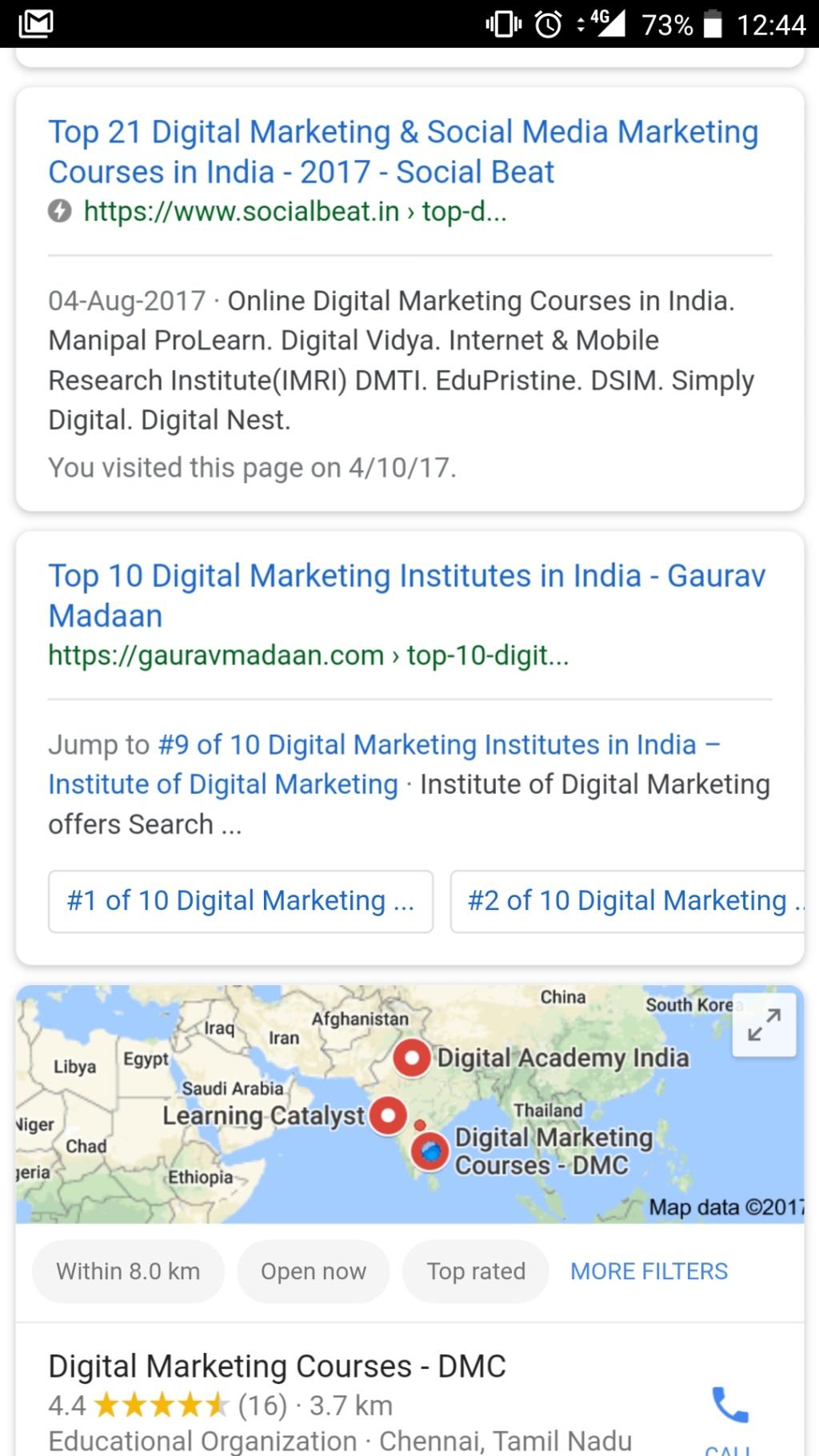
If there’s one keyword that Google cannot steal traffic from, it’s searches for your brand. For example, if a user were to search for just ‘digital marketing companies in India’, Google would first list out map listings of companies.
However, if they were to directly search for ‘Social Beat’, none of Google’s SERP features would show up to distract them from clicking on our website.
Going forward, therefore, brands need to focus on building the strength and volume of branded searches if they want relevant traffic on their website.
Most keyword research today consists of analysing keyword volume and difficulty alone. But with the new SERP features, high volume keywords don’t necessarily guarantee high traffic from them. To counteract this, content creators should include a third dimension when choosing keywords to optimise their content with: CTR percentage. By carefully choosing a keyword that has a high click-through-rate, content marketers can be assured that they will be creating content that will drive organic traffic to their website and not just adding to Google’s no-click search percentages.
You can do a simple CTR analysis through most keyword research tools. In this example, we used Ahrefs to dig deep into our focus keyword, ‘digital marketing blogs’. According to the results that the tool gave us, this keyword is worth trying to rank for as 65% of those searching for the keyword have clicked on a result.
In the case of SERP features, content marketers are better off following the adage, ‘If you can’t beat them, join them!’. A featured snippet, can either steal traffic from your website or increase it depending upon how you tailor your information for it. If a user can get all the information they require for their query from the snippet without having to actually click on the link, chances are they aren’t going to visit your website. But if you can offer users just enough information and intrigue them so they click on your link to read more, then the featured snippet can be the most powerful tool in your arsenal to drive traffic to your website.
For example, if a user knows that this list includes 10 mobile wallets, but the snippet only displays a few of them, they will be more likely to click on the link to read the full list.
Creating 10x content and using long-tail keywords have always been the cornerstones of modern SEO, but they were never more important than they are today. The goal for content marketers today is to create in-depth content on nuanced topics that cannot be pigeonholed into any of Google’s SERP features. Essentially, the longer a keyword is, the greater the chance of your actual website ranking for it and not an answer box or any other feature.
Even if parts of your content can snag a featured snippet, it should offer your audience several useful elements that they need to click on your link to explore. The demand for interactive content is on the rise and thankfully, Google hasn’t found a way to display interactive tools directly on SERP yet. Tools like calculators, interactive maps, planners and more can drive organic traffic to your website and offer immense value to your readers.
If SEO is dying, then the one thing offering it CPR is pillar content. This unique comprehensive content format has created waves in the SEO sphere, promising almost an instant surge in traffic and even several high-quality leads. The secret ingredient that makes pillar content so powerful is that it is linked to several related articles within your blog, providing instant link juice to each of them. Because of this, organic traffic to your blog and overall website improve dramatically.
For example, we created a pillar for our client Shriram Properties on ‘A Complete Guide for First-Time Homebuyers in India’. Within a matter of weeks, it started ranking for over 1000 keywords in total and for 100 keywords on page 1. Achieving similar results for a regular page within such a short time span would have been close to impossible with a regular page.
If there’s one thing that has stayed constant in the ever-fluctuating landscape of SEO, it’s that meta descriptions and titles can make or break your organic traffic. These two elements are the simplest, yet most crucial aspects of SEO. If all your hard work has helped your content reach Page 1, but the title and description aren’t compelling enough for users to click on it, your traffic is unlikely to show any improvement. It is also important that content creators don’t get disillusioned by the variety of SERP features available today. A study by Ahrefs found that featured snippets get only 8.6 percent of clicks, while the next result gets 19.6 percent of the clicks!
So even if your brand has lost out on the featured snippet, it doesn’t necessarily mean that your organic traffic will drop because of it.
Instead of putting all your eggs in a single basket, barnacle SEO offers you a way to spread your chances to drive more traffic and increase brand visibility. Today, ‘aggregator sites’ are more visible on Google than they ever were. These sites, for example, Zomato, Urban Clap and Little Black Book, list companies and services on their website. If a user were to search for best massage parlour in Chennai, their search results are most likely to throw up aggregator sites and not individual massage parlour websites.
Is this disheartening for individual businesses? Not necessarily. Trying to compete with aggregator sites will be a David vs. Goliath situation since these sites are typically larger and have a higher domain authority. Instead, businesses should try to get featured on aggregator sites to make their target audience aware of their brand and increase traffic to their website. Getting featured on a compilation can also increase the brand’s credibility in the eyes of the user.
With all the panic about Google’s CTR shrinking, many marketers tend to forget the second largest search engine in the world: YouTube. YouTube is beneficial for marketers for two reasons: 1. It’s a new platform to reach out to users and 2. It can help brands rank on Google as well.
The number of subscribers and video views on YouTube is growing exponentially - particularly in India. If you are finding it challenging to rank for a relevant keyword on Google because of high competition, YouTube could be an excellent way to circumvent this. You can read our in-depth blog on YouTube SEO Tips: The Secret Sauce to Ranking Your Videos to get started!
The second reason to optimise your videos for YouTube is just as important. One of Google’s SERP features is video listings pulled from YouTube that are related to a search term. If your brand is able to create a video that also ranks on Google’s SERP, then you will automatically be able to increase visibility and awareness of your brand.
This strategy is a great way for marketers to beat Google at its own game and use SERP features to their advantage.
You can also check out our video on 'YouTube SEO: 8 Powerful Tips to Help Rank Your Videos'.
Voice search can be viewed as a disruptor or facilitator, but one thing’s for sure: marketers cannot afford to ignore it. Here are just a few incredible statistics on the growing importance of voice search:
To avoid being left behind in the voice search wave, marketers need to optimise their websites and brands to appear for voice queries. This can also help them reach out to new internet audiences, those who are from tier 2 and 3 cities and are more comfortable using voice than typing out a query.
If there’s one thing that hasn’t changed, it’s that content marketing backed by continuous optimisation still has the highest ROI compared to any other type of campaign. By getting an early head start and implementing these elements in your content strategy before your competitors do, you can cement your position on Google’s SERP and gain a high content marketing ROI.
Page loading speed and mobile-friendliness have been among the most important Google ranking factors. To combine the two, Google has worked towards making mobile pages load faster with the help of an open-source framework which is called AMP (Accelerated Mobile Pages). AMP is considered to be one of the best ways to build good web pages that rank on Google and drive higher organic traffic. With the success of mobile AMP, Google developed other versions like desktop AMP. The most recent innovation with AMP involves a platform people spend a considerable amount of time on: the email.
AMP in email is offered by the Gmail Developer Preview. This helps developers in creating a more engaging and interactive email experience. Here are some of the advantages of AMP for email.
Completing actions with the help of AMP will be much faster, like sending RSVP for an event, scheduling appointments, or simply filling up a questionnaire within the email message.
AMP helps in keeping information of the email relevant and content accurate so that emails don’t become stale. This also makes it easy to keep information updated. A simple example would be confirming an account on a website, with the help of AMP for Emails one can access the confirmation page instantly without having to open a new tab. This makes the overall process more efficient and time saving. This new update also offers a preview for websites like Booking.com and Pinterest within the email.
To optimise your page for a faster load time check out Google PageSpeed Insights.
AMP-powered email has potential that can be beneficial for email marketing, because the engaging content can increase CTR while also generating more interest when compared to a regular email.
Content marketing benefits from this update, as users can receive and access content on their email itself. This again improves the users experience making going through emails a more pleasant experience. This holds true even for users accessing emails from their mobile device.
To make the most of your email campaigns, check out our blog to know more about How to build a strong email marketing database.
Companies are working on creating new customer experiences by using AMP for emails. Adding this functionality to emails helps in eliminating the need to open a new tab to finish the task; instead it can be done within the email itself.
The new format of AMP for Emails is supported by Google’s Gmail, Microsoft’s Outlook.com, Mail.Ru, Verizon owned Yahoo Mail to list a few while it is open to other providers as well. With security and protection of personal information becoming increasingly critical lately, Google has taken several measures to safeguard this. This is why companies creating dynamic emails will need to seek approval from Google first.
Companies which have already started supporting this format are:
The format supports AMP features like carousels, lists and forms among others, while also including the standard HTML markup for email clients supporting AMP. Google has brought in other partners who will also support the AMP for Email on their respective platforms as well. Some of these partners include:
AMP for emails is a much needed update for emails making them more engaging and interactive. This update for emails opens up opportunities for content creators as well as advertisers to roll out fresh content for email marketing.
Digital media is changing the landscape for marketers everywhere, especially in the FMCG sector. Traditionally, campaigns for every FMCG product would depend upon determining the right marketing mix of the 4 P’s (Product, Price, Place and Promotion) that would best influence the target audience’s purchase decisions. Today, however, consumers are making buying-decisions differently and with this, strategies aimed at impacting this process need to evolve as well. Covid 19 only accelerated this trend even further with purchases via market places, apps and direct to consumer brands has increased.
Consumers now are exposed to their phone and laptop screens more than they are to traditional media like television, newspapers and billboards. There are also a growing number of consumers who prefer to shop online for FMCG products rather than visit a physical store. According to a report by Google and Bain and Co. $11 billion, or two-thirds, of the total sales in beauty and hygiene products will be influenced through online marketing. In today’s digital era, a strong full-funnel digital marketing strategy is indispensable for FMCG brands
Digital marketing for FMCG companies doesn’t mean retiring the tried and tested 4 P’s which formed the holy grail of marketing for years. Instead, it involves tweaking the marketing mix for FMCG products to bring them into the current era. Digital marketing trends in FMCG allow marketers to not just capture the consumer at the final buying stage, but also to establish a relationship with them from the start, something that was not possible before. This requires marketers to formulate a holistic FMCG digital strategy to not just influence their consumers, but also to personally engage with them.
Quick Tip: We recently published a book on wading through digital marketing, grab a copy of Decoding the Digital Jungle
Incorporating a strong digital marketing strategy in the overall marketing mix offers many clear advantages to brands.
The FMCG sector is marked by a large variety of similar products, which offer consumers a wide range to choose from. One of the biggest advantages of having an effective digital marketing strategy in place is that it helps brands create a unique brand identity. This helps consumers form a strong opinion of the brand, which will ultimately influence their purchase decision.
In traditional marketing for FMCG, the product display was considered one of the most important factors which influenced purchase decisions. Consumers are visual creatures, so the more attractive your packaging, the higher the chance of it being noticed by them. In much the same way, digital marketing for FMCG companies can be approached as a virtual shelf display. It is even more effective than a physical display because it helps you reach your specific target audience, making your overall marketing strategy more cost-effective. This enables top-of-mind awareness, which can influence purchase decisions. Like physical shelves, digital marketing also allows you to position your products contextually. Through tools like AdWords Smart Display, you can showcase your products while consumers browse through similar categories. For example, if you are a skincare brand, you can display your ads next to beauty blogs your consumers are browsing through.
Often, your product's own website is one of the best ways to showcase your brand because you have complete control of a user's experience on it. Anmol, a household name in the northern and eastern regions of India, wanted to upgrade their website. We completely did away with the old, lifeless website and gave it a fresh new look that was as vibrant as their products. Our UX, content and design teams adopted an out-of-the-box approach that had a generation-wide appeal, complete with interactive elements, engaging language and quirky designs.
Read about the full journey here: A Young and Vibrant Website for One of India's Most Loved Biscuit and Cake Brands
One of the biggest advantages digital marketing has over traditional marketing is that it helps you track every facet of your marketing efforts. FMCG brands spend large sums on hoardings, TV commercials, print ads, radio ads and more. However, the results of these campaigns are very difficult to measure effectively. While speculative figures can be produced, there is no way to arrive at a definite conclusion.
Digital marketing, on the other hand, helps you track and measure every aspect of your campaign. With the help of analytic tools, brands can recover information about number of impressions, clicks, conversions and more. It also lets them find out exactly which ad prompted the consumer to make the purchase. Advanced analytics can even let you gain deep consumer insights. This can help you create campaigns and content that your target audience will actually find engaging. With the ease of tracking digital marketing offers, FMCG brands can refine their strategies and make it more cost-effective.
Offline purchases might still form the bulk of FMCG sales but the future belongs to mobile phones. Mobile phones and high speed, affordable internet have penetrated almost every section of the Indian audience. A significant portion of Indian consumers are shopping for FMCG products online through various apps and this number is only going to grow. Digital marketing trends in FMCG need to keep up with the increasing volume of customers who prefer to shop online.
Via seosolutionsindia.com
One of the biggest areas of growth in mobile usage will be in tier 2 cities and small towns in India. FMCG brands need to stay up-to-date on the constantly evolving digital marketing trends in these tier 2 and tier 3 cities. Unless brands solidify their FMCG digital strategy now, they are going to witness severe drawbacks in the future.
Digital media offers a number of streams for FMCG brands to market themselves. These various platforms also help brands meet a number of marketing objectives, right from creating awareness and brand building to driving conversions and cultivating brand loyalty.
For a long time, the focus of marketing strategies for FMCG brands revolved around a one-way promotion of their products. Today, however, digital marketing trends in FMCG are shifting the focus to creating user-centric content that brings actual value to consumers’ lives. By creating informative content, you can drive conversation among your consumers and build strong communities. Having a solid community is crucial to developing a loyal consumer base. Digital marketing can help strengthen your brand’s community through a number of innovative content marketing strategies that work.
Clever use of content marketing is essential because it helps establish your authority in the space. For example, Johnson & Johnson created BabyCenter.com, a website for moms to share information and engage through helpful forums. While not overtly a part of Johnson & Johnson, all ads displayed on BabyCenter.com were for the brand. This allowed Johnson & Johnson to build a strong community of moms they could tap into to sell their products. This kind of user-focused marketing is unique to digital marketing and helps brands promote their products more effectively than ever before.
Another facet of content marketing that is essential for FMCG brands is creating SEO-friendly content. Incorporating a strong SEO plan as well as including strategies for content amplification is crucial because it drives consumers to your website, enabling them to become more aware of your brand. Keyword-optimized content also helps consumers find you when they have a query, which goes a long way in establishing your brand’s credibility in that domain.
Facebook is undeniably one of the biggest avenues for digital marketing. Through advanced tools for social media analytics, you can find your target audience, refine your marketing strategy and even drive conversions. The Facebook custom audience tool can help you widen your target audience and reach them through your campaigns. FMCG brands can also use Facebook to get deeper insights into consumer behaviour. For example, Raaga Professionals innovatively used an audience poll on Facebook to simultaneously understand the needs of their consumers as well as advertise their products.
However, your consumers aren’t using only Facebook and as a brand, neither should you. Digital marketing for FMCG brands needs to be integrated over various channels to have the maximum impact. This includes ads which play before a Youtube video, promotions through Twitter, Instagram posts and much more. Effective digital marketing for FMCG even includes SEO-friendly content, so your brand shows up when consumers search for a related need. With an increase in the number of FMCG products showing up online, Google Ads are also another important avenue for FMCG marketing.
Videos have emerged as one of the most consumed forms of content. The massive growth of platforms like YouTube and TikTok are testament to this renewed interest in video content. Because of this, any successful digital strategy for an FMCG brand should include a strong video strategy. One of the main advantages of using videos for your product is the unlimited room for creativity it offers.
For our video campaign for Wonderchef, we broke away from the stereotypical product-centric video formats and instead tried to explore video concepts that could spark a conversation among our audience. One insight that came out was that the kitchen was traditionally considered a 'woman's domain' and a lot of men were unaware of even the basics of cooking. In order to highlight this inequality and to encourage men to take up more responsibilities in the kitchen, we created the 'Dear Man Hold the Pan' campaign. In this video, we asked a number of men in Mumbai basic questions about cooking. Expectedly, most were unable to answer and many gave downright hilariously wrong answers. This video put forth a strong social message in a humorous way and quickly went viral on social media.
Traditionally, FMCG advertisements were a one-way interaction, with brands informing consumers about their products over TV commercials, radio spots and print ads. Advertising was done mostly when there was a new product or service to promote. Buying space in traditional media is expensive and only allows for a one-way communication. This is why brands were unable to consistently engage with their consumers.
Digital media is changing all of that permanently. Digital marketing has a clear edge over traditional marketing when it comes to generating user engagement. Digital marketing trends in FMCG products are aimed towards establishing your brand as a constant presence in your consumers’ lives. Through shareable content, helpful information and meaningful interaction, brands can continue to stay relevant at all times. This helps consumers recall your brand at the time of making a purchase decision. Whole Foods, for example, utilised chatbots in their digital marketing strategy to engage consumers and direct them towards completing a purchase.
Influencer marketing is proving to be one of the most important digital marketing trends in FMCG. Through the use of influencers, your brand can tap into their huge number of followers and increase consumer awareness of your products. Influencer marketing is also very useful for FMCG brands because consumers are more likely to believe in the credibility of your brand when an influencer whom they trust recommends it to them.
A one-size-fits-all marketing campaign is no longer effective for FMCG products. While email marketing in general keeps your consumers updated on latest products and promotions, drip emails in particular are a groundbreaking way to personalize your marketing tactics. Drip emails, also known as automated emails, are a set of emails that are sent to consumers based on a specific set of parameters. For example, there will be one email that is sent to consumers when they first sign up, one that will be sent if consumers add products to their cart but leave without completing the purchase, one that will be sent after a purchase is made and so on.
Via chasenewmedia.com
Drip email campaigns are one of the most effective lead nurturing strategies. These automated mails can target consumers at a number of different stages, ultimately guiding them towards making a purchase. This technique can prove a very effective step in digital marketing for FMCG companies by helping influence the consumer decision making process. Automated emails which are sent when consumers abandon their shopping carts are particularly effective, because it pushes the consumer to complete the purchase. Drip emails also help you retarget consumers who have already purchased your products. Research show that consumers who have purchased your products in the past are more likely to do so again in the future.
While this may sound self-evident, not many FMCG products actually sell their products online. To this day, even if FMCG advertisements are being displayed on digital media, their marketing efforts are aimed at influencing the consumer’s in-store purchase decision. But with the launch of many websites that let you purchase FMCG products online, an increasing number of consumers are beginning to shop online. In this case, even if a consumer has every intention of purchasing your product, they will choose a competitor’s product if yours is unavailable online. FMCG brands can choose to sell products through Amazon and Facebook or similar sites to increase sales.
Selling products online also gives you the advantage of being able to reach consumers beyond a limited geographical location. For example, a local makeup brand can start selling their products nationally by making it available online. This ultimately increases the consumer base for FMCG products, a key factor in eventually increasing sales. With a few simple steps, selling online through Amazon and other sites is a very easy way for FMCG brands to increase their online presence. For example, Raaga Professionals, a personal care brand, sells their products through Nykaa. In this way, their content marketing through blogs can direct consumers to a clear point of purchase.
For most FMCG brands, tier 2 and tier 3 cities offer the next big avenue for growth. At the same time, most consumers in these areas are becoming more digitally connected. While the number of English-speaking users online has more or less peaked, regional language users are only going to grow from here. This has been facilitated in a huge part by the dual penetration of mobile phones and internet connectivity in India’s smaller towns. A study conducted by Google and KPMG estimates that the number of non-English speakers using the internet will grow by around 18 percent annually. Additionally, 99 percent of these users will access the internet primarily through their mobile phone. For FMCG brands, this offers a huge opportunity to leverage digital marketing to attract this new wave of consumers. The growth of regional content online will be one of the key factors that can influence FMCG sales in tier 2 and tier 3 cities.
Cavin’s Milkshake is one of the top-selling dairy-based drinks sold by the parent company CavinKare. These milkshakes are sold in single-serving sized tetra paks, and are known for their delicious flavour variants and high adherence to quality standards. Cavin’s is also one of the best examples for a well-thought out digital marketing strategy. Through the use of creative and engaging posts over social platforms like Instagram and Facebook, Cavin’s was able to successfully utilize social media for their brand building efforts.
Cavin’s Milkshake maintains an active Facebook profile, with funny, creative posts that attract a large number of comments and shares. They also have a very large, vibrant community on Facebook who actively engage with the brand by writing positive reviews on their page and interacting with their posts.
Cavin’s Milkshake is a staple in most school canteens and the product brings back a flood of nostalgic school memories. The #JustHighSchoolThings campaign for Cavin’s stuck to the same theme, by associating the brand with school memories most people have in common. The campaign showcased the most common characters most of us were familiar with in school such as ‘The Geek’ and ‘Cutest Couple’ through Cavin’s Milkshakes. These posts were very popular throughout social media, garnering a high reach and number of audience reactions. What is most noteworthy about these posts is that they have performed well organically, proving that excellent content is the most important aspect of digital marketing for FMCG companies
Cavin’s Milkshake utilized Instagram extensively for brand-building. Through the use of striking visuals, their posts on Instagram were able to generate high levels of engagement from their followers. Their Instagram posts involved the clever use of popular memes, special events and engaging artwork tied in with their products. In this way, digital marketing for FMCG companies can help keep brands relevant by immediately cashing in on the latest trending topics.
Instagram was also an important channel for Cavin’s to rope in their followers and build a strong community. With the hashtag #Cavin’sSuperstar, each month, Cavin’s Milkshake showcased one of their followers and asked them a few fun questions about their love affair with Cavin’s. This was an excellent social engagement technique to foster brand loyalty and encourage participation.
Cavin’s Milkshake was able to successfully utilize influencer marketing to reach moms who would ultimately purchase the product for their children. One of the key influencers roped in for Cavin’swas RichaChoudhary who runs the blog All That’s Mom. As part of the influencer marketing campaign, RichaChoudhary wrote a blog post on Cavin’s Milkshake, along with 2 social media posts on Facebook, Instagram and Twitter, plus a short video for Cavin’s. These posts performed extremely well on the blog as well as on social media. Through the innovative use of Cavin’s Milkshake in recipes as well as her posts on how much her child loved Cavin’s Milkshake, the product developed a positive brand perception from her huge follower base.
Apart from macro-influencers, Cavin’ Milkshake also worked with a number of micro-influencers on Instagram. These micro-influencers put up a number of posts where they talked about their positive experiences with the brand, used it in recipes and recommended it to their followers.
Through the innovative use of various social media platforms, Cavin’s Milkshake was able to build their brand identity and reach out to their consumers.
The perfect marketing mix for FMCG advertisements involves a customized combination of digital and traditional media. Developing this unique mix requires a deep understanding of your consumers. Consumers often use their phones and laptops in tandem with other forms of media. For example, they might be browsing on their laptop while watching TV or checking their phone while listening to the radio in their car. This is why digital marketing for FMCG companies also need to develop strategies that effectively blend both these channels. With campaigns and FMCG advertisements that are spread over multiple platforms, brands can develop consumer awareness and influence purchase decisions.
If you are looking for the best digital marketing agency in Mumbai and best digital marketing agency in Bangalore and Chennai, reach out to us and grow your business.
If you’re trying to successfully drive traffic to your website’s blog page, getting to the top of Google’s search results is your biggest task. However, if you thought ranking at the number one position was the ultimate goal, you now have a new contender – the Google Answer Box or Featured Snippet.
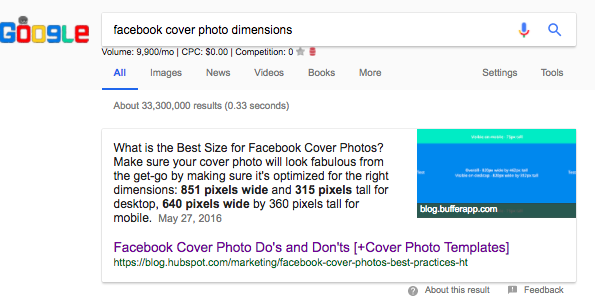
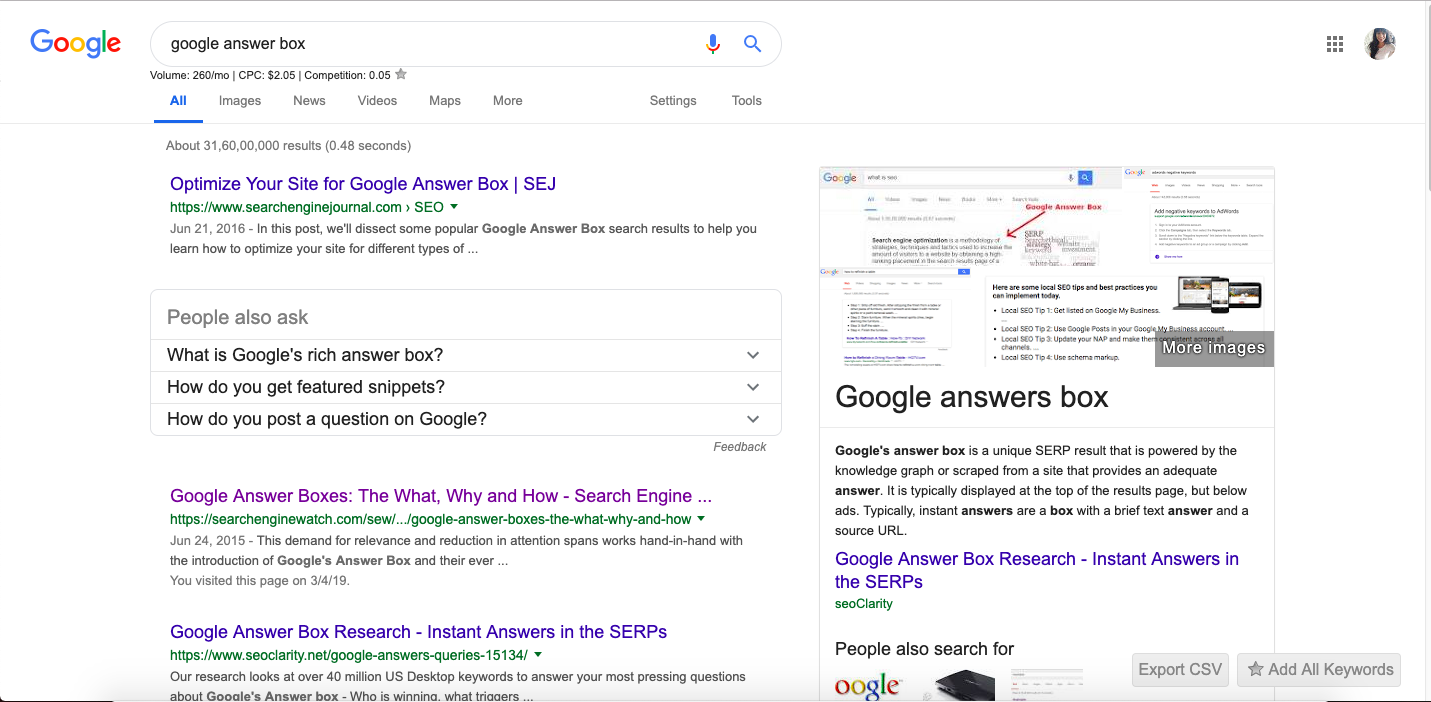
Google introduced its new Answer Box feature in 2015. Referred to as the Google Answer Box or Rank 0 or Featured Snippet, this feature is a box you see above all search queries on Google. The Answer Box provides users with quick and easy answers or “snippets” of information. These answers are selected from content that ranks on page one, but not necessarily Position One.
Google Answer Boxes are not only convenient for users who are looking for answers, but it is also an excellent opportunity for brands to gain more page visitors, as Google Answer Boxes get a 2x higher click-through rate and steal most of the organic traffic on the internet.
Before we dive into a few more details, here’s a quick video on the benefits of Google Answer Boxes and how you can rank for them.
Before we get into how you can optimise your content to get a Google Answer Box, let’s take a look at the four different kinds of Featured Snippets.
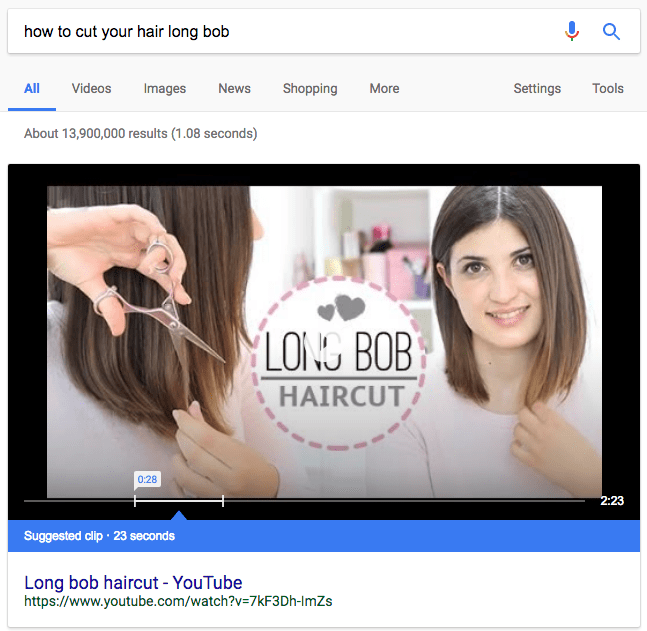
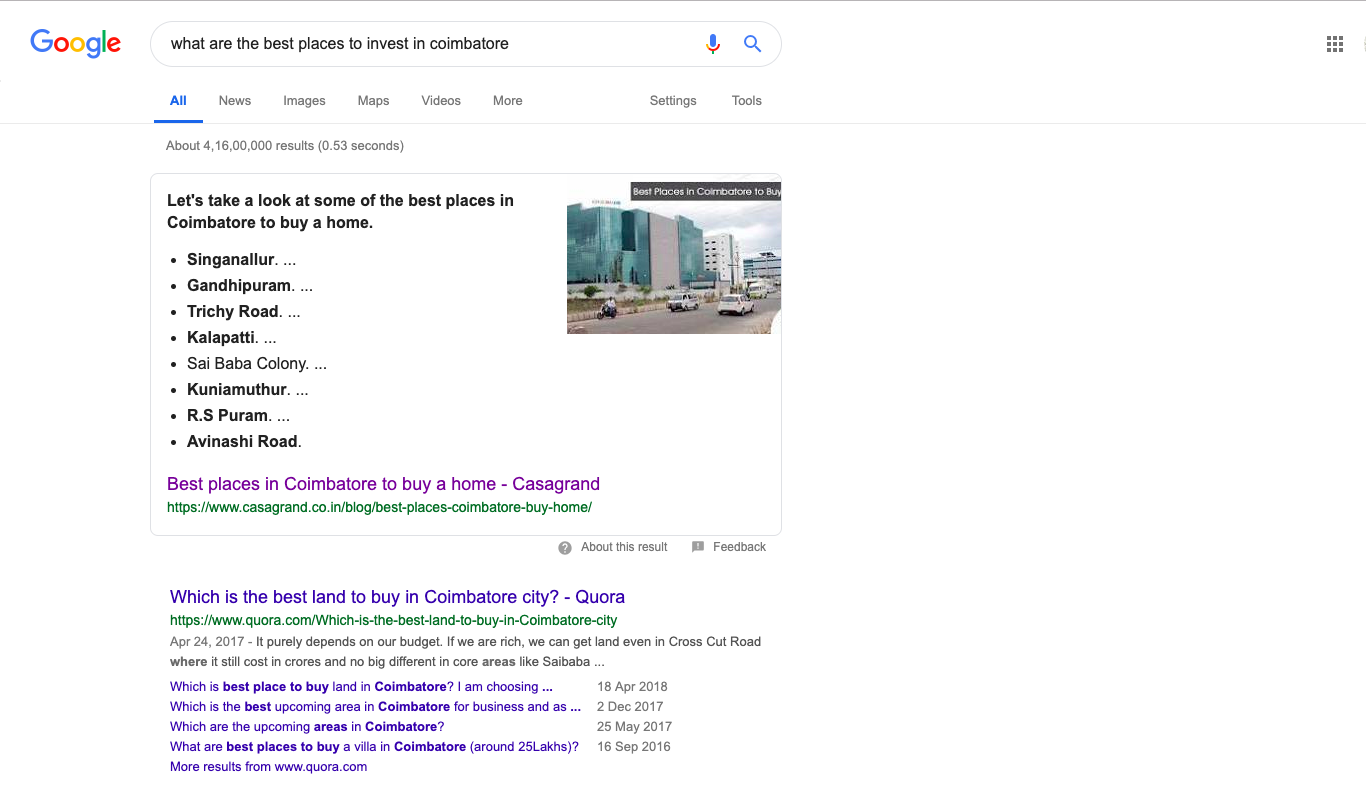
Paragraph Featured Snippets will only include a short section of your content – around 40 to 50 words, so be sure to provide your answer within that limit. To maximise your chances of getting a Paragraph Featured Snippet, use the query as the title and then answer the query directly below, as seen in the example.
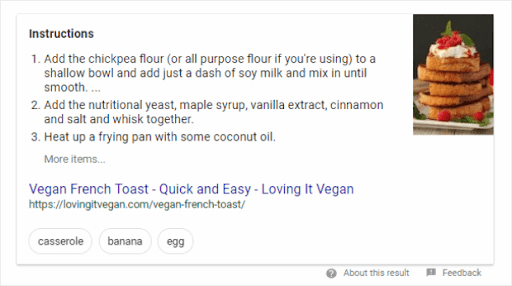
Numbered Featured Snippets appear for content that explains a step-by-step process. For example, a recipe or DIY project.
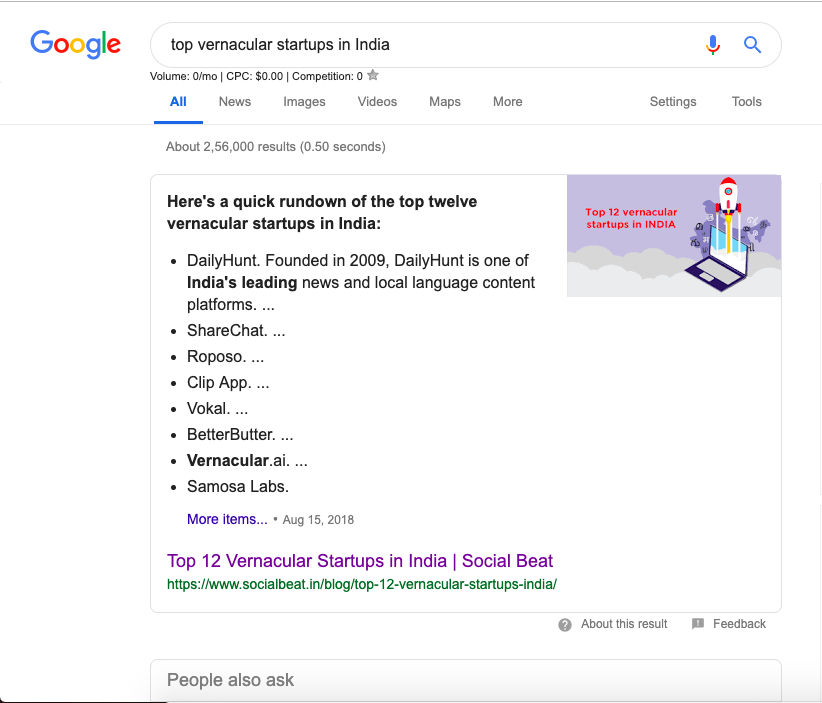
Bulleted Featured Snippets, on the other hand, will display content in a bulleted list where the order of the information doesn’t matter.
To optimise your content for a Numbered or Bulleted List Featured Snippet, you need to ensure that your content is formatted in the form of bullet points. Like in the case of a Paragraph Featured Snippet, you can maximise your chances of getting picked up by having the query as your main title and answering it directly below, this time as a list. Another way to optimise your content is by outlining steps in your blog post, and using each step as a heading.
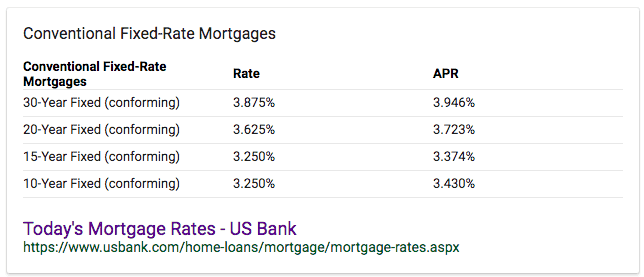
Start by doing the work for Google – put your information in a table. Not only will this make your website’s visitors happy to get all the information they need at a glance, but it also makes it easier for Google to find your content. Finally, start with an appropriate heading followed by your table of data.
For further information on how to get your videos to rank, head over to our in-depth article on YouTube SEO Tips: The Secret Sauce to Ranking Videos in 2019.
Now that you know the basics of optimising your content for the different types of Featured Snippets, let’s delve a little deeper into a few more best practices you can adopt for your content to get its own Google Answer Box.
The first rule of getting a Featured Snippet is ensuring your content answers specific queries. More often than not, when a user types in a query, it is in the form of implicit or explicit questions and long phrases. Structuring your content to answer these questions and phrases effectively is how to rank in Position 0.
For example, if the query you wish to get a Google Answer Box for is “Best residential localities in Coimbatore” try and match it as closely as possible to that keyword so that you have the chance to appear as a Featured Snippet. Additionally, make sure your answer is precise and that you stay within the prescribed word limit of 40 to 50 words (a maximum of 100 words) or 3 to 4 sentences. If you’re looking for more information to rank higher in the search results, take a look at our blog on must know Google Search tips and tricks.
Efficient and effective keyword research is the cornerstone to any great piece of content. Creating content without adequate keyword research is like shooting an arrow in the dark – you stand very little chance of ranking in Google’s SERPs.
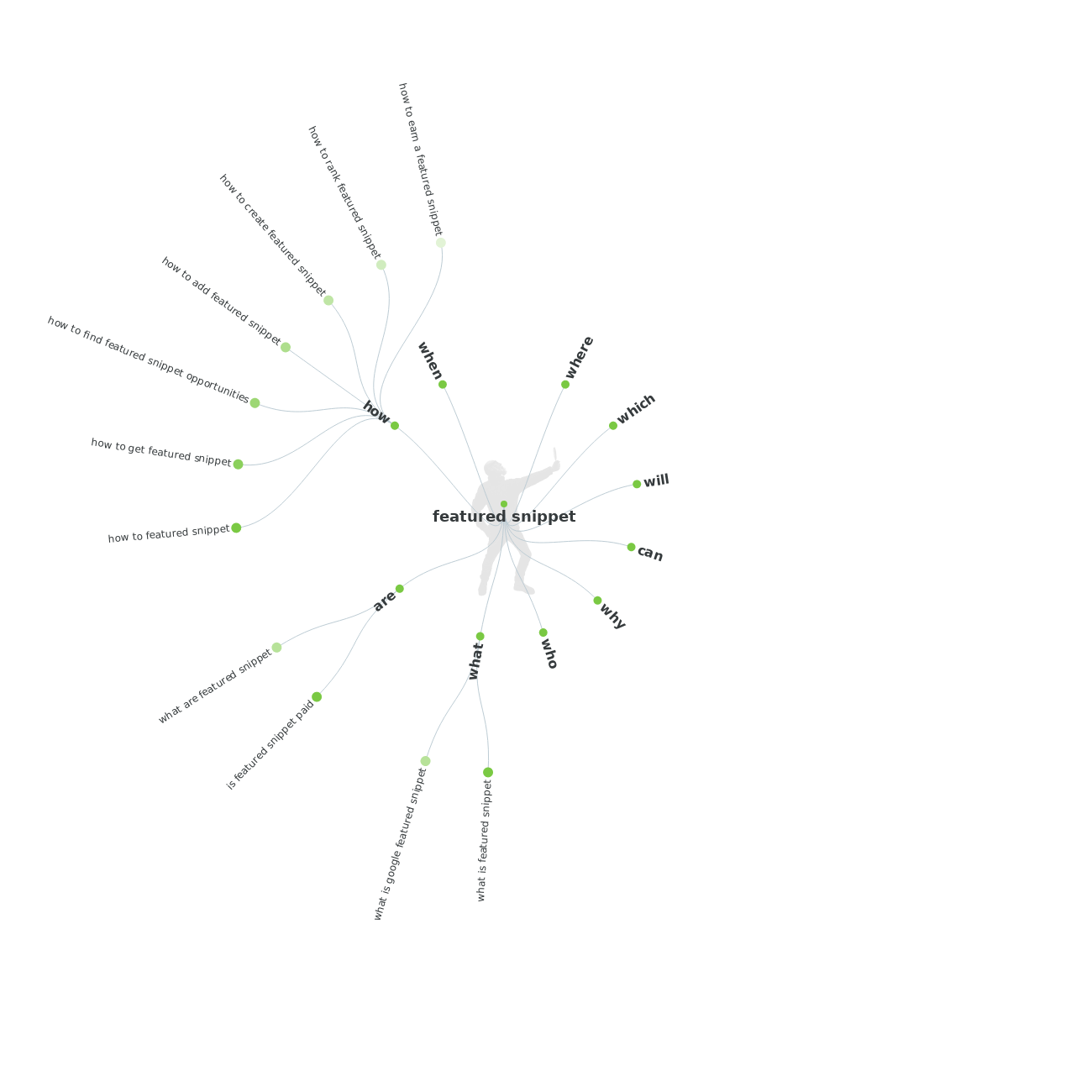
Before you begin writing content for a Google Answer Box, start your keyword research by looking for question-type queries – those that begin with what, why or how, as well as long-tail queries with no question words. The aim here is to include a seed keyword with as many long-tail keywords as you can in your article. This way, you can create well-written long-form content that answers multiple related questions in a clear and cohesive manner.
To intensify your keyword research, there are a number of tools at your disposal, namely Moz’ Keyword Explorer, Answer The Public or Ahrefs. These tools will be able to throw up more results related to your search query helping your broaden your search for keywords that trigger a Google Answer Box.
You can also browse through Google's own "People also ask" section to further research your topic or selected keyword. These related questions can offer massive insights into what Google considers related topics to your own. You can also check out our blog on On-page and Off-page SEO Tips for 2019 for more information.
Very often, many of Google’s Answer Boxes are filled with content that doesn’t fully answer user queries. Target such examples and ensure your content is better aligned to what users are looking for. If your competition has a Google Answer Box for a particular keyword, read through the content and analyse if you can create similar content or can modify your own existing content to better respond to the search query. This increases your chances of getting your own Answer Box and staying in Position 0 for much longer.
Getting a Featured Snippet isn’t just about the quality of your content. You can also improve the design and experience you provide your visitors. Not only do phenomenal UI and UX play critical roles signal Google to rank your website higher, but also heighten your chances of holding on to your Featured Snippet.
Once you’ve achieved your Featured Snippet, work does not end. Answer Box results can change in mere seconds, so the onus is on you to constantly track your progress – for how long you have managed to sustain your Position 0 or if you have slipped down the rankings. Try different things like opting for a table or a list instead of giving information in the form of a paragraph, or answering queries that appear in Google’s related search queries. Including high-resolution images with the right captions and tags and structuring your content with appropriate headings and sub-headings in H2 and H3 tags are also a few ways to help you improve your content and the user experience you provide.
The final point to keep in mind is optimising your content for voice search. India is seeing a 270% year-on-year growth in voice searches, as revealed in the 2017 Google India ‘Year in Search’ Report. As marketers, it becomes imperative for you to action change and leverage the power of Voice Search marketing to tap into India’s next billion users. A vast majority of them will be accessing the internet from Tier II and Tier III cities and Voice Search is a more convenient option than typed queries, particularly because they will be engaging in vernacular languages.
Additionally, Voice Search queries are very often picked up from Featured Snippets, particularly by smart speakers like Alexa and Google Home. Brands will need to constantly update and optimise their content to stay in Position Zero to feature prominently for Voice Search queries. You can also check out our detailed video on Voice Search Marketing for more information.
With these tips in hand, you’re now ready to win your own Google Answer Box! Remember to implement all of these strategies as Google’s Answer Box feature is in a constant state of flux, with rankings and results changing overnight. Keeping yourself up-to-date with the latest trends in digital marketing, will enable you to rank higher, achieve a Featured snippet and sustain it for an extended period of time. Before you go, take a look at our informative video that further explains how to optimise your content for a Google Answer Box.
There are currently around 225 million active Indian users on YouTube, with this number expected to increase to 500 million by 2020. Interestingly, this platform’s popularity spans across age groups, languages and regions. 60 percent of videos are watched by audiences outside the top 6 cities in India. Brands are also increasingly switching to YouTube ads from traditional media
SEO in 2019 and beyond requires us to rethink our very concept of search engines in order to rank for them. Google might be the undisputed king in this realm, but YouTube closely follows as the second largest search engine in the world. To grow your organic traffic, marketers cannot afford to ignore YouTube SEO.
Our comprehensive YouTube SEO guide covers eight helpful YouTube SEO tips that you can start implementing immediately!
Did you know that 28% of search queries in India are already done by voice? And that by 2020, 50% of all global searches will be voice searches? In fact, India is seeing 270% year on year growth in voice searches, as revealed in the recent Google for India event.
The rapid adoption of personal assistants - Alexa, Siri, Google Assistant and Cortana - is changing the way consumers search the internet. Voice search is fast becoming the preferred mode for people to interact with their connected devices. The Mary Meeker 2018 Global Internet Report also noted the advancements made in voice technology and its growing adoption.
So how do we as marketers adapt to this change? Well, that's what this article is all about!
We'll talk about the growth of voice search, what it means for you as marketers and how you can use it to drive awareness, engagement and sales for your brand.
Well, to start with…
Over the last decade, laptop and mobile screens have been the primary ways users have interacted with the internet. However, with the advent and growth of voice assistants, particularly smart speakers like Google Home and Amazon Echo, this is changing.. and changing fast!
The interaction has now started happening through voice, with smart speakers, without using a screen in most cases.
As marketers, we have spent years optimizing for screen User Interfaces and screen User Experiences but when there is no screen anymore, then these aspects become obsolete. The focus is now shifting to building conversational User Interfaces and screen User Experiences, which we will talk about later in this article.
The second thing which makes voice so important is the ability to reach new audiences.
Think about it - the next wave of India's Internet growth - the next billion or so internet users - are going to be largely from smaller cities and towns. For most of them, voice is a much easier and effortless way to interact as compared to typing on a small screen device. While there are indic keyboards to help these new users, voice is also a natural way to ask a question or query. Google is seeing a 270% year-on-year growth in voice queries in India. As a marketer, voice is your gateway to reach them.
Great, so now that we've seen why voice is important, how do we leverage it?
Almost all the keyword research that we do today is based on keywords that are typed into a search box.
However, the queries that people type in are drastically different from queries that people ask a personal assistant.
Think about it - let’s say you wanted to know who the CEO of Google is. If you're using a laptop, you would just head to Google and type "Microsoft CEO".
If you're using a personal assistant like Siri or Alexa, you would ask "Who is the CEO of Microsoft".
The first query was two worlds long while the second one was 6 words long!
Voice queries are almost always conversational, tend to contain questions and tend to be much longer. The average query length on desktop is 1 to 3 words, while voice is 7 to 8 words.
In fact, Moz pulled out data for query length for Cortana searches and compared that with the query length for general text searches. This is what they found:
This changes the way we as marketers should approach our keyword strategy. Brands will need to start optimizing for longer voice-based queries, as compared to shorter keywords that are more used with traditional typed search.
For those of you who use voice assistants frequently, where do you think the assistant pulls up most of its answers from? Well, most of it comes from something called an answer box.
Let me give you an example. Let's say you ask - "Hey Google, what are the top marketing blogs in India?"
Google gives you this answer:
You can see that the assistant credited the brand site here, from which it pulled out the answer.
Now, type in the same query into a Google search box and you will find that the assistant actually read out the answer from the first search result:
This is the answer box, also called a featured snippet or "position zero". To ensure your brand gets featured in answers to relevant voice queries, start building and optimizing content for the answer box.
Here’s a great guide from Moz on how to optimize for featured snippets.
A good percentage of voice searches are for local queries. For example, "What are the best Chinese restaurants around me" or "Where is the nearest coffee shop?"
Owing to this, optimizing for voice search becomes all the more imperative for businesses with a local physical presence. Ensure your local SEO strategy takes into account location-specific conversational based queries.
Here is a useful article on how to capitalize on voice search for Local SEO.
The smart speaker market, led by Amazon Echo and Google Home is projected to reach 225 million installed devices by 2020.
Currently, there’s no way to run sponsored ads on Amazon Echo or Google Home, though I personally feel this will roll out at some point in the near future. However, as marketers, you can use Alexa Skills and Google Home Actions to drive audience engagement, product use and even a new point-of-sale.
Quite a few brands have already started doing this. Just search for Alexa skills in India and you will find all the skills that are currently available.
Brands like ClearTrip, UrbanClap, Byju's and FreshMenu have been early movers here and are already using this to engage their audiences in different ways:
In the US, Tide has a very useful stain remover skill, with step-by-step voice instructions on how to remove over 200 types of stains - a great example of digital marketing for FMCG brands tailored for voice.
Another example of a brand using Alexa Skills really well is Nestle Purina, which helps you find the best canine companion for you, based on your lifestyle.
As the interface to interact with the internet moves from screen to voice, brands must start focusing on building more conversational user interfaces and experiences, modelled on natural human conversation. To start with, this could be as simple as adding voice functionality to the search bar on your website, which can now be done fairly easily by using the Google Web Speech API. Chatbots are another example of a conversational user interface
Voice is one of the biggest trends in digital marketing in India at the moment. As marketers, the faster you begin adapting to it the better.
So, which of the points that we have just talked about are you going to act immediately? Are you going to relook at your keyword strategy? Are you going to optimize for position "0"? Or are you going to try building Alexa skills? We look forward to hearing from you in the comments below!
With almost 80% of search queries coming from mobile platforms, Google has been implementing new ways to make the mobile search experience more streamlined and convenient for its users. One of the most drastic moves to facilitate this was the introduction of Accelerated Mobile Pages (AMP).
On an average, pages take longer to load on mobile than they do on the desktop. This is especially significant in the Indian context as Indians have the highest amount of data consumption in the world and access the internet primarily through their phones. If brands want to engage India’s next billion internet users, implementation of AMP will become one of the most crucial differentiators.
Unlike its direct competitor (Facebook Instant Articles), AMP is an open-source framework which is very easy to access. A page can be AMP-enabled by modifying the website’s HTML code with certain specified tags or by implementing a specialised JavaScript framework. But even if you don’t have any experience with coding, you can still implement AMP if you use a CMS platform like WordPress. Just by installing a Google AMP WordPress plugin which is easily available, you can make your page AMP-optimised and help it load faster.
Google initially launched AMP for static content-heavy sites such as blogs. Since an AMP page is a stripped down version of the original version, it improves readability for the user. Implementing AMP on blog pages can have several benefits for the reader and the site owner.
According to a study by Kissmetrics on How Loading Time Affects Your Bottom Line, loading time is one of the biggest factors contributing to bounce rate. Over 40% of those surveyed said they would leave a page if it took longer than 3 seconds to load. A study by Tractus looked into the effects just a 1-second delay in page load time can have on several key metrics. They found that bounce rates increased by 8.3% and page views decreased by 9.4%. This clearly shows that for a successful blog, you need more than just great content. You need an optimised page that improver a reader’s overall experience.
Implementing AMP on blog pages can be one of the most important ways to help your website perform better. When a page loads almost immediately, users are less likely to abandon the page. They are also more likely to explore your site further and click on other links within it. Below is a quick glimpse of one of our blogs, where you can see significant improvement in terms of time on site – just because of the AMP blog page.
When a website implements AMP, they are very likely to see an increase in page speed, page visits, dwell time and a reduction in overall bounce rates. Incidentally, these are also some of the main factors Google takes into consideration when ranking a page. In addition, ever since Google’s algorithm started prioritising mobile-optimised pages, the implementation of AMP could further help improve your website’s SEO.
Implementing AMP will also help your website gain more visibility. AMP-enabled pages have a lightning icon next to them which helps them stand out from the other results displayed. Users are also likely to seek out pages with this icon, knowing that it will load faster. All of these factors can help a website rank high on a search results page.
For content marketers, analytics is one of the best tools to understand user behaviour, what kind of content is working and where traffic is coming from. Tracking AMP pages is very easy as there are analytical tools available to help you track page visits, link clicks, conversions and more on AMP versions of your pages.
Page load speed is a critical factor in improving a user’s experience, especially when you are trying to drive conversions. Understanding the importance of this, Google launched AMP for landing pages. Brands can significantly improve the performance of their landing pages by implementing AMP.
If you run an e-commerce site or any other online business, leads or sales are most likely your number one priority. But if your website doesn’t load quickly, then you could be losing out on valuable customers. The same study by Tractus found that 30% of shoppers who have a bad experience with an online shopping website say that they will never visit that site again and that they will not wait more than 2 seconds for a website to load. So if you want to improve the quality of leads generated via digital, optimising your page speed is crucial.
Implementing AMP could be one of the best measures to create a landing page that converts. There has been shown to be a direct correlation between page load time and the number of conversions. If a page loads quickly and the customer is satisfied with their experience on it, they are much more likely to purchase a product or complete any other call to action.
If one of the main goals of your website is to monetise through ads, then implementing AMP could help you achieve this. This is primarily due to the difference in the way ads are showcased on an AMP-enabled page as compared to a regular page. Since implementing AMP trims all the unnecessary elements of your page and streamlines it, ads are displayed more prominently and with fewer distractions. This can increase the number of clicks on an ad displayed.
Background: India Home Health Care (IHHC) is a leading provider of home nursing and other healthcare services. They work in partnership with BAYADA Home Health Care to provide patients with registered nurses, visiting doctors, physical therapists and more from the comfort of their home.
Goal: India Home Health Care (IHHC) wanted to generate a higher number and quality of leads at a lower cost-per-lead (CPL).
Strategy: In order to achieve higher leads for IHHC, we decided to implement AMP for their landing pages. Since a majority of the leads for IHHC came through mobile, enabling AMP would have a strong impact. Google ads targeted towards potential clients redirected them towards an AMP-implemented landing page. As this would significantly reduce the load-time of these pages, we predicted that it could generate higher leads for IHHC.
Results: The implementation of AMP led to a higher number of leads generated as compared to any other pages on the site. The two most important results from this were:
As the number of mobile internet users in India and around the world continues to grow, making pages more mobile-friendly will become one of the biggest objectives for brands. Implementing AMP could be one of the most effective ways for brands to become more discoverable and ultimately, gain higher conversions, whether you are a real estate giant or a leading FMCG company. So do try it out and let us know the results you get!
Google announced the beta launch of its Neighbourly app last week. Neighbourly is a location-based app that connects you to people in your neighbourhood and helps you find the most up-to-date, relevant, and credible answers to your questions about the locality.
For example, if you want to know if there is a good, affordable math private tuition centre in the vicinity, people in your neighbourhood can help you find one. Likewise, if you’re looking for a reliable electrician near you or a place where you can quickly get a print-out, the app is designed to help you.
So, how is the launch of the Neighbourly app going to impact the digital marketing landscape in India? Here are five key points:
The Neighbourly app has been launched by Google, as part of their Next Billion Users (NBU) project.
India’s internet population stood at 481 million in Dec 2017. With the population at about 1.4 billion, there are still nearly a billion Indian's yet to access the internet! It is these billion users that Google is going after with their NBU initiatives like Google Station (providing free WIFi to 400 railway stations across India) and now, the Neighbourly app.
These initiatives will accelerate the pace at which the next billion users come online and will rapidly increase the reach for digital marketing.
If you are looking for the best ways to reach the next billion users, here’s a deck that will help you:
The Neighbourly app works in English, Hindi, Marathi and six other Indian languages. This is in line with Google’s recent push on vernacular language content and advertising.
Out of the next billion users yet to access the internet in India, over 90% of them are not proficient in English. That will bring about 900 million people online who will want to access the internet and consume content in their vernacular language.
If you want to succeed with your digital marketing efforts going forward, you must include vernacular language content and advertising as part of your strategy. Here’s an interesting case study of how a multilingual approach got us 90% growth in leads
Google CEO, Sundar Pichai, has said in an interview to The Economic Times in 2017 that “Over time you will see more global products that are developed in India first.”
India’s diversity in terms of languages, regions, traditions and social strata, combined with the fact that less than half of its 1.3 billion-plus population is using the internet, makes it a great testing ground for new internet apps and products, for large global companies like Google.
Neighbourly is not the first app or initiative which Google has built with an India-first approach. Payments app Tez, two-wheeler navigation on Google Maps and missed calls in Google Adwords are other initiatives where Google has earlier adopted an India-first approach.
Going forward, we could see a lot more global companies using India as a launch pad for their tech and internet products
One of the key reasons why Google is building apps like Neighbourly is to capture user data. With apps like Neighbourly, Google can capture a lot of hyperlocal user data from millions of users. Moreover, with the growth of voice search, we are hoping the same will be integrated with the Neighbourly App, leading the next billion internet users in India to have a seamless experience. This data is invaluable and can be used not just for extensive research but also to enhance ad targeting capabilities. Which brings us to the next point.
Google Adwords has been constantly enhancing its targeting capabilities to make the platform more powerful for advertisers. Some of the more recent additions have been the inclusion of custom intent audiences and life events targeting. All these improvements become possible only when Google knows more and more about each individual. As Google becomes more data-rich with its various NBU initiatives, Adwords will become a much more potent tool for digital marketers.
It’s important to keep an eye out for these feature enhancements and test them as soon as they come in to stay on top of the game.
What are the other ways you think Google’s next billion users project could impact digital marketing in India? Do let us know in the comments below.
.