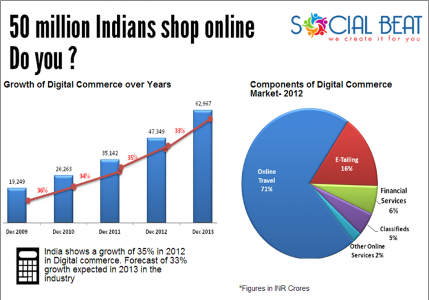
The digital commerce market in India was valued at INR 47,349 Crores in 2012 and is expected to grow by 33 percent. It is undoubtedly the fastest growing online market in the last 12 months when compared with the other BRIC Countries. According to the latest Digital Commerce Report, by the Internet and Mobile Association of India (IAMAI) and IMRB International.
The report finds that while Online Travel, which includes booking rail, air, bus tickets, hotel accommodations and tour packages comprised a majority 71 percent of the whole Digital-Commerce market in 2012,E-Tailing, which includes purchases of various consumer products/services such as electronics, apparels, footwear, jewellery, home & kitchen appliances, consumer durables, furnishings, constituted only 16 percent of the overall share. This is the segment which all ecommerce companies including Amazon India are trying to target.
Financial Services, which include services such as paying insurance premiums and renewals, paying utility and mobile bills, trading shares and securities amounted to 6 percent of the overall share. B2B and B2C Classifieds (jobs, matrimony, car, real estate etc.) contributed 5 percent, whereas other online services such as online entertainment ticketing, online food delivery, buying discounts/deals/vouchers etc. constituted 2 percent of the overall digital commerce market in 2012.
With more and more people planning their payments and Financial services online, market was valued at INR 2,886 Crores in 2012 and is expected to grow by 25 percent and reach to INR 3,607 Crores by the end of year 2013. According to the report, Classifieds market has seen a significant growth and has reached INR 2,354 Crores in 2012. Classifieds as a category has grown with a CAGR of 45 percent growth from 2009 and is expected to grow by another 30 percent to INR 3,061 Crores by 2013.
Online travel industry in India has on an average grown by 32 percent from INR 14,953 Crores in 2009 to INR 34,544 Crores in 2012 and is estimated to grow by another 30 percent and be valued at INR 44,907 Crores by the end of December 2013. The travel industry also sees interesting fact about the average cart value of goods purchased ranging from 17$ in IRCTC to about 204$ and 166$ in Make my trip and Yatra.com respectively.
The E-Tailing category has grown from INR 1,550 Crores in the year 2009 to INR 6,454 Crores in year 2012. With the entry of the world's largest online retailer, Amazon through the launch of its online marketplace in India, Amazon.in and hundreds of start ups emerging, this category is estimated to grow by 55 percent and cross INR 10,000 crores by the end of 2013 December.
India represents Amazon's tenth marketplace where buyers can browse through a catalogue of 7 million books and 12,000 movies titles initially. The company is planning to expand its product footprint to cameras, mobiles and other electronics devices.
With the Digital commerce market having so much to offer to the country, one could only see internet and Ecommerce reaching not just the metropolitans and the major cities in India but also hitting the Indian Villages soon. Of course, it comes with its humongous set of challenges forcing even Flipkart to follow a marketplace (no-inventory) model. For now, its time to watch the big players battle it out in the ecommerce market
In this digital age, almost all companies want to have a digital strategy but either they do not know how to leverage the digital medium to boost their business or they do not have the required expertise to effectively handle it. After all, digital marketing does not just involve launching a website or creating a facebook page, rather it requires a deeper knowledge of the specific industry in which the company is operating and what channels can leveraged for that particular industry and most importantly, how the online initiatives can be integrated with a company’s overall marketing strategy to boost their businesses significantly.
To get a better understanding of how businesses are leveraging their digital strategy, we carried out a survey amongst 50 companies across industry verticals across the country. The findings were interesting and we have given you summary of it here. You can also download the full Social Beat Digital Marketing Report 2013.
Currently, around 76% of the companies are using social media in one form or the other to leverage their businesses. Moreover, 91% felt that social media has a huge role to play in his/her industry. This shows that there is only a very minuscule percentage who believe that social media does not have a role to play in their industry.
Social media is a great way to build communities around the brand. This is clearly reflected by the survey results where by the respondents felt that brand awareness, customer engagement & generating leads for business seems to be the top-3 objectives of the social media. So, it is definitely a multi-pronged strategy. Initially the focus should be on building the critical mass in terms of number of fans/followers. Now, it is not just about likes and shares for companies, it is also about converting them into tangible benefits for the company, i.e. sales and revenues. But once you have the communities around your brand, you can easily leverage it to your advantage.
Facebook & YouTube seems to be the most preferred channel but Twitter & LinkedIn is also very quickly catching up in India. Facebook and YouTube are visual-driven channels thereby providing great opportunity for B2C companies to target the end-consumers who want visual content.
The quick rise of YouTube as a medium for digital marketing emphasizes the importance of seeing for believing. 2010-2012 period saw the rise of pictures as the prominent medium but the now the focus has changed to videos. Thus, it would not be out-of-place to say that it is evolving from look-n-feel towards a watch-n-feel experience.
Among the B2B companies, LinkedIn and Twitter seems to have a headway. LinkedIn’s relevance among the B2B marketers is not surprising because it is one of the best places to get business leads, create groups based on industry verticals or topics and engage people. Also, getting your employees active on LinkedIn, grow their networks and their active participation in various industry forums can be a great way to impact business relationships through the entire funnel.
Twitter again has attracted the CEOs, top managers & busy professionals. It is a very useful medium for business marketers because of its targeted marketing capabilities using the #-trend feature, break news and announcements, provide link backs. Twitter is a place where all professionals are, this is where real-time conversations happen so it is obvious when you are planning to create buzz in the professional circles, you need to leverage Twitter as a marketing channel.
Marketing Spends & Resources
Around 33% of the companies are ready to spend around Rs. 50000 to Rs. 1 Lakh per month on their social media marketing initiatives. Companies with in-house teams are ready to spend more than 18 hours a week on the internet. Around 50% of the survey respondents are ready to spend more than 18 hours a week on social media marketing.
Now, 18 hours a week is quite a big chunk of time from the marketing initiatives point of view. But there is an associated pitfall here that we can do things but it is important to the right things in a right measure. And this is where the role of digital marketing agencies come to the fore. They know the market and social media dynamics better and can ensure that the investments in terms of money and time do not go down the drain.
Results from Digital Marketing
In our view, unless the digital strategy is leading to tangible results in the medium term then its not worth it. One of our ecommerce client has had a 250% increase in revenues and 300% increase in web traffic since their association with us. This result in the highly competitive ecommerce industry when all players are putting in a lot of effort on the digital marketing is great by any measure. You can read the Ecommerce India Case Study for more information.
Again, one of our healthcare client which is already a leading name in the industry, had a 300% boost in the number of leads generated via digital media. Now, if this result would have been for a new player in the industry, it would have been good but if it is the impact on established businesses, then it clearly says something big. In this case, the returns that were generate due to their social media presence, were far greater than their investments. You can read the Healthcare India Digital Marketing Case Study for more information.
On the whole, the writing on the wall is quite clear. No matter how well-known the business is, if we are ignoring the digital media, we are clearly losing a chunk of our business. How big the chunk is, depends on the industry. But clearly, we would not like to end up on the wrong side. It is all about money. If it is able to drive the revenues for a business, then definitely it is not just a concept. It is for real and here to revolutionize the way marketing is done traditionally.
As goes the famous quote "The biggest ROI for digital marketing, is that your business will still exist after 10 years"
Cart abandonment has proved to be one of the major pitfalls of ecommerce companies in India over their brick-and-mortar counterparts because there is no stigma attached to dropping your basket at the cash counter in online retail. In a physical store, though there is no one stopping us from dropping the shopping cart at the cash counter but the associated embarrassment or stigma is enough to prevent us from doing that.
In case of window-shopping, abandonment rate is not necessarily an indicator of success/failures of an ecommerce website. The aim may be to just browse through, compare and check out different offerings of various sites. There is very high probability that such customers are going to abandon the basket. Then, it becomes very essential to develop proper metrics for analyzing the behavior and predict personalized offers / deals to attract those customers, through retargeting platforms like Google & Adroll.
Firstly, there has to be an acknowledgement of the fact that a particular basket has been dropped. Generally as an online retailer, we might be tempted to consider an abandoned basket as a case of delayed purchase. That may be a highly optimistic assumption that disregards this fact- there could have been a cheaper deal he/she may have got from a competitor. But it is not the case every time. There has been a fair number of conversions if the visitor has returned to buy the product within a short period. So, we need to consider a timeframe to allow the time for comparison of parameters but post that period, we may take certain steps to push our product.
Retargeting in combination with Email and Sms marketing to retarget the cart droppers via incremental offers & deals can make huge difference; but look out for dupers who deliberately drop the basket to get deals; may go for a cap provision like at max 2 deals every 3 months.
Reasons for Cart Abandonment
Lets look at some of the most prominent reasons that may result in high number of basket abandonments, especially from an Indian context:
Last but not the least, retarget the abandoners quickly as they are more likely to buy than first timers. But there is a need to not overdo it. Analyze the consumers purchase profile to trace any attempts of deliberate abandonment due to the probability of getting a better offer next time.
You can also read our Ecommerce Case Study.
More to follow in the coming days on Retargetting and techniques for digital advertising in India.
Ernst and Young (EY) recently launched the a report on trends in social media marketing in India. They went to about 50 companies across the country to understand how are marketers and digital agencies leveraging social media. While most of these companies are mid to large size, it throws up some interesting insights. As EY calls it, these are the "social media-savvy organisations", who are possibly by and far fewer in percentage terms compared to other countries.
The study interestingly also looks at how does an organisation measure social media marketing efforts, and also what could be the future of social media. Though the report is 27 pages long, we have given a summary of the most interesting insights:
Social Media Usage in India
95.7% of the social media-savvy organizations that were surveyed by EY use social media to build communities (more engaging for the consumers), while 76.1% use social media as a platform to highlight brand news (which in our view, may not necessarily be as engaging as building a community). In terms of generating leads, only 43.5% of the organisations use it to actively help their sales efforts.
Not surprisingly, Facebook tops the charts as the most important and most influential social media channel. There is a wide gap in terms of usage between FB and the 2nd and 3rd ranked platforms Twitter & Youtube. The study also shows that around 29% of the organisations don't plan to use Google Plus in the near future. This is in spite of the fact that Google+ Local is increasingly becoming more integrated with Google Search (we will be writing more on this in our future posts). We agree with Prasant Nair of Lighthouse insights when he says "I believe integrating networks over social media is the future for Indian brands.". This is surely the way forward and even all digital efforts need to be integrated with offline marketing efforts.
Content & Consumer Engagement on Social Media
The study validates a known fact that brands in India show special favor for their online fans and consumers. It could be in the form of prompt customer service or in the form of giving special deals. EY also quotes the According to Lighthouse Insights study, where in the period from 1 January –31 May 2012, out of Airtel’s 34,991 tweets, 33,928 were replies. For Vodafone, out of 1,015 tweets,1,013 were replies.
Blogging and Content will be the driver for social media going forward and the study shows that less than half the organisations actively engaged with the blogger community, inspite of a platform like Indiblogger. So what kind of content is currently going on the social media platforms? A majority of the updates are generic updates as opposed to brand led updates. This increases the connect with the fans. This could be showing the tired cheerleaders after Gayle's 175.
Social Media Advertising & Spends
Close to 83% of the organisations surveyed said they advertise on social media to promote their online campaigns and also for overall brand visibility. 89% of felt the results were achieved. But this is an interesting question to ask as to how do they measure the ROI on social media? Disappointingly 81% said that they measure results on social media through platform specific parameters like Likes, Plus Ones etc. Almost half the surveyed organisations have not measured sales, leads or revenue from social media. This lack of clarity on ROI is surprising because they spend between 1% to 5% of their marketing budget on social media marketing. Inspite of there being no result focussed approach, the surveyed organisations are optimistic about the future of social media. It does brands engage with consumers and create communities but a result oriented approach is required. You can see some of our case studies on healthcare and ecommerce of how an ROI approach has helped achieved desired results for client.
More on individual sections of the report soon.
The recent Havell's advertisement "Havaa Badlegi" aptly sums up many of the changes we are seeing in Indian Businesses today. Entire industries are beginning to get disrupted by technology and innovation. While businesses have been doing things the same way for decades, the drastic changes in the landscape, both globally and in India, have prompted many senior executives to relook at their digital strategy. While some industries have already seen massive changes in the last 5 years, for some industries, the next 5 years are going to be even more impactful.
Sectors where we have seen significant impact already
Offline Retailers: Offline Book retailers have been one of the first casualties of the ecommerce space. With a standardised product and ease of shipping, ecommece players have undercut book prices to take away a large chunk of the book market. Similarly, mobiles and small gadget sales are growing significantly online. Apart from sales, pre-purchase research online now plays a decisive role, where one recent survey showed over 80% of urban consumers now look up for research online prior to buying a mobile. Window shopping at stores and then going online to buy has prompted many large players in the US to shut shop. We haven't seen a similar impact in India as yet, but this shift from offline to online is irreversible.
Travel Booking: Travel booking for nearly all segments - flights, trains, buses, taxis and now even Autos in some cities, have seen significant market share being taken by online players. While holiday booking has some strong online players (e.g. SOTC, Thomas Cook and regional players like Raj Travels), online travel companies are now going aggressively after the holiday market. Expect more people to book their holiday packages online in the near future. As per a report by the IAMAI, over 80% of online commerce is travel related, reaching Rs.15000 Crores in 2012 and growing at a staggering 40% annually.
Recruitment / Hiring: Technology has changed the way someone searches for a job. From mass market sites like Naukri to Linkedin and Referring friends for jobs on Facebook, technology disrupted the way the 1990's head hunter worked. The HR agencies adopted to add value on top of these platforms instead of taking them head on, ensuring profitable growth. Due to the smart repositioning by off-line players, Online portals account for only 3% of the $250M market, while still playing a critical role in the ecosystem.
Upcoming sectors where technology will drive change
Education: Elearning has been a buzz word for a while, but there have been no large education companies which have nailed learning in India. Schools have changes, with smart blackboards, digital media lessons and online report cards, but the fundamental way of teaching and learning has not really shifted. On the other hand, globally, there are companies really breaking out. Successful examples include Coursera which allows anyone to take a virtual class from the best universities in the world on a wide range of topics to Codecademy, where one can learn computer programming. These global companies are seeing traction, even from Indian consumers. Some Indian players like Sikkim Manipal University have started initiatives like the EMBA course. It won't be too long before innovations in elearning change the way we learn.
Healthcare: Hospitals and Doctors in India are being swamped by the number of patients. While the leading hospitals and chains have invested a lot in technology, seamless connect with the patients pre-treatment and post-care is missing. New initiatives like booking a doctor appointment online to storage of reports on the cloud are seeing traction amongst the more adaptable medical organisations. Read our Healthcare Digital Marketing Case Study.
In our upcoming blogs, we shall discuss more about the options you have in your industry to adapt and lead the digital revolution.
Gartner has recently reported that across USA, companies spend 10.4% of their revenue in marketing of which 2.5% of revenue (or almost 25% of their entire marketing spend) on an average is spent on their digital marketing efforts. The more interesting finding of this survey is that this number is expected to rice to 9% this year. The survey was done with over 250 marketing executives from across 6 industries in USA towards end of 2012. The complete findings of the Gartner's US digital marketing spending report can be found on their website.
The largest chunk of digital marketing spend went to digital advertising, possibly with Google Adwords leading on this spend. Such increased spends are increasingly being seen even in India. However this also means that ROI on digital marketing needs to be more specific and tangible than ever before. The digital marketing spends and efforts need to be measured with sales growth, brand recall and actual market penetration.
Gartner also reported an increase in spends on content management and content driving marketing. So while digital advertising pushes customers to the brand, content marketing actually pulls customers and creates a community where brands can interact and excite customers.
In a recent article on this subject, Damodar Mall (Currently Director, food strategy at the Future Group) said to Forbes India that "Ecommerce is a new game for everyone. People will have to try different things. In the grocery space, I would like to say that most of e-commerce is imagined by men and designed by men. As long as you do that, I believe you cannot crack most categories except for a few like gadgets. Till you design it for women customers and till the woman customer bites into it, they won’t succeed. It has to be e-commerce later and shopping first. Right now, it is for men and by men"
In our view, women love shopping (in India or otherwise). The question is how do you create the WOW experience online. She loves window shopping, trying out clothes and looking at new designs, colours etc. So how do you create this intimate shopping experience. Moreover, its a social activity. So how do you create an interface which tries to replicate the experience online. Ofcourse for a category like grocery, Damodar Mall might have a different take but for lifestyle products creating a social shopping experience is essential.
Read the entire Forbes article here.
This IPL dozens of brands are making the best IPL and the connect with cricket on social media. Rajasthan Royals recently teamed up with Operation Smile India, which provides free surgery to repair cleft lips, cleft palates and other facial deformities in children.
The company decided to use the power of social media to drive social change. Through a campaign developed by Ogilvy India, consumers are exhorted to express support for the cause by tweeting. The goal is to reach one million tweets by April 30. Though the company is in talks to bring corporates on board to help with funds, and is engaging with telecom majors to monetise the tweets, its first priority is the mass awareness of cleft deformity and available medical solutions. Besides Twitter and Facebook, YouTube and other platforms are in use.
Corporates are adding cricketers to the social media mix. Virender Sehwag wearing corrective prescription glasses attracted immense attention late February in Bangalore, during the Australia tour of India. Godrej Consumer Products used social media for its Cinthol brand.
The best case study is probably that of hashtag (#InViratsHead) which invited Indian cricket fans to answer what was going on in Virat’s head. Within three hours and without any media spends, the hashtag was trending worldwide. In just one day, the campaign generated 7,000 tweets and had 400+ followers in a five-hour time frame. The current reach: over 730,000. The campaign has reinstated the power of social media.
You can read the full article by Business Line here.
Forbes recently had an interesting article on 10 Time Management Tips for managing Social Media in Small Business
The tip that we find most interesting is "Focus on one tool at a time". We also believe that as you start on your social media strategy, it is important to excel in one social media tool initially and then expand into others. Moreover, one social media tool should be at the epicenter of it all. For some businesses Facebook is the epicenter, for some it is youtube or blogs and in some rare cases it is twitter.