Whether it is opening a bank account or investing in a mutual fund, most users first move is to "Google it." In fact, according to Google's Year in Search report, there has been more than 61% growth in personal loan queries and 72% growth in mutual fund queries. This statistic shows the growing need for the finance industry to adopt digital marketing. Here is a complete guide on digital marketing for finance, one that will help you understand the benefits and ways you can use it along with case studies and best practices.
With over 470 million active users on the Internet, India is the world’s second-biggest online community. The figures are estimated to increase to a whopping 635 million by the end of 2021. These stunning statistics are proof that digital marketing for the financial industry is a guaranteed way to reach a large percentage of the Indian population and convert them to loyal customers.
The dynamic medium of the Internet is a two-way street. Apart from providing financial sectors with an excellent platform to market their brand and feature their products, the online space also offers the benefit of evaluating your services and seeing what works. You will also have complete access to analytics and other such statistical data to track the performance of your digital campaigns.
Customer satisfaction is of vital importance in the finance sector. Ensuring your consumers are happy and satisfied with your services is what drives the banking sector and digital marketing for the finance industry offers just that. From online posts to discussion forums, you will get a closer insight into what your customers are looking for in your products and how you can improvise your services for better consumer delight.
There is no doubt that marketing your brand on the digital space costs much lesser than traditional advertising and branding. Apart from comparatively lesser costing, financial organisations will also get a better reach and can target their audience more effectively. Banks and other financial institutes can take complete advantage of this cost-effective technique and have resorted to digital marketing for the financial industry as their branding strategy.
Now that we know the importance of digital marketing for the finance industry. Let's take a look at ways the finance industry can use digital marketing to reach a wide audience and create a powerful brand online.
Banks and other organisations in the financial sector can leverage digital marketing for the financial sector as their branding strategy by working neck-and-neck with a digital agency. These agencies, such as Social Beat, provide end-to-end digital solutions from social media posts that go viral to top-notch website content that will rank you in the first page of Google.
There are an estimated 300 million smartphone users in India and this statistic is expected to reach a mind-boggling 2.3 billion by the end of 2022. With such a large percentage of the Indian population relying on apps for their daily chores, it is time you dive into the digital space with a high-end app, designed to cater to every need of your customers.
Whether you are a leading bank or a financial data aggregator, investing in a good app is a guaranteed way to take your business to towering heights. In today’s day and age, people like to be on the move even while making financial plans or surfing the internet for research. Apart from merely searching for information, most money transfers and other financial transactions also happen over the phone. With a user-friendly app, all your services and programs will be available at the click of a button which will lead to higher lead conversions and, ultimately, customer satisfaction.
You can also explore the concept of Progressive web apps for your company. This phenomenon is one of the top digital marketing trends in 2018 and is guaranteed to change the outlook of your financial organisation.
Financial institutes can increase the exposure of the organization by tapping on the reach of social media marketing. India is leading the online community with 241 million active users on Facebook. This only means that a large number of potential customers are currently scrolling through their social feeds and there is a possibility that a lump sum of this audience is in the lookout of a reliable and reputed financial partner. With relatable social media posts, and engaging videos, financial organisations can easily use content to engage with their target audience and widen their consumer database. You can also track the performance of your posts through advanced social media analytics tools and strategize accordingly. For more insights on digital marketing for the financial industry, check out our blog on the Facebook marketing trends of 2017.
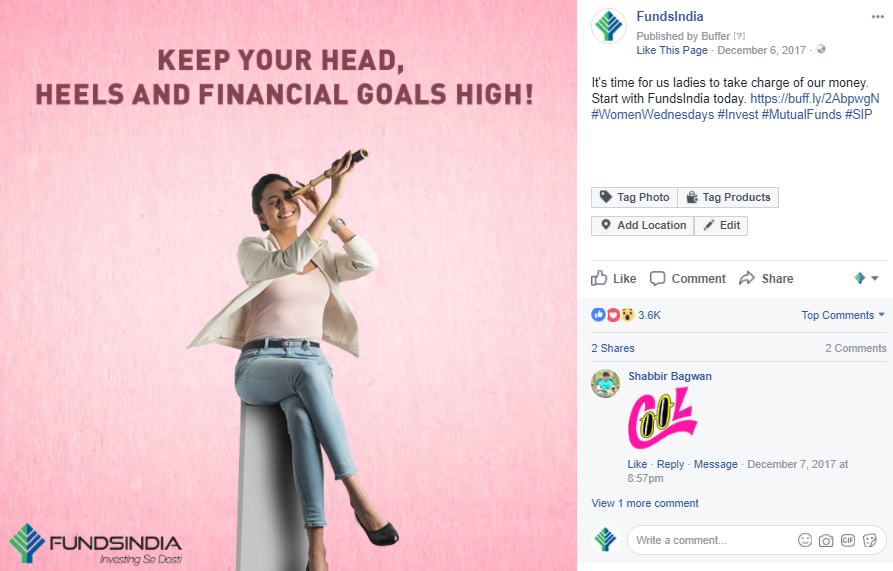
FundsIndia is India’s biggest online investment platform with over 1 million consumers. In one of their most recent Facebook campaigns, on investing in mutual funds, they targeted the women of India with a quirky creative and copy.
Additionally, they also used a humorous vox-pop video to understand peoples' spending and saving habits. This video helped FundsIndia with their brand awareness and reach.
In today’s day and age, the first thing which pops up in a consumer’s mind while looking for a particular service or product is to perform a mobile search. If you are considering digital marketing for the finance industry, one of your first steps should be to ensure you rank on Google. Focusing on optimal search engine optimization will drive a higher traffic to your website which, in turn, will lead to higher lead conversions.
You can start by ensuring your organisation is featured on Google local listings to increase the footfall to your outlets. You can also get showcased on Google My Business listings to give potential customers a brief insight of your organisation. Apart from Google listings, it is also a good idea to leverage the power of content marketing to get ranked. You can promote your services and packages with engaging blogs and other posts that have the potential to both ranks on Google and go viral on social media. However, make sure you explore all content amplification strategies to promote your content. It is also vital to incorporate all the keywords and trending topics in your blog posts for better results.
Facebook and Google ads have taken the world of digital advertising by storm. From website conversion ads to carousel and lead ads, banks can opt for an array of advertising techniques to drive enquiries and quality leads. You can also market your brand with a creative combination of videos, images and copy to attract your target group. Facebook is the best bet when it comes to online advertising as you can opt for detailed targeting based on age, geographic location, content consumption, online behaviour and many other such demographics. You can also target the users who have previously clicked on your ad or recently visited your website for leads of premium quality.
A Google ad is the other “non-social” type of ad financial organisations can invest in to widen their clientele. These ads show up in Google when potential customers type in the relevant keywords in search of a renowned banking institute.
Email marketing is the most traditional and effective type of online branding, especially when it comes to digital marketing for the financial industry. With the beginning of 2018, this trend has been upgraded with an improvised version of customized emails. Reaching out to your potential consumers with personalized emails featuring the various offers and packages provided by your organization is a guaranteed way of increasing lead conversions. For example, if a user has logged into your website and shown interest in your services by subscribing to your newsletter, you can nurture the lead with regular notifications and offers provided by your firm to attract them further. According to a recent survey, drip email marketing provides a 119% click-through rate on authentic emails.
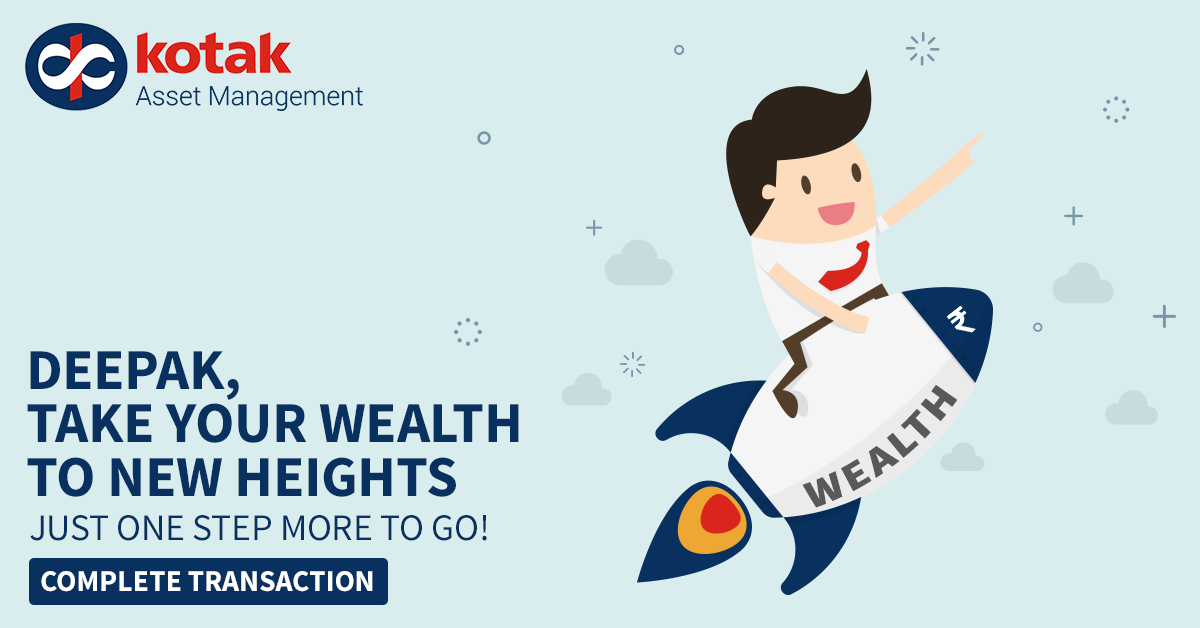
Apart from lead nurturing, drip emailers are also effective triggers to close incomplete transactions. For example, if a user had clicked on one of your financial programs or was in the middle of a transaction but could not complete the task, your digital team can target them with follow-up emails as gentle reminders. The emails can be customized as per the demographics of the user, with an effective call-to-action to close the deal in a single click. Featured below is one of the creative used in a drip emailer for one of our top clients – Kotak Asset Management who have engaged in digital marketing for the finance industry.
Influencer marketing is one of the top digital marketing trends of 2017 and is expected to continue its reign in 2018. There is a personal element of trust and assurance when customers choose their financial partners based on the advice and suggestions of a commoner and that is exactly the type of branding influencer marketing has to offer. Influencers upload engaging posts and modest reviews in the form of blogs, videos and pictures which has the potential to instantly attract viewers and convert them to consumers. Influencer marketing is one of the main pillars of digital marketing for the finance industry and is definitely something you should leverage for your organisation.
Speaking about digital marketing for finance, follow our YouTube channel Paisa Pujari for insights on how to control your finances. Here's a video on the smart use of credit cards, to get you started:
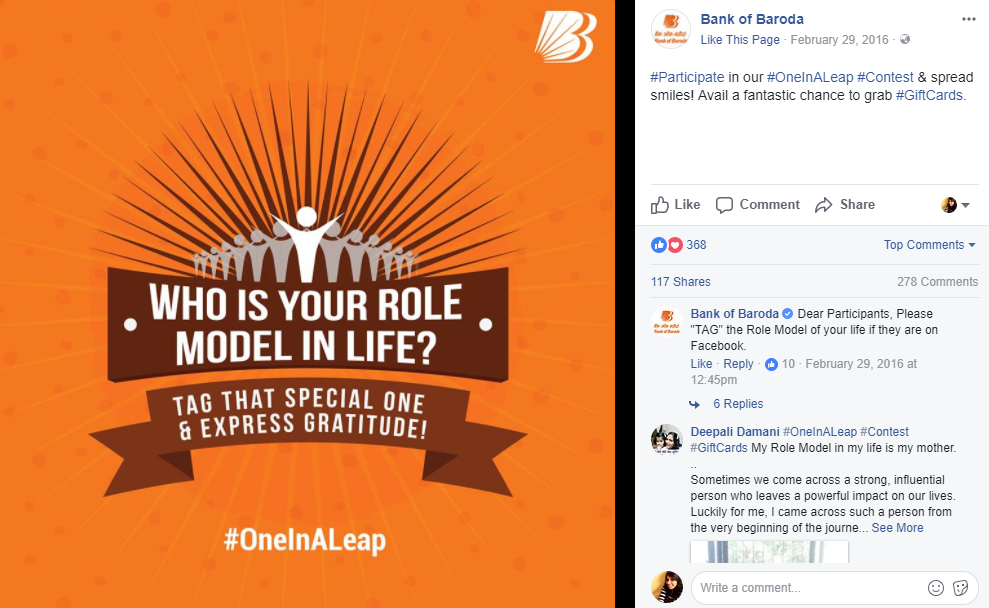
Bank of Baroda is one of the first public banking organizations to have resorted to digital marketing for the financial industry. Their marketing team focused on creating a premium presence on the online space rather than giving plain emphasis on the number of followers. Each of their campaigns had a specific objective from promotional content to lead generation. One of their most commendable campaigns was that of “One in a leap”. In this campaign, the bank put up a post on Facebook asking their customers to tag the one person who is a role model in their lives. The post was put up on the 29th of February during the leap year of 2016. The hashtag #OneInALeap was trending for a good six hours along with the hot topic of the day – the Indian Union Budget 2016.
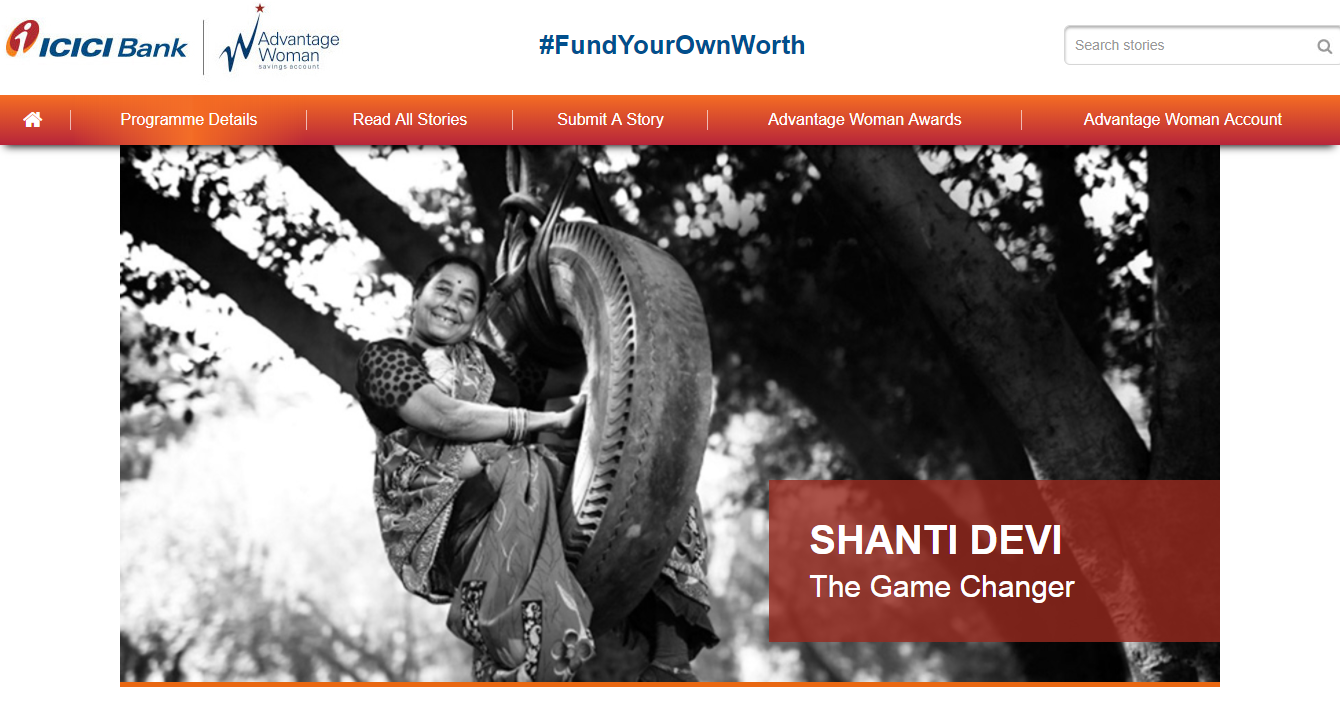
Being one of the leading banks in the nation, ICICI tapped the Indian female population with the #FundYourOwnGrowth campaign. The campaign focused on encouraging women to invest in themselves and not be tied down by the shackles of the society. Women around the subcontinent could enroll in the Fund Your Own Growth program and open a woman’s account to enjoy a plethora of irresistible offers and benefits. A lot of online traffic was driven to their website which showcased the program details, advantages of opening a woman’s account and a series of inspirational stories of real women and their struggles against poverty. Through this campaign, the bank took the angle of empowering women to sell a financial product. The campaign also included a 2-minute video ad featuring top Indian actress Konkana Sen Sharma which was splashed on all major digital video platforms, including Youtube.
Apart from banks and leading monetary institutes, B2B organisations that cater to the technologies involved in the financial sector are also focusing on digital marketing for the financial industry. BijliPay, one of India’s top end-to-end providers of payment solutions, collaborated with Social Beat to up their digital game and gain quality leads from the online space.
When the Rs 1000 and Rs 500 notes were demonetized in the end of 2016, a lot of businesses realized the need to go digital in order to survive in the market. Understanding this demand, BijliPay used Google to advertise their mPOS devices (card swiping machines). The primary objective of the campaigns was to acquire more customers in the wake of Demonetisation. In order to achieve our targets, we performed AB testing for different landing pages and altered the copies of various search campaigns based on what was performing well. Our ground-breaking campaigns landed 3,569 lead conversions with a cost per conversion of just Rs 285.
With an average of 225 million active Indian users through mobile every month, YouTube is the world’s favourite search engine for videos, emerging as a game-changer in every brand’s marketing strategy. Keeping this in mind, we partnered with Sundaram Mutual Fund to leverage the reach and branding of YouTube Masthead ads while introducing a new fund offer. Masthead ads are primarily used by brands to create a buzz about a product or service and reach out to consumers in a wide range of demographics. They are displayed on the homepage of YouTube and charged on a daily basis. The open-ended equity scheme offered by Sundaram Mutual Fund was advertised in a short 20-second Masthead ad on YouTube, and the results were phenomenal.
The primary objective of the campaign was to increase awareness about the brand, drive traffic to their page and increase the number of subscribers with the introduction of the new fund offer. The 20-second Masthead ad spiked the number of subscribers on Sundaram Mutual Fund’s YouTube page from a mere 363 to a whopping 56K in just a matter of 24 hours.
With such astounding statistics and mind-boggling figures, there is no doubt that digital marketing for the finance industry is an emerging trend which is here to stay. It is time you leverage the power of digital and secure the future of your financial organisation.
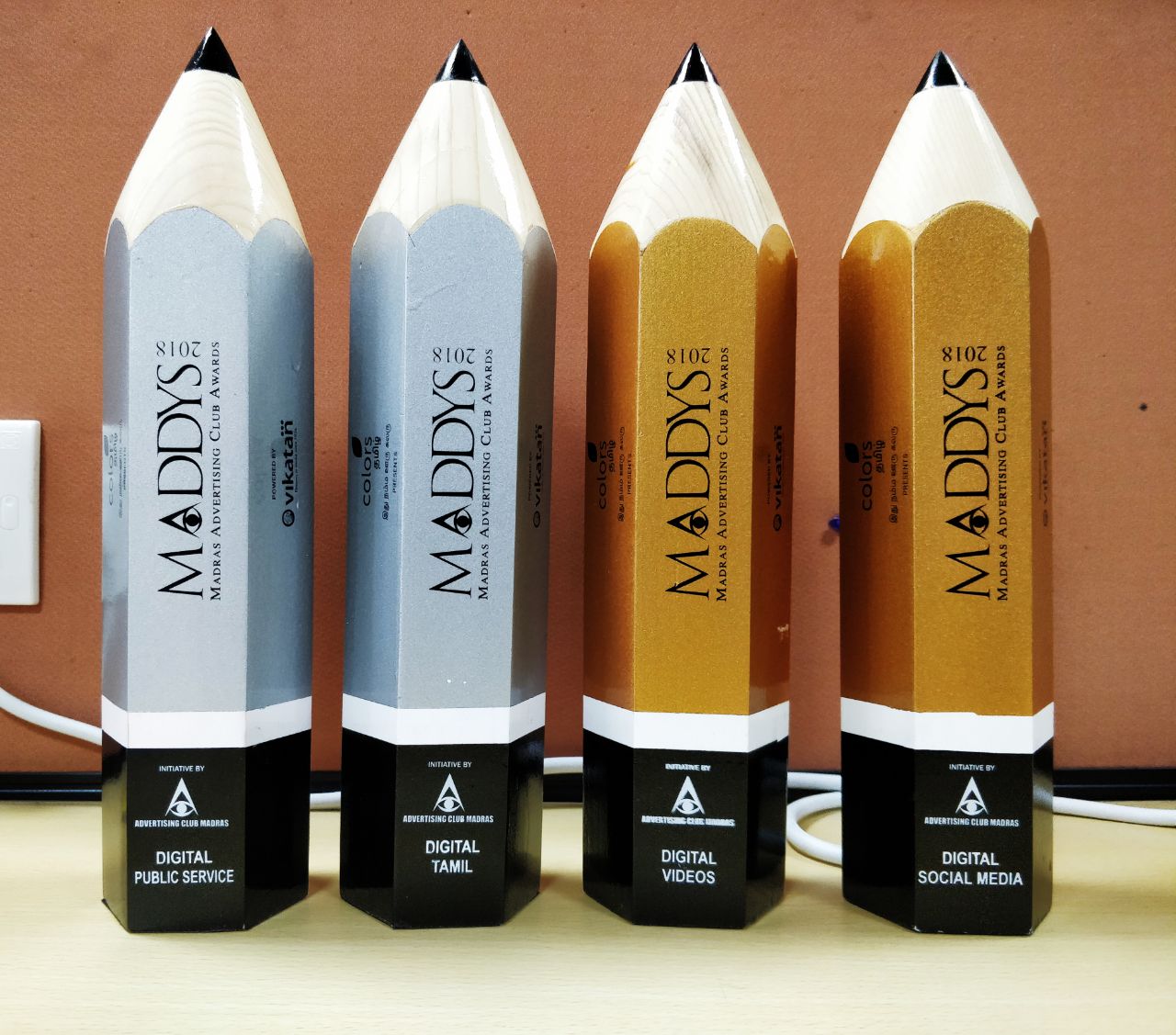
In today's competitive digital space, Social Beat and Murugappa are proud to have bagged four prestigious awards at MADDYS 2018 - a flagship event hosted by the Advertising Club Madras. MADDYS identifies and appreciates creative brilliance and industry benchmarks in media agencies from across the nation in more than 30 creative and media-oriented categories. 2018 witnessed the 37th edition of the MADDYS which was indeed a special one for us! We won 4 MADDYS in the following categories:
These awards were presented to us for our ground-breaking work on the Netizen campaign. Read on to know more.
Have you ever heard of the saying “If it is not on Social Media, it’s like it never happened”? Most of us are so addicted to social sharing platforms that the moment we spot something even remotely cute or unusual, our first instinct is to capture and share it. How would you feel if someone kept telling you what their day is looking like?
There is no doubt that social media has taken over our lives and has become an alternate universe that showcases the supernatural life we love to portray. However, in this quest to show the world how perfect we are, we tend to go overboard and become bad netizens. Addressing this issue, the Murugappa Group has come up with a series of funny yet thought-provoking videos that remind us how we are unintentionally causing havoc in the online space. They also create awareness on the right usage of social media. From snippets targeting the over-sharers in Social Media to the those who constantly update their feed with outdated posts, each video has a clerly cut-out target group with the common aspect of relatability.
With a total of over 14 million views on Facebook, almost 2 million on Youtube and 1.5 lakh shares across social media, it is safe to say that the "Good netizen good citizen" campaign has broken the internet. One of the the most popular videos is Update Azhagi.
As the name suggests, Update Azhagi is a shout-out to all the obsessive sharers in the digital world. These people love to share every instant of their day with the rest of the world, not realizing that their followers also include mere acquaintances and borderline strangers who really do not need to know every detail. If this post reminds you of an Update Azhagi in your life, tag them and let them know how you feel about it. After all, sharing is caring!
This video currently has reached more than 6 million people with 70,000 shares and is almost touching 5 million views. Since this video was conceptualised in Tamil, it was well accepted by the Tamil speaking community, proving that multilingual marketing can be a great approach.
Watch this space for more humorous videos with strong messages to ensure we all strive to be good netizens.
In the wake of the backlash that Facebook has been facing after millions of users personal information was leaked, the company has decided to cut off access to third-party data providers. Ad-targeting based on consumer data provided by third-parties allowed advertisers on Facebook to target consumers based on very personal, deep insights. This was made possible through a feature called Partner Categories, where Facebook partnered with external consumer data providers. Now, however, Facebook has ended this feature after details came out of Cambridge Analytica, also a third-party data provider, exploiting private user information. The company also announced that this was a part of their larger efforts to improve security and integrity of the platform for users.
For advertisers, this move means that they will have to re-think their targeting strategies on Facebook. While they might not be able to rely on consumer insights provided by external agencies, they can continue using the Custom Audience tool on Facebook. The Custom Audience tool will not be affected by Facebook’s new policy because the data used is owned by the advertisers themselves. Facebook also uses third-party data providers for advanced social media analytics and will continue to do so. However, they have announced that they will be reviewing the integrity of these external agencies before going forward.
The company has insisted that removing the Partner Categories feature will not put Facebook at a disadvantage in the competition between its rivals like Google. Instead, they believe that it will prove their commitment to protecting consumer data and placing privacy of their users above all else. With the growing number of Indians joining Facebook, it is very likely that the platform will continue to be one of the most important ways for brands to engage with India’s next billion internet users.
Facebook expects that their new policy will come into effect gradually over the next few months. This gives digital marketers an opportunity to rethink and refine their ad targeting strategies.
To mark its 10 year anniversary in India, YouTube hosted Brandcast 2018, an event to help marketers understand how Indians consume video content. Since it first launched in 2008, YouTube’s rising popularity has been inextricably linked with India’s own growth story, giving it a special understanding of the Indian internet audience. Today, around 225 million Indians actively use YouTube every month just through their mobile phone. This number is set to increase to 500 million by the year 2020. With such a rapidly expanding audience base, YouTube is becoming increasingly more important for brands to effectively leverage. Interestingly, YouTube’s reach is over 80% amongst the 55+ segment.
Brandcast 2018 provided invaluable insights into who is accessing YouTube, what content they are watching and how they are consuming it.
YouTube has become one of the most important platforms for brands to engage with their consumers. The most remarkable feature of YouTube is that ads here have a very high reach and a viewability rate of as high as 95%. The viewability rate refers to the number of audience members who have actually viewed the ad. YouTube’s audience is one of the most engaged across all platforms and is also the best way to create a brand story. Brandcast 2018 revealed how actively users consume content on YouTube:
Clearly, YouTube can be extremely effective for brands to capture the attention of their audiences. You can learn more about creating videos that rank on YouTube in our in-depth article: YouTube SEO Tips: The Secret Sauce to Ranking Your Videos in 2019.
Case Study: On1y #ForkTheBananaLeaf Campaign
The use of creativity and engaging content works very well on YouTube since audiences are more inclined to spend a long time viewing your video. For the #ForkTheBananaLeaf campaign, On1y created a funny, unusual video to advertise their brand and to keep their viewers engaged. On1y is a premium spice brand with a signature grinder to ensure you get maximum flavour. They chose to speak about their product USP in an unusual way and effectively use humour to capture the attention of their audience.
On1y wanted to steer away from the predictable storylines and advertise their product in a way that would increase brand recall among their audiences. To do this, they depicted a traditional South Indian wedding with the couple waiting to be served food on a banana leaf. However, instead of traditional South Indian food, they are served international dishes like pasta and pizza. While confused at first, they begin to love the food once they sprinkle seasonings by On1y over them. The idea of food with a twist was a unique play on the ‘twist’ of the grinder that is one of On1y’s biggest USPs.
This video worked phenomenally well for On1y and went viral in a very short time. The overall reach for the video was over 10,000,000, the total views on YouTube were over 480,000. Capitalising on the huge success of the video, they also release a ‘Behind the Scenes’ video which also garnered a high number of views. This clearly showed that audiences were so engaged by the original video that they were willing to watch the second video about the same product.
YouTube has a number of different features and advertising options to help brands achieve their business goals.
Bumper Ads: 6-second videos which can increase brand reach
TrueView: In-stream ads which play when a viewer is watching another video
Video Ads Sequencing: A customised video funnel brands can create to take viewers through a journey
Director’s Mix: Make different versions of background copy on the same video based on various parameters of the target audience.
These tools allow brands to increase brand awareness, brand recall, physical store visits and ultimately, sales.
Influencer marketing has emerged as one of the most effective strategies brands can use to build brand awareness and credibility. India has witnessed a growing number of powerful influencers in many different categories. Many of the biggest influencers today across all categories can be found on YouTube. From just 16 YouTube channels in India with over a million subscribers in 2014, there are now 300 channels. Indians today are using YouTube as a way to gain more information, rather than just for entertainment. They turn to YouTube influencers they trust to provide them with reviews, tips and tutorials. The Brandcast 2018 event revealed very important figures about how powerful influencers on YouTube really are.
These numbers prove that YouTube is an indispensable platform for brands trying to widen their consumer base.
The biggest avenue for growth is going to be regional audiences in tier 2 and tier 3 cities in India. While English-speaking audiences have almost peaked, regional language users online are only going to grow from here. Access to the affordable high-speed internet as well as the availability of low-cost smartphones has made the internet more accessible than ever before. Brandcast 2018 also revealed figures which prove that multilingual marketing is going to be becoming increasingly important for brands.
It has almost become a necessity for brands to explore regional language content in their marking strategy.
At Social Beat, we have witnessed first-hand the power of regional content on YouTube. For the ‘Good Netizen Good Citizen’ campaign by the Murugappa Group, we conceptualised ideas for a video that would resonate with their audience base. As they are based out of Tamil Nadu, their target audience would be able to better understand and relate to Tamil language content.
The goal of the video was to effectively utilise humour to spread a message about responsible sharing on the internet and to be a good ‘netizen’. They created funny, yet thought-provoking series of videos on internet etiquette. From a young woman who over-shares every mundane detail of her life with strangers to the way Whatsapp rumours are spread, these informative videos are aimed at raising social awareness on the responsible use of social media and the Internet.
These Tamil videos performed incredibly well on YouTube with one of the videos even getting over 570,000 views. Users also actively engaged with the video, leaving comments and sharing it on various social media platforms. Undoubtedly, the fact that the video was in Tamil, played a very important role in the fact that it went viral. You can watch the entire series of the Good Netizen Good Citizen videos here.
According to the latest numbers, Tamil is currently the most used regional language in India among internet users with 42, while Hindi follows with 39 percent. Clearly, unless brands incorporate a strong regional language strategy in their marketing, they will be unable to engage with India’s next billion internet users.
YouTube is one of the biggest platforms for brands to reach out to their consumers. As its reach in India continues to grow, brands will need to learn how to effectively utilise it to grow their presence.
Cholamandalam Investment and Finance Company Limited (Chola), is the financial services arm of the Murugappa Group, providing a variety of loan options to its customers. The vision of Chola is to enable its growing clientele of over 8 lakh customers to enter a better life. Since Chola is a small loans provider, most of its consumer base consists of middle-class Indians, especially from tier 2 and tier 3 towns. This is why it was crucial that our communication and design strategy appealed to this audience segment in order to create maximum engagement. The core objective of our redesign strategy for Chola was to break away from previous design formats and offer a fresh new look.
The Target Audience that we were dealing with is the middle-class section of the Indian society. The visual appeal of both the design and the copy has to go hand in hand for the TA to be able to relate to it. The campaigns were tailor-made for the TA to ensure maximum shareability. The ideation for the campaigns primarily involved topics trending with socio-economic groups we were targeting. The TA had to be able to identify with these topics in order to feel compelled to share the posts.
Throughout a number of brainstorming and ideation sessions keeping the target audience and their interests in mind, the team explored various approaches and ideas. During this process, we decided that the best approach would be to understand the feelings of the TA. By putting ourselves in their shoes, we would be better able to understand the kind of content our target audience would find engaging. This was one of the best ways to gain traction as viewers can relate best when they see their life stories projected creatively on their screens. All of our campaigns for Chola mainly focused on trending topics of that period to maximize the shareability of the posts.
With our campaigns for Chola, we decided to try out something new in terms of design style. Having utilized a vectorized design style over the past campaigns, we decided to give the new campaigns a fresh new look. Instead of vector designs, we used detailed, sketched, hand-drawn line illustrations to retain the sophisticated nature of the brand in a creative way. We also utilized the latest super tools in design gadgets.
The design process began with ideation of themes, conceptualization of scenarios based on the content and visualizing people, actions, costumes, spaces and objects to portray in the designs. The next step involved collecting and documenting relevant imagery on the basis of the ideation. Followed by this was the creation process of digitally hand-drawing sketches and creating customised vectors with reference to the collected imagery. Once this process was completed, the colour palette, font styles and the layout were structured and executed.
Our campaigns for Chola usually revolve around a central theme. They include a series of creative images which relate to the theme and tell a compelling story. Here are a few of the design campaigns we created for Chola which performed very well on social media.
Children’s Day was around the corner and so we conceptualized an interesting campaign for the same. There has been a drastic change in the lifestyles of children today compared to children 10-20 years back. The central theme of this campaign was to portray how children from the previous generation led such different lives as compared to children today. We tried bringing in various aspects of childhood like pocket money, holidays, summertime and weekends as themes to compare children then and children now.
A detailed line drawing sketches were made to portray different scenarios. Only the images of the children had colours added to ensure that the emphasis was solely on them. The layout was kept very simple using minimal colours as the drawings were intricate.
Goals and Dreams are different yet interrelated. We created a metaphoric representation of this concept for the #DreamsToGoals campaign. The basic story of this campaign centred on an entrepreneur who strives to cross a cliff. Using a story-based design representation, the concept made it easier to understand and more relatable.
The design attributes followed in this campaign were meaningful illustrations designed with a minimalist aesthetic. A fresh and bright colour palette was used to break the monotony of past designs in the finance industry and create a new visual language. A clean typography, layout and illustration style was implemented throughout the series to express the sophisticated nature of the company.
This campaign shines the spotlight on the untold success stories of small business owners who have made it big. Throughout our design process, we focused on portraying the achievements of these small business owners in a captivating, original manner. A clever collage representation of the content was executed by overlapping images over illustrations. We also added minimalistic movements to the design elements to make it more compelling. The colour palette used in this campaign was a combination of gradients in relevance to the businesses. A clean decorative placement of the copy added to the visual element to the designs.
These campaigns performed very well on social media, garnering a high number of reactions, comments and shares. These numbers proved that creative and thoughtfully designed posts can engage with customers, contribute towards a positive brand image and increase brand awareness. You can also read our blog on What Brands Can do to Engage With India’s Next Billion Users to find more ways to capture the attention of your consumers.
There is no doubt that reaching your target audience through vernacular content is one of the biggest trends of digital marketing. Though the early internet users in the nation are predominantly fluent in English, marketers have noticed that the current crop of digital-savvy individuals find multilingual content much more engaging and relatable. Keeping a tab on this trend, many brands have leveraged the reach of vernacular content to engage with India’s next billion internet users.
We, at Social Beat, took advantage of the reach of vernacular content and the engagement of video content to come up with a ground-breaking social media campaign for our client Cholamandalam Finance. Since the brand mostly caters to small-business owners and entrepreneurs from tier 2 and tier 3 cities, we targeted their audience with an animated video featuring the life lessons we can learn from an ant. The video was initially made in English and gained a traction reach of 409,609 with 3k shares. Seeing these numbers, we released the same video in Hindi which went viral.
The Hindi video currently has reached 2.2 million views with 94% of it being organic. Furthermore, 2 million of these views are unique. The post has reached 7 million users through 79k shares and 50k reactions. These stats are a testimony to the fact that the digital space is evolving and adapting itself to the needs and preferences of its new breed of internet users.
Need more convincing that vernacular is the need of the hour? Follow our Hindi YouTube channel Paisa Pujari for financial tips for individuals from all walks of life. Here's a video to get you started:
With close to 450 million Indians already online, the digital industry is fast-evolving. Since the launch of Jio, India has seen 9 times growth in usage of internet data. Owing to this, the dynamic platform of digital marketing has witnessed a lot of progression and development. The digital trends that worked a few years ago have reached their expiry date and newer, more effective trends have emerged. Let’s take a look at few of the digital marketing practices that are no longer effective in today’s day and age and their improvised versions that have taken over the online community.
Nobody likes mass e-mailers that flood their inboxes with coupons and deals they are not interested in. Non personalised emails are clearly dying out as the content may not be relevant to the audience you are sending it out to. Email marketing work when it is done right. Mass emailers have been upgraded with personalized emailers that are guaranteed to catch the audience’s attention. Apart from mere personalization in the form of your potential customer’s name, you can retarget them with what they were previously searching for, and present them with irresistible offers based on their demographics, interests and past behavior on your website. This will not only pull them towards your website but will also leave them constantly refreshing their inbox in a quest for more such deals and offers.
Brands have always been misguided by the notion that the higher number of posts they put up on social media, or the higher number of blogs they put up on their website, the more traffic their content will generate. However, the truth is that with the abundance of content available online, it is more important to provide viewers with high-quality content that really stands out rather than a multitude of average blogs that will just get lost in the ocean of information.
The trend of bombarding your target group with a plethora of information till they ultimately get converted to loyal consumers is now a thing of past. Potential customers are now being targeted with a fewer number of posts comprising of content that the audience will find engaging. The secret lies in bringing out a primary purpose in the blogs, like showcasing a particular product, branding or luring viewers with an emotional connect. This strategy coupled with content amplification techniques will ensure that the content reaches the right target group.
Though Twitter is one of the leading social media platforms, the strategy of using Twitter as a marketing tool is on a decline. Though Twitter did post a higher revenue for the last financial year, we are not seeing a significant growth in the user base in India. Brands are flocking to other effective mediums like Facebook, YouTube and Instagram where they are more likely to get better reach due to the higher number of active users. Additionally, the cost of ROI and effectiveness of advertising spend on Twitter vis a vis the other platforms are very different. While twitter does well in some genres like news, entertainment and politics it is not a preferred platform for all brands in India.
Blogs are extremely important for any business. However, if you want to leverage the power of content marketing to showcase your brand and attract leads, it is time you bid adieu to short-form content. The average length of a blog is usually around 800 words but in order to rank on Google, you need to work on longer content with in-depth analysis, research and loads of information. According to data, a well-researched content that is around 2000 words have a better chance on ranking on page one of Google search. Pack your blogs with different types of content from infographics and videos to statistical research and relatable memes. Apart from different forms of visuals, optimize your content with keywords and related keywords while you sit back and relax as viewers come flocking to your website. Also, make sure you interlink your blogs well to provide readers with more related posts and keep them hooked on to your website.
At the same time, apps like Inshorts are growing due to its byte sized articles – brands may want to continue experimenting by giving both short form and long form content depending on the purpose.
Optimising your ad campaigns is of key importance to generate leads and widen your client database. However, it is quite challenging and time-consuming to create a campaign and to manually check out each digital ad campaign and optimise them as per industry standards. These practices are now being done using automated tools and Artificial Intelligence. For example, there are cost effective tools like Optmyzr that allow automated optimization of advertising platforms like Google.
As dramatic as it may sound, there is no such thing as organic reach on Facebook anymore. As a brand, you need to promote your posts and invest on Facebook ads to reach your target audience. Facebook has also rolled out a new feature called “Explore Feed” tab, specifically for brands. This tab is a new feature on Facebook where users can view top relevant posts which are hand-picked for them based on their demographics, interests and content consumption.
Last-click attribution is now being replaced by data driven attribution. This upgraded trend is a process in which the analytics model of the website credits the entire process of marketing, from attracting a potential buyer and procuring the lead to converting them to a consumer, rather than the last click that closed the sale. The last-click attribution model will let you understand that a recent buyer logged on to your website to indulge in a sale. But, the data driven attribution model will give you a detailed insight of the journey of the consumer, from the initial Google ad, to the Facebook retargeting and emailer they received to push them to make the purchase.
Everything comes with an expiry date and digital marketing trends are no exception. It is time you upgrade your digital marketing strategies and stay ahead of the online curve.
This article was originally published on Campaign India. You can read the published article here.
Audience engagement has always been a challenge for most brands and companies. Reaching out to your target group is just half the battle won. The key lies in engaging your viewers to an extent in which they ultimately convert to loyal customers. One such digital marketing trend that has emerged as an effective tool to keep customers engaged with your brand is Live Videos.
The advent of live videos has changed the face of audience engagement for the better. The live video streaming option is available on all leading digital marketing channels such as Facebook, Instagram, Twitter and YouTube, to name a few. With live streaming, like Facebook Live, companies have a cost-effective mode of promotion that audiences can easily view since studies have shown that there has been an increase in the viewing of live videos after the introduction of the 4G network. There are many benefits and drawbacks of the usage of live videos but overall, it has been found to be an extremely effective method of communication and engagement between brands and audiences.
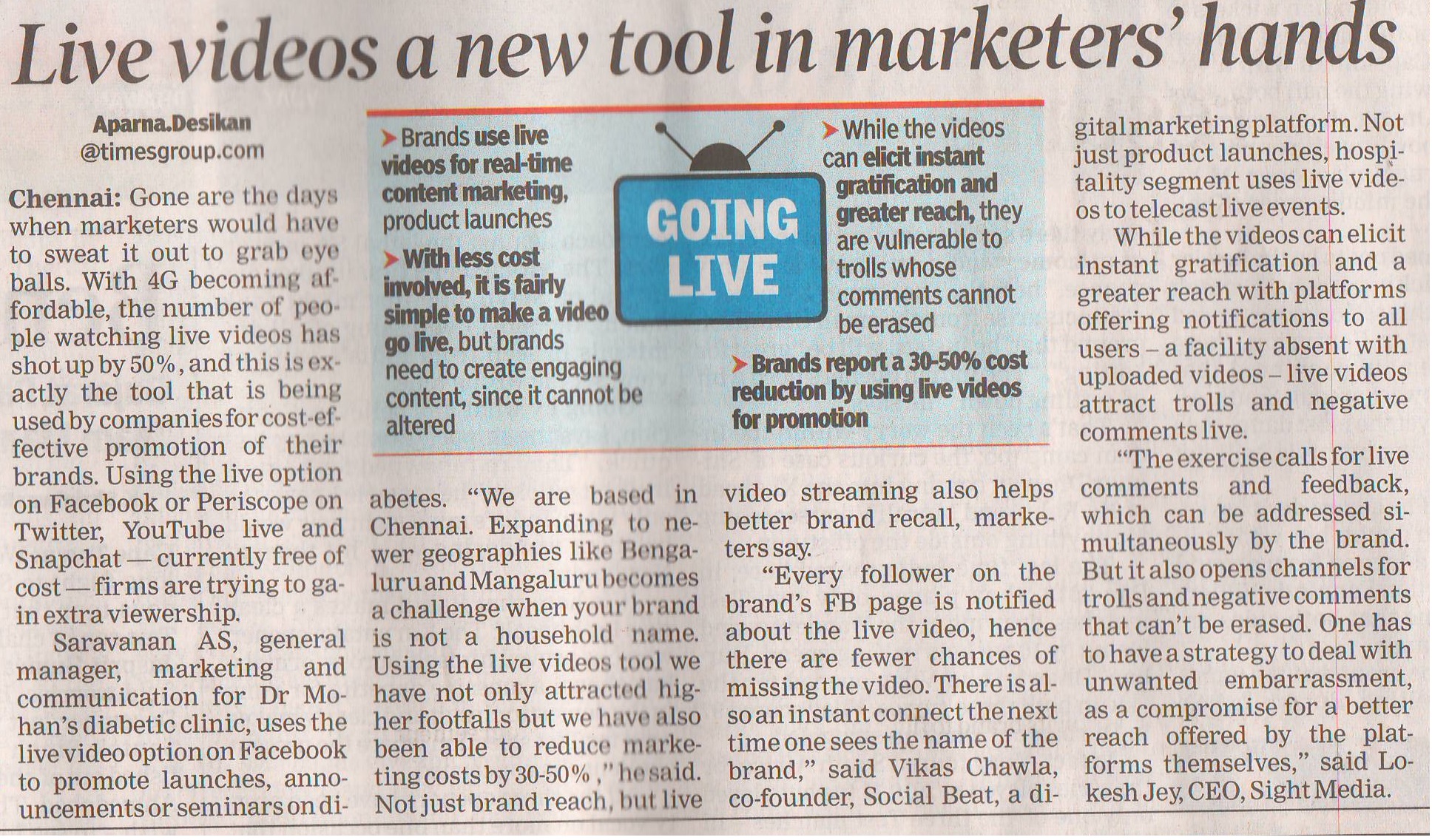
Social Beat believes in the power of live videos for promotion and marketing. Featured below is Times of India's article where our co-founder, Vikas Chawla, gives us clarity on how live videos can benefit your brand and help you reach your marketing goals. For more insight on Live streaming, make sure you check out our blogs on the top 10 live chat software for your website and 4 tips to integrate social media for live events.
Casagrand is one of India’s fastest growing real estate companies and committed to building aspirations and delivering value. It offers superior homes in premium locations of Southern India. To date, the developer has delivered dream homes across 68 landmark properties to over 4,000 happy families.
We are delighted to announce that Facebook has published a case study on Casagrand’s meteoric success using Facebook marketing solutions. This is an important example of how no brand can risk ignoring the power of social media in today’s digital landscape. In the last financial year, Casagrand, a real estate company based out of Chennai has generated an incredible 190 crore in revenue using Facebook marketing solutions and at a 60% lower cost per lead compared to other digital channels. Find out about how we helped our real estate client grow with real estate digital marketing for Facebook marketing solutions.
Casagrand came to us with the objective of increasing their residential project sales through online enquiries and reducing their acquisition cost by 50%. To do this, we knew we had to devise a unique approach to Facebook marketing. We couldn’t afford to use Facebook as just a brand building tool, but also as a sales channel to boost residential sales. In all, we used 8 Facebook marketing tools to generate record sales for our client through online enquiries alone. Each of these tools was crucial in brand building and lead generation.
To help our client achieve their goals, the first thing we did was to run video ads on Facebook. Video is one of the key trends in social media to increase brand awareness and recall. Once we knew which of our target audience had viewed the videos, we were able to build a Custom Audience and target them again, using lead generation ads. These lead gen ads came with a pre-filled form with key information such as name, email and phone number so all the potential customers had to do was click on the ad and enquire. Additionally, the builder also created lookalike audience of these leads and targeted them as well. The sales team too was quick to follow up on these leads and convert them into buyers.
Using Facebook’s reach and frequency tool, Casagrand pushed a specific offer to potential buyers for five days. This method increased both brand awareness and leads. To expand the reach beyond Facebook, the builder also used the audience network and Instagram platform to reach their target audience.
Using a combination on lead ads, slideshow ads and Canvas ads, Casagrand was able to achieve their targets with real estate digital marketing using Facebook marketing solutions.
This case study is an important example of the power of social media marketing. With higher sales numbers and lower cost per lead, digital marketing has transformed the real estate industry. Don't forget to check out our comprehensive guide for digital marketing for real estate for a more in-depth analysis.
Considered one of the biggest property markets in India, Mumbai has many real estate developers trying to reach their target audience online. Digital Marketing is one of the primary channels to connect and engage with customers online and generate quality leads. The best real estate marketing companies in Mumbai have noticed this trend are willing to go the extra mile to help real estate developers tap the online space. Here’s a detailed report on the digital marketing strategies of the top real estate developers in Mumbai.
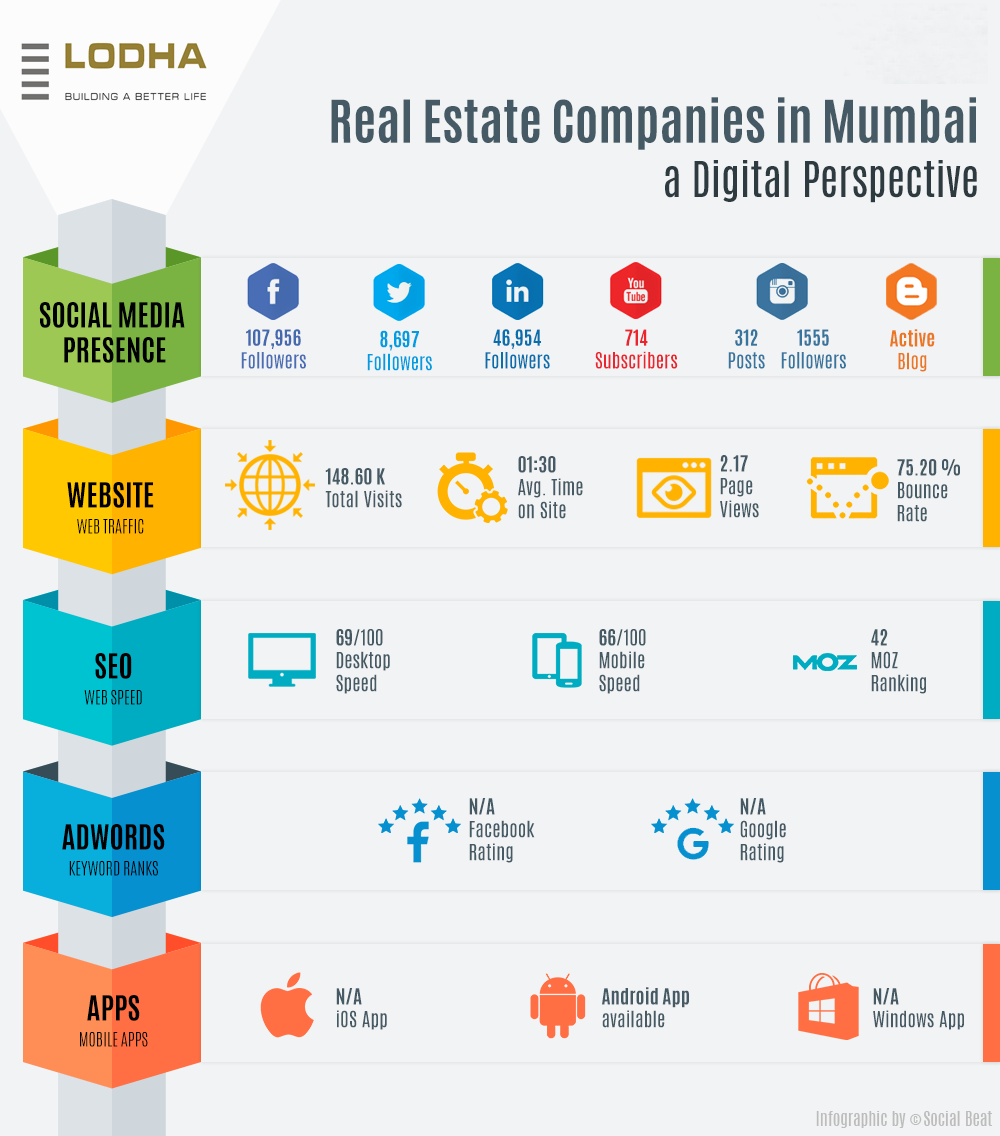
Lodha Group is one of the leading real estate developers in Mumbai and the most profitable players in India. They are known for making landmark developments in residential and commercial spaces and pioneering new trends.
UX Audit:
They have an interesting design of image slider that showcases all the project launches and promotions. The project locator is a nice filter functionality to find project developments. Project page showcases the projects based on their location and has the information about the price too. This leads to the enquiry page with project brief and lead generation form. The website is, however, not mobile-friendly as the text is too small to read and the contents are wider than the screen.
Key Features:
Web Insights:
| Total Visits | Avg. Time on Site | Page Views | Bounce Rate |
| 148.60K | 00:01:30 | 2.17 | 75.20% |
Moz rank: They have a Moz rank 42 for Domain Authority.
Website Speed:
Twitter: They have an active Twitter account with around 8000 followers. They do 20+ tweets a week and have no promoted tweets. They tweet about a wide array of topics ranging from their projects to the general industry based news. In spite of these, engagement is low on tweets.
Facebook: They have an active page with around 100000 followers. The engagement is good, highlighting the use of promoted posts. Their content includes customer testimonials and event invites.
LinkedIn: They are very active on LinkedIn and have around 47000 followers. Below is a recent post about demonetisation, which received a good response
Youtube: They have 720+ subscribers with not-so-engaging videos
Google+: Their Google+ account is active having 35 followers.
Instagram: The account is active and has 1500+ followers.
Content Marketing: Though the blog page is not very attractive, they are posting at least 4 articles per month. They have a live chat option on their blog.
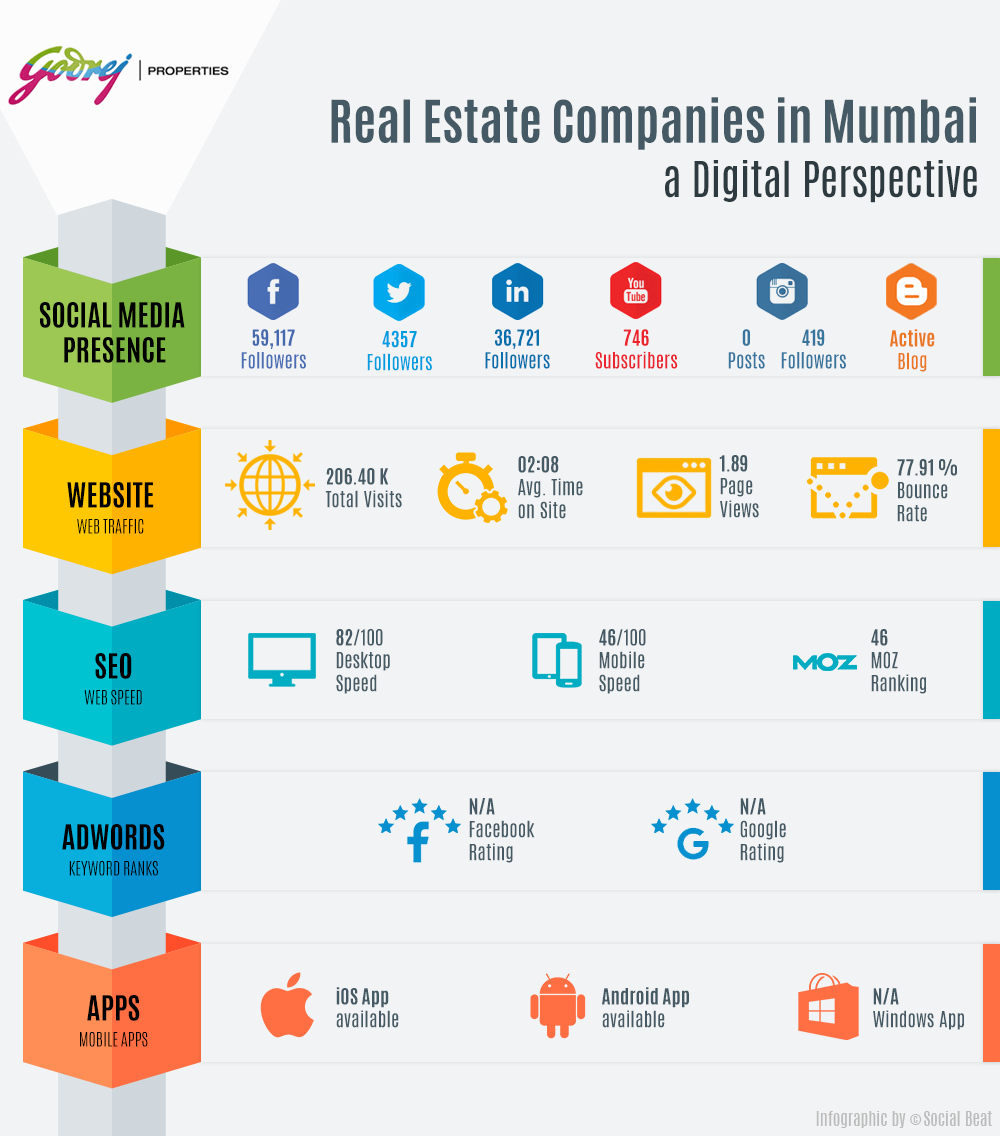
Godrej Properties develops residential, commercial and township projects across 12 cities in India. They provide imaginative and extraordinary spaces keeping customers’ needs in mind, making them one of the top real estate developers in Mumbai.
UX Audit:
They have a well-organised menu catering to different kinds of website users (buyers, investors, NRIs etc.) They also have a nice hierarchy for project menu, leading to different property projects. Individual project pages include features like project overview, highlights and enquiry form. Their page is mobile friendly.
Key Features:
Web Insights:
| Total Visits | Avg. Time on Site | Page Views | Bounce Rate |
| 206.40K | 00:02:08 | 1.89 | 77.91% |
Moz rank: They have a Moz rank 46 for Domain Authority.
Website Speed:
Twitter: They don’t have a twitter account for Godrej Properties.
Facebook: They are not very active on Facebook but they still have around 58000 followers. Below is a recent video post, which has received some responses and views.
LinkedIn: They are active in LinkedIn with around 36000 followers. Compared to other social channels they are more active on LinkedIn.
Youtube: They have 740+ Subscribers and videos in their channel are pretty engaging, having a decent number of views.
Google+: They have an active Google+ account having 474 followers.
Instagram: They have 400+ followers on Instagram.
Content Marketing: They have been blogging since May 2016. They have 15 articles as of now, and they have a separate domain for blogging.
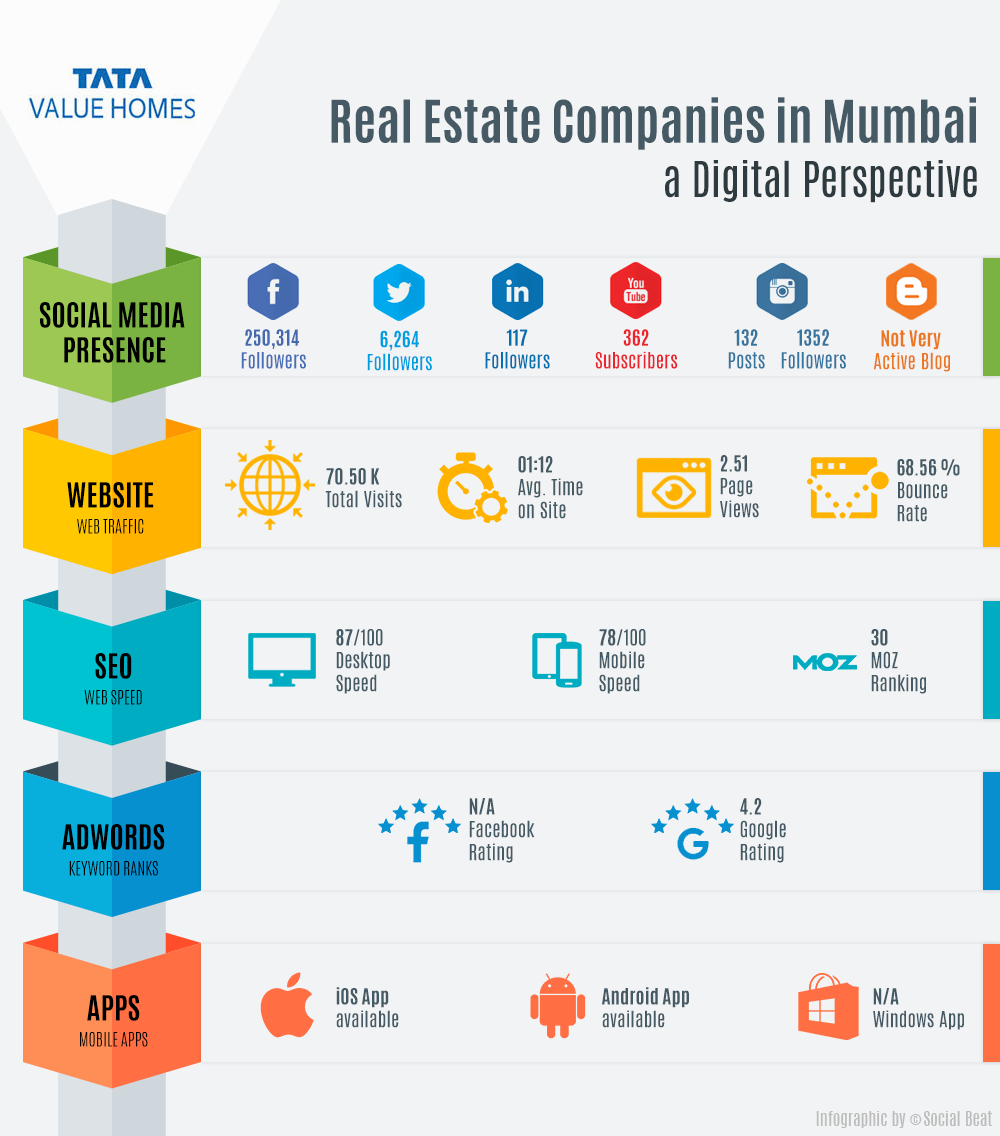
Tata Value Homes is a subsidiary of Tata Housing. It is one of the larger real estate companies that focus on low-cost housing with modern amenities.
UX Audit:
They have allocations to provide a quick filter for the audience based on the city/location of the user. The quick search option leads to a map with property locations highlighted for user convenience. Showcasing their featured projects on the homepage with prominence is an interesting feature. Laying out interesting blogs on the homepage is another noteworthy feature.
Key features:
Web Insights:
| Total Visits | Avg. Time on Site | Page Views | Bounce Rate |
| 70.50K | 00:01:12 | 2.51 | 68.56% |
Moz rank: They have a Moz rank 30 for Domain Authority.
Website Speed:
Twitter: They have around 6000 followers. They aren’t tweeting on a regular basis and they use the same content across social media platforms.
Facebook: They have around 250000 followers and have boosted some posts a few months back, but recently they are not very active. Below is a boosted post shared a few months back which has a large number of likes and responses.
LinkedIn: They have only 110+ followers, and the page has no posts till date.
Youtube: They are current not active. Their last uploaded video was 4 months ago.
Google+: They have an active Google+ account with 85 followers.
Instagram: They are also active on Instagram having 1300+ followers.
Content Marketing: They have posted only 3 blogs in 2016, highlighting the missed opportunity in content marketing.
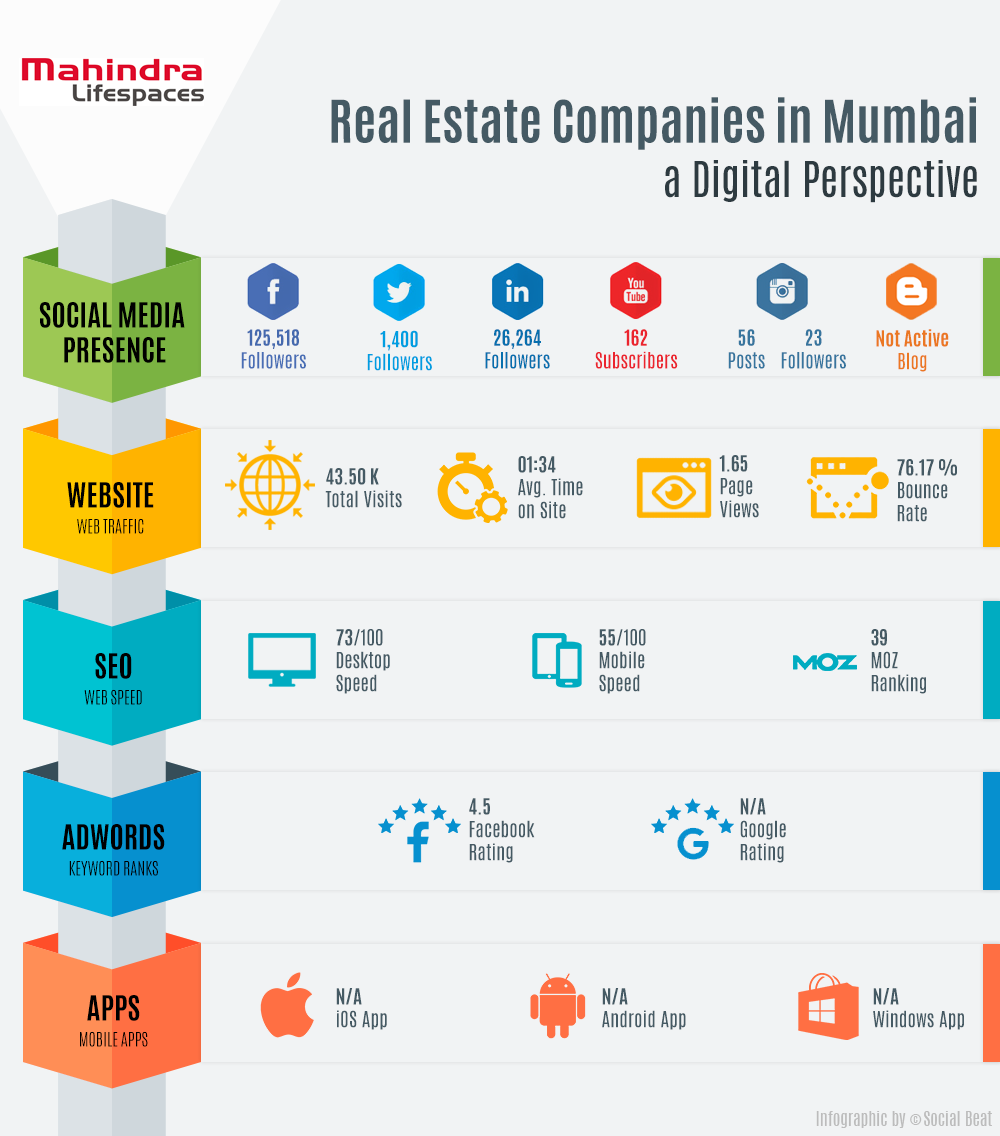
Mahindra Lifespaces is the real estate company of the Mahindra Group. They are one of the top real estate developers in Mumbai and the first Green Home Developer with Green Design & Healthy Living as their main focus across their projects.
UX Audit:
The web page has nice project filter on the home page following the banner. Sticky enquire now button to provide constant CTA is an interesting feature. A section to attract NRI investors is also present. Menu dropdown feature is quite interesting, especially the categorized submenu for projects.
Key features:
Web Insights:
| Total Visits | Avg. Time on Site | Page Views | Bounce Rate |
| 43.50K | 00:01:34 | 1.65 | 76.17% |
Moz rank: They have a Moz rank 39 for Domain Authority.
Website Speed:
Twitter: They are active on twitter with engaging tweets. Below is a public awareness tweet.
Facebook: They are very consistent in boosting posts and are active on Facebook, having around 125000 followers.
LinkedIn: They have an active LinkedIn page, which has around 26000 followers. They are posting engaging contents on a regular basis.
Youtube: They have only 160+ subscribers. They upload two to three videos per month.
Google+: They are not active on Google+ and have only 6 followers
Instagram: They are active on Instagram having 50+ followers.
Content Marketing: They don’t have a company blog.
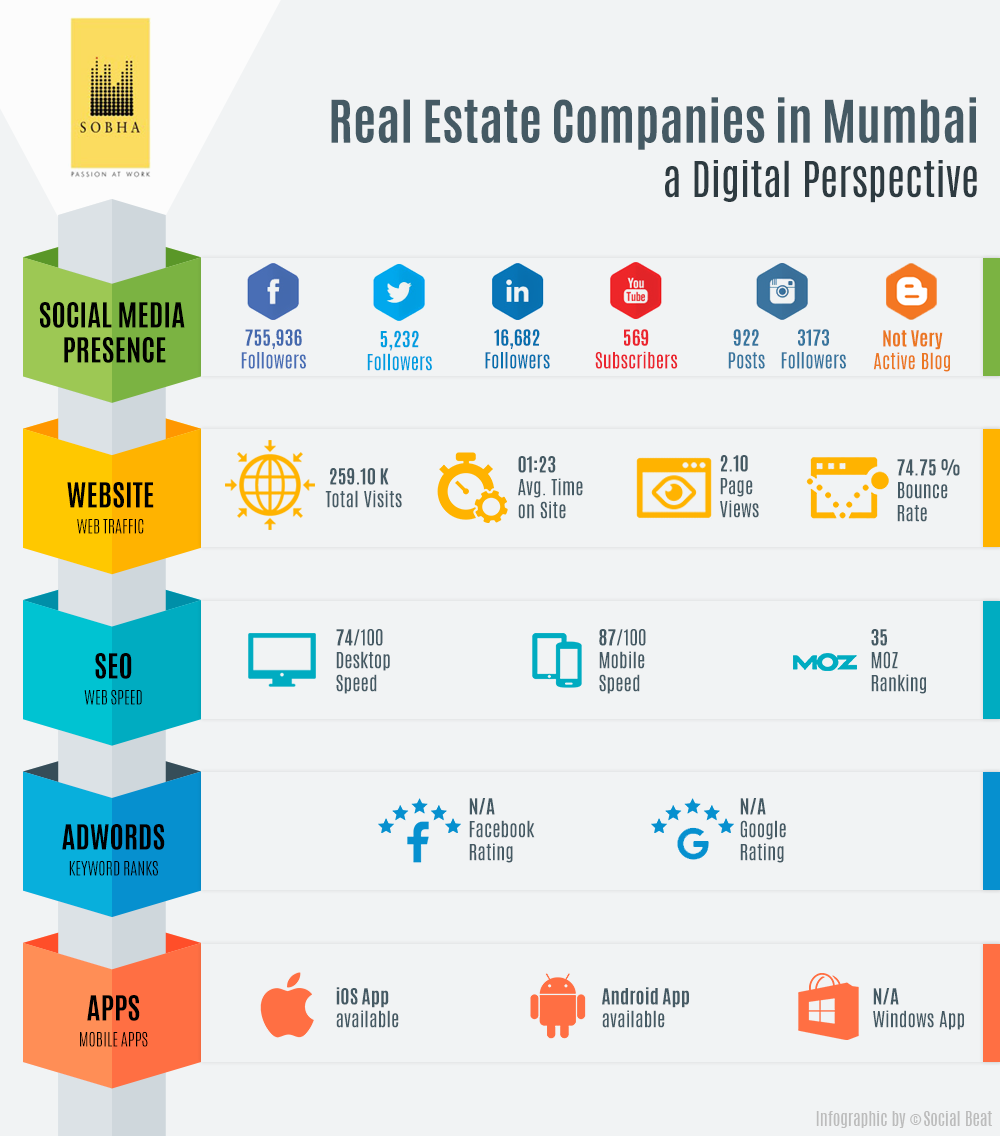
Sobha Group is one of the largest real estate organizations in India and the Middle East. They focus on delivering the highest levels of quality, with no compromise, making them the top real estate developers in Mumbai.
UX Audit:
The premium images rolling in the banner connects the user to the luxury of the brand. The main menu could have been more prominent instead of being placed against the sliding banners. Apart from that, the site has a very nice organization of the project information – presented state-wise and sorted by price.
Key Features:
Web Insights:
| Total Visits | Avg. Time on Site | Page Views | Bounce Rate |
| 259K | 00:01:23 | 2.10 | 74.75% |
Moz rank: They have a Moz rank 35 for Domain Authority.
Website Speed:
Twitter: They are very active in Twitter having around 5000 followers and they do 3 to 6 tweets a day which is a lot compared to other developers. They have a diverse set of tweets ranging from new project launches to general industry based news. Despite these, engagement is low on tweets.
Facebook: They have an active page with around 7 lac followers and they have been posting at least twice a day and the engagement is good. Below is an organic post which had a good response.
LinkedIn: They are very active in LinkedIn having around 16000 followers.
Youtube: They have an Active Youtube account with 570+ subscribers and they have interesting Testimonial videos.
Google+: They have an active Google+ account with 554 followers.
Instagram: They are active on Instagram with 3100+ followers
Content Marketing: They have a blog, which is not active.They do not have any mention about their blog on their website.
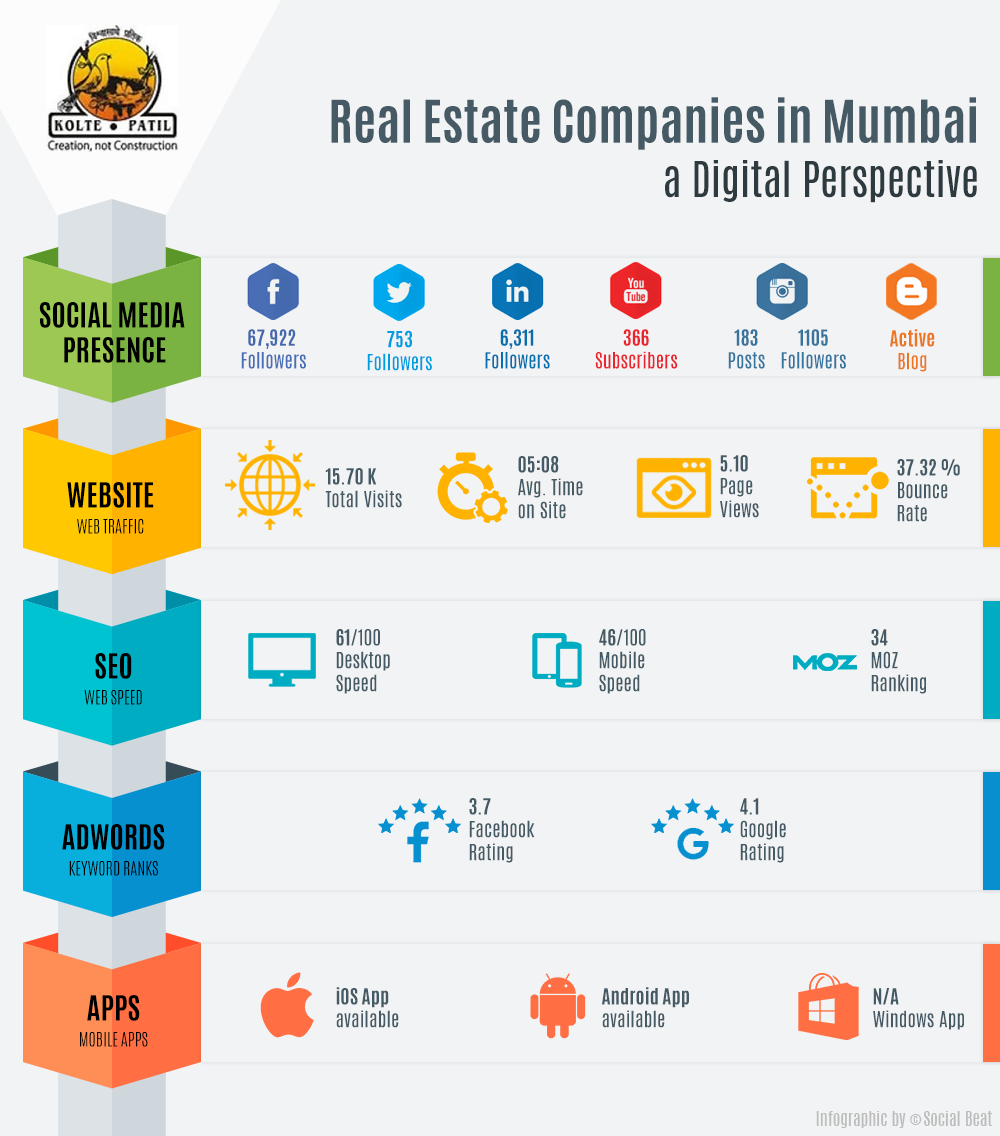
Founded 2 decades ago, Kolte-Patil has built residential, commercial, retail, and integrated township projects till date.
UX Audit:
Interesting zoom in feature on the banner images attracts the users. Well organized menu putting out all the necessary information is a great feature. Book Online page showcases all the projects with the quick facility to book. They also have live chat option in all the pages.
Key Features:
Web Insights:
| Total Visits | Avg. Time on Site | Page Views | Bounce Rate |
| 15.70K | 00:05:08 | 5.1 | 37.32% |
Moz rank: They have a Moz rank 34 for Domain Authority.
Website Speed:
Twitter: They have around 10000 followers and are highly active on Twitter. Their tweets are very engaging.
Facebook: They are having around 67000 followers and post twice a week.
LinkedIn: They have around 6000 followers and are moderately active on LinkedIn with 3 to 4 posts per month. Below is a post, which got pretty good responses.
Youtube: They are not very active and have only 367 Subscribers. Their videos have a decent number of views.
Google+: They are active on Google+ with 114 followers.
Instagram: They are also active on Instagram having 1100+ followers.
Content Marketing: Though they do not have an attractive blog page, they are posting 2 articles every month.
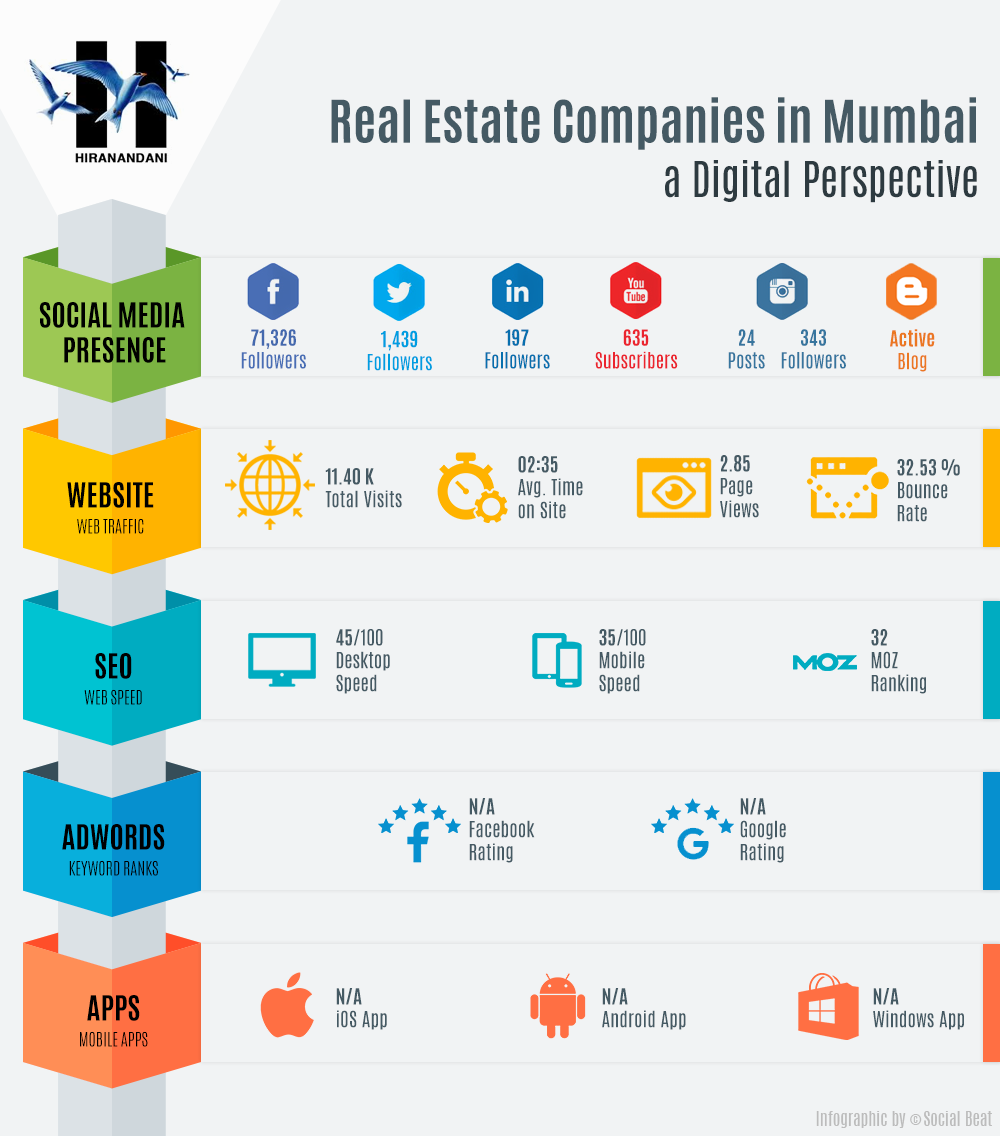
Pioneering new technologies & bold design, Hiranandani Developers have created residential townships & commercial complexes meeting the expectations & lifestyle of the people.
UX Audit:
Their Homepage design focuses on all the launches/promotions. Placement of a common enquiry form across all projects, to make enquiries for the visitor easier is appreciable. The website is mobile friendly.
Key Features:
Web Insights:
| Total Visits | Avg. Time on Site | Page Views | Bounce Rate |
| 11.40K | 00:02:35 | 2.85 | 32.53% |
Moz rank: They have a Moz rank 32 for Domain Authority.
Website Speed:
Twitter: They have around 1400 followers and are highly active on Twitter with at least 4 to 5 tweets every day.
Facebook: They do have an active page with 71000 followers. Below is a Selfie contest post, which was engaging and had good responses.
LinkedIn: They have only 190+ followers in LinkedIn and they haven’t posted anything until now.
Youtube: They have 630+ subscribers on Youtube. Though they are not active on YouTube, they have decent views for their engaging videos.
Google+: They are not active on Google+ and have only 29 followers.
Instagram: They are active in Instagram having 300+ followers.
Content Marketing: They have their blog in Weebly and actively post articles about real estate, their ongoing projects, and latest industry related news.
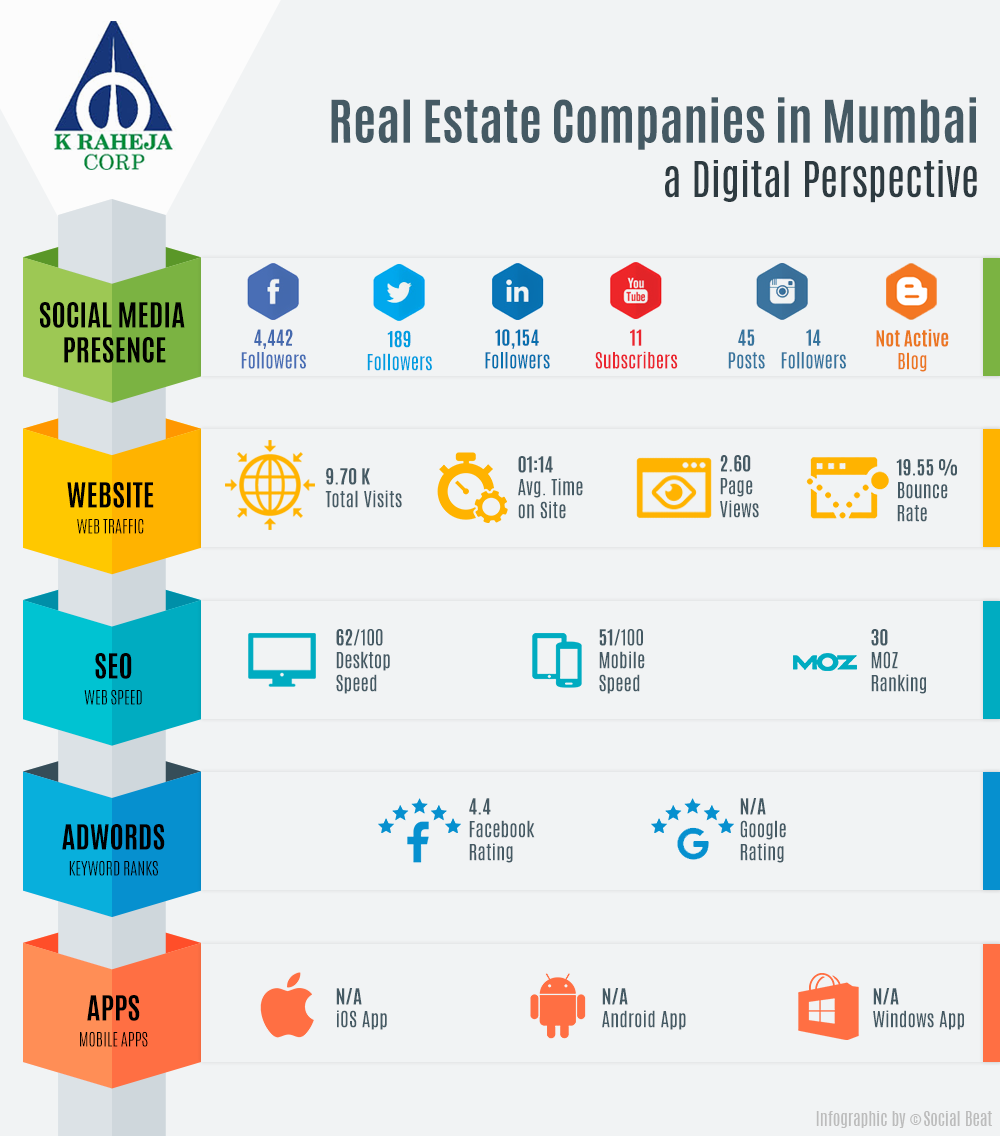
K Raheja is one of the most trusted real estate developers in Mumbai and the Indian subcontinent. From residences to workplaces, hotels to retail destinations, they have made a meaningful impact on the evolution of modern-day living.
UX Audit:
They have a Minimalistic home page with user engagement focussed to the menu. Explore our Projects feature introduces users to all the brands, where each brand project page comes with details of the project and enquiry provision. Their website is not mobile friendly because the text is too small to read and the content is wider than the screen.
Key Features:
Web Insights:
Total Visits |
Avg. Time on Site |
Page Views |
Bounce Rate |
| 9.70K | 00:01:14 | 2.60 | 19.55% |
Moz rank: They have a Moz rank 30 for Domain Authority.
Website Speed:
Twitter: They have only 180+ followers, and they have good quality tweets with no engagement. If they promote their tweets, they can get results.
Facebook: They have 4500 followers on Facebook. They are consistently posting 6 to 7 contents per week all are organic, so they are getting low responses and engagements. Below is an interesting post with not much engagement.
LinkedIn: They are not active on LinkedIn but have around 10000 followers and they haven’t posted anything till now.
Youtube: They are not active on Youtube and have only 11 Subscribers, and their last upload was a year ago.
Google+: They do one post a week in Google+ but still they have only 8 followers.
Instagram: They have only 8 followers in Instagram.
Content Marketing: They don’t have a company blog.
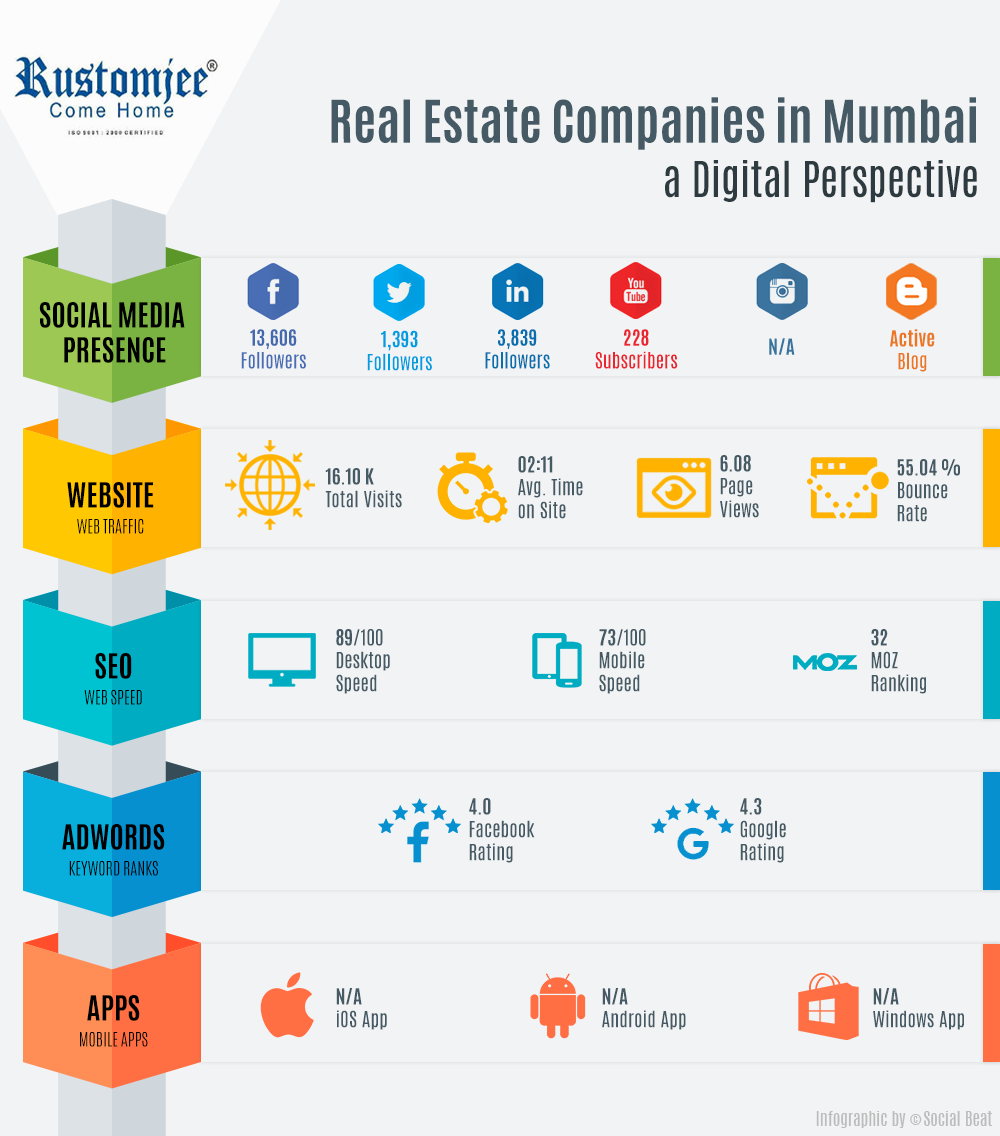
Rustomjee Spaces have transformed 10 million square feet of the city into premium townships, corporate parks, retail spaces, and 8,500+ homes with a special focus on Mumbai Metropolitan Region.
UX Audit:
The web page has a simple banner with prominent CTA and Project locator. There is a showcase of featured properties, and they do have an enquiry form. Project Explorer has filters that would help the user to find properties easily and closer to their choice and their website is mobile friendly.
Key Features:
Web Insights:
| Total Visits | Avg. Time on Site | Page Views | Bounce Rate |
| 16.10K | 00:02:11 | 6.08 | 55.04% |
Moz rank: They have a Moz rank 32 for Domain Authority.
Website Speed:
Twitter: They are active having 1400 followers on Twitter, and they have been consistently tweeting 6 to 9 tweets per week. They have no promoted tweets so there is only little responses. Below is an interesting tweet with little engagement.
Facebook: They have around 13000 followers posting 5 to 6 times per week with little response. All their posts are organic. They might get good engagements if they boost their quality posts.
LinkedIn: They aren’t active past 3 months, but they have decent engagements in their previous posts.
Youtube: They have 220+ subscribers, and they are uploading 3 to 4 videos per month. They have decent views. All the videos are real estate Industry related.
Google+: They are not active on Google+ for the past 2 years.
Instagram: They do not have an Instagram account.
Content Marketing: They are maintaining 2 blogs and have been posting their project related and educative articles at least once per month.
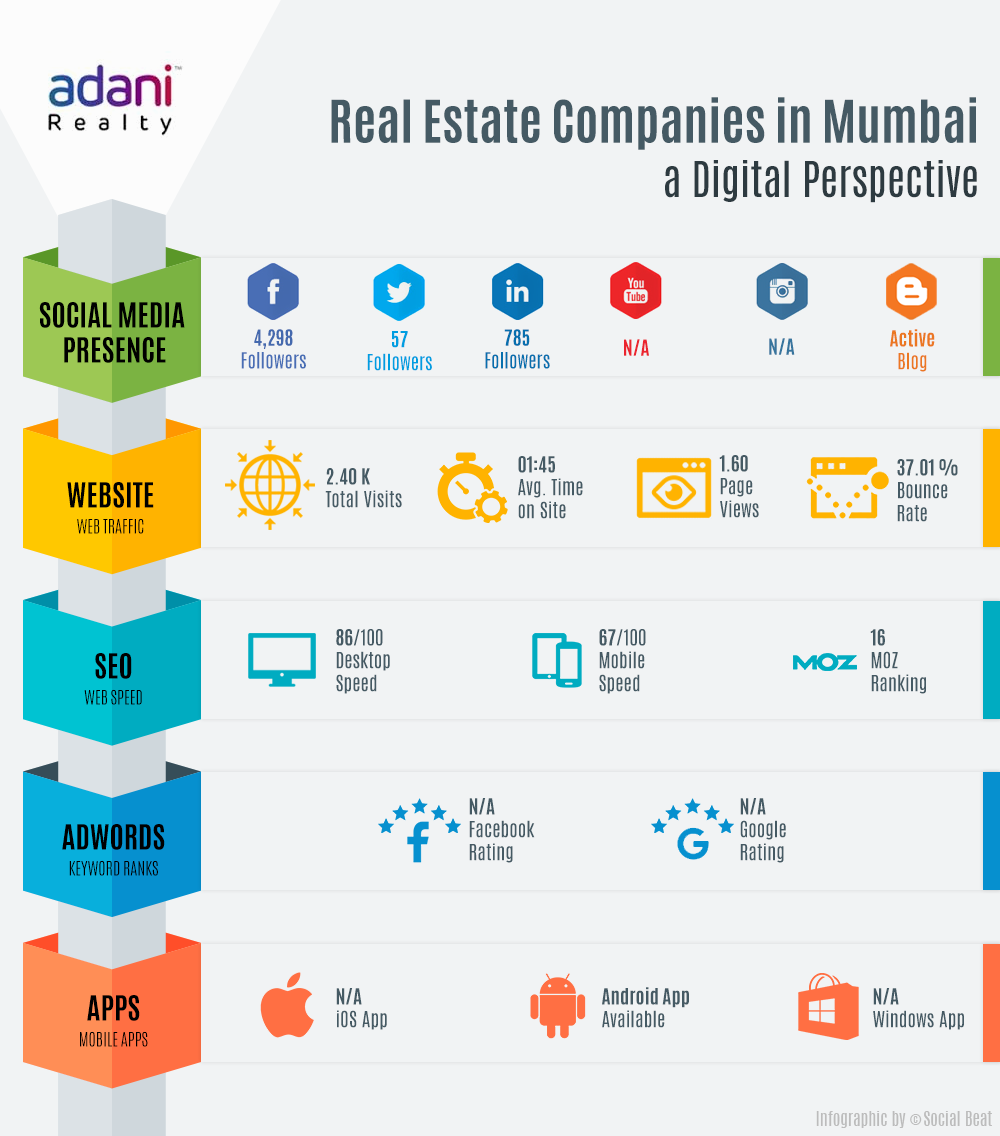
Adani Realty has been developing residential, commercial and social club projects across Ahmedabad, Mumbai, Gurgaon, Kochi & Mundra.
UX Audit:
Their web page has an interesting single scroll homepage design, which focuses on two utilities - one showcasing all their launches and promotions and the other leading the visitor directly to projects/gallery/other information via the menu. Elegant project showcase with the project overview and CTA's leading to individual project websites are some of the noteworthy features.
Key Features:
Web Insights:
| Total Visits | Avg. Time on Site | Page Views | Bounce Rate |
| 2.40K | 00:01:45 | 1.6 | 37.01% |
Moz rank: They have a Moz rank 16 for Domain Authority.
Website Speed:
Twitter: They have 50+ Followers in Twitter and are moderately active. They do 4 tweets per month. Below is an interesting post having low engagement.
Facebook: They are active in Facebook having around 4k followers, and they do at least one post per day and have boosted a contest campaign, which had a good response
LinkedIn: They have 785+ followers and are not that active. They do 4 posts per month and the engagement is low.
Youtube: They don’t have a Youtube channel.
Google+: They are not active in Google+
Instagram: They are not active on Instagram
Content Marketing: They have an active blog in their website itself, and there are around 300 articles.
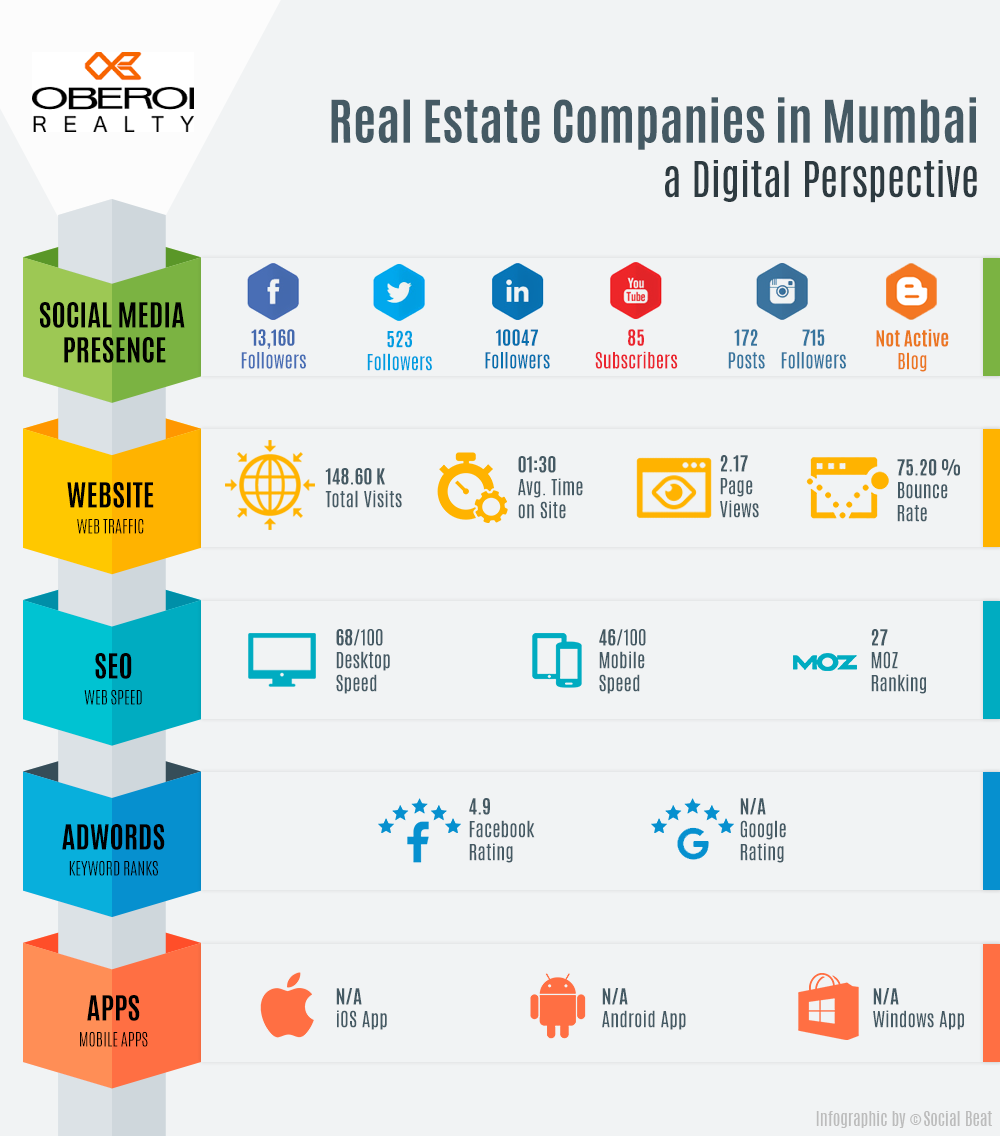
Oberoi Realty has developed over 39 projects at strategic locations across the Mumbai skyline. Over the past three decades, they have been consistently providing high-design and quality residential, commercial, and retail spaces.
UX Audit:
The banners and featured projects provide prominent information to the audience coming to their site. Individual project pages are organized state/city wise to make the navigation easier for the users. Schedule a visit is a useful provision for interested buyers/investors.
Key Features:
Web Insights:
| Total Visits | Avg. Time on Site | Page Views | Bounce Rate |
| 148.60K | 00:01:30 | 2.17 | 75.20% |
Moz rank: They have a Moz rank 27 for Domain Authority.
Website Speed:
Twitter: They are moderately active having only 50+ followers, and they do 2 to 3 tweets per day mostly about their ongoing projects.
Facebook: They are active on Facebook with around 13000 followers posting 3 to 4 times a week. Their posts are organic and have decent engagements. Below is an interesting post about their project.
LinkedIn: They are moderately active with around 10000 followers. They do post 3 to 4 times per month, and the posts are engaging with good responses.
Youtube: They are not active this month but have 80+ subscribers. They have many testimonial videos which are having a good number of views and response.
Google+: They are not active on Google+.
Instagram: They are highly active on Instagram having 700+ followers.
Content Marketing: They don’t have a company blog.
There is no doubt that the best real estate marketing companies in Mumbai are on the lookout to help leading real estate developers leverage the power of going digital. Make sure you read through our blog on Digital Marketing by Real Estate Developers in Bangalore and our detailed Case Study of How a Real Estate Company grew via Digital Marketing for better insights.
You can also check out our blog on how Casagrand generated a record 190 crores in revenue via Facebook for a detailed understanding of digital marketing for real estate.