Since it first launched, WhatsApp has quickly taken over SMS as the most preferred form of messaging among Indians. WhatsApp currently has 225+ million users in India, which is around half of the total number of internet users in the country. It a mobile app that’s here to stay in India.The growing number of Indians using WhatsApp can be attributed to the sudden drop in data costs and the introduction of low cost smartphones. Because of this, the app quickly became popular among Indians of all ages and economic backgrounds as it offered a free, simple way to connect with each other. But WhatsApp wasn’t just used for personal conversations among friends and families. For a long time, owners of small businesses like grocery stores and tailors used the app informally to communicate with their customers. Taking notice of this huge potential, WhatsApp launched WhatsApp for Business, a feature which can help brands engage with India’s next billion internet users. This new feature aims to simplify the process for SMEs (Small and Medium Enterprises) to connect with their customers.
WhatsApp for Business is currently only available as an Android app which can be downloaded for free from the Play Store. iPhone users will have to wait a little while longer until WhatsApp for Business rolls out an iTunes app as well. WhatsApp for Business is exclusively for business owners to communicate with their customers. In other words, businesses will use WhatsApp for Business to speak to their customers who will receive these messages on their regular WhatsApp account. To register on it, businesses will need a number that isn’t connected to their personal WhatsApp account. If you don’t have a separate business number, you will need to either get one or transfer your personal number to your WhatsApp for Business account. Once the app verifies your number, you can start setting up your business profile and begin communicating with customers.
WhatsApp for business looks almost identical to the regular WhatsApp, however, there are a few key differences. A number of tools have been added to the business app, facilitating easier communication for business users.
Once on the app, WhatsApp allows you to create a ‘Business Profile’ on your account that needs to contain important information such as your business’s email ID, contact number and address. There is also a location feature which allows business to locate their store on the map. Filling in this information will help users understand your business better. Over time Whatsapp also aims to verify each business and link their FB profiles as well, so that only authenticated businesses and stores can reach out to their customers.
WhatsApp for Business also makes it very simple to engage with your customers, even if your consumer base grows very large. The ‘Messaging Tools’ feature allows you to create message templates which can be sent out to your customers automatically. ‘Quick Replies’ allows you to set message templates to questions that your customers frequently ask, so you can easily respond to them. These include ‘thank you’ messages every time your customers order something or details about your products and prices. You can also set up ‘Greetings’ messages which are sent when you are first interacting with a customer and ‘Away’ messages which are sent when you are unable to respond to them at that time.
When Whatsapp for Business was first showcased to our team at the FB SME Council in India, it was made abundantly clear that it is not going to serve as a bulk/promotional messaging service. The intent is to provide customers the convenience to reach brands and vice versa. So its ideally meant to keep in touch with existing customers or leads.
One of the key features WhatsApp for Business offers is an easy way for business owners to understand how well their messages are performing. For now, the current version of WhatsApp for Web offers basic statistics such as the number of messages delivered and number of messages actually opened. The data collected from these statistics can offer business owners invaluable information on the efficacy of their message strategies. This information allows them to identify the type of content their target audience will find engaging. This can help them come up with more targeted message strategies that will resonate better with their audience. While the current statistics offered are very straightforward, future updates of WhatsApp for Business might include more detailed statistical tools.
One of the biggest hurdles that WhatsApp for Business faces is that non-business users might not like receiving business messages in their WhatsApp inbox. Most of our SMS inboxes are filled with promotional messages from businesses with barely any messages from our actual contacts. With the introduction of WhatsApp for Business in India, especially since it’s free, these businesses might start using WhatsApp instead to message people. Because WhatsApp is such a personal form of communication, the fear of spam is ever-present, with users expressing concern over their WhatsApp inbox also becoming flooded with promotional messages.
However, WhatsApp has ensured that it is putting the users first even with the introduction of WhatsApp for Web. If users are receiving too many messages from a business or they aren’t interested in the business, they can easily block the business or report it as spam. The rigorous verification procedure ensures that the business on the app are legitimate, reducing the chances of spam. WhatsApp is also introducing a verification badge against businesses if their WhatsApp for Business number matches the number registered against their business. This feature will help users understand which businesses are authentic.
After the success of an initial beta version of the service, WhatsApp launched the WhatsApp Payments feature in India for Android during early February of 2018. This feature is very similar to other digital payments services like PayTM as it operates through the United Payments Interface (UPI) and supports most of the major banks used in India. Once you have verified your bank account details, you can directly transfer money from your account to other users through WhatsApp.
WhatsApp Payments and WhatsApp for Business in India are two new features which can work together in synergy. It can enable small business to reach out to their customers who can then pay for their products or services directly through WhatsApp. Since the upper limit for the amount of money which can be transferred through WhatsApp Payments is set at Rs. 5,000, it makes its features best suited for SMEs. For example, using WhatsApp for Business and WhatsApp Payments, users can easily order and pay for their weekly groceries from the local convenience store. This can go a long way in helping small business improve their sales.
As the name suggests, WhatsApp for Business works like a typical WhatsApp account but has additional privileges that are tailor-made for businesses. Aptly titled “WhatsApp Business”, the app can be downloaded from the Google Play Store. Once downloaded, you can register with a phone number that is exclusively used for your business. You can then stay connected with your consumers with interactive tools that let you respond to messages easily, sort your messages as per your preferences and automate your replies, among other functional tasks.
Just like the regular app, WhatsApp for Business is also free. The only expense you will face is setting up a distinctive mobile number that will be used exclusively for your business. You will need this to register your business on the app. However, WhatsApp may begin charging businesses in the future for these services.
You begin by downloading the app titled “WhatsApp Business” from the Google Play Store. Once you agree with the terms and conditions, you will have to register with a phone number used exclusively by your business. Once the number is verified, you can begin using the app to stay connected with your consumers.
WhatsApp for Business is currently available only on the Google Play Store. You will need an Android device to download and use it. However, the app is under development for iPhone users and will be available on iStore soon.
Apart from it being exclusively designed for businesses, WhatsApp Business has a distinctive feature called “Business Profiles”. This tab helps consumers generate more information about the business such as the official email ID, website and store address. This tab also accommodates a small description of the business to give consumers detailed insights into the kind of products or services offered.
WhatsApp for Business also offers a plethora of handy messaging tools to make it easier for to interact with consumers by sorting messages, creating automated replies and designing frequentlyused templates for messaging.
There are many messaging tools available in WhatsApp Business that make it easier for businesses to interact with their consumers. For example, you have a “Quick Replies” option to send instant answers to frequent questions. You can also create a template to greet your consumers with a greetings message or a thank you note. Additionally, you can create a customised “Away Message” to let your customers know you are currently not available and will get back to them shortly.
Apart from tools for easy execution, WhatsApp Business also offers statistical data of your messaging pattern. You can keep a tab on the number of messages sent, delivered and opened to give you a fair idea of how consumers are responding to your messages.
While WhatsApp for Business is still in its nascent stage, it definitely has the potential to explode in India. Evolving digital marketing techniques in tier 2 and tier 3 cities should definitely begin to utilise WhatsApp for Business in their strategies. For small businesses, it could prove to be an important tool to help them expand their profits in the face of growing competitions from larger corporations. We also understand that APIs to allow for managing larger number of conversations is on the cards so the future of Whatsapp for Business is indeed exciting.
With 300 million active Indian users from diverse backgrounds, Facebook is one of the best platforms for brands to reach their target audience. However, the competition is undeniably high and brands need to constantly look out for ways to stand out. One of the most effective ways for brands to capture their audience’s attention completely in this crowded space is through Instant Experiences. Previously known as Canvas, Instant Experiences offers brands an immersive full-screen experience with new and updated features.
Instant Experiences comes in five templates, each of which is tailor-made for brands with specific goals:
Instant Storefront: Certain to become one of the top social media trends for FMCG and retail brands, this template showcases products in a grid format along with their price. After clicking on them, users are immediately taken to the product page where they can make a purchase. The convenience that this offers can help brands increase their sales through social media marketing.
For D:FY, we used Storefront to showcase the products and direct viewers to the Amazon product page where they can actually buy the product. This led to higher engagement and increase awareness of the brand.
Instant Lookbook: With the artsy aesthetics of magazine spreads, the Instant Lookbook template can help fashion brands bring their looks to life. Users can scroll through each of the looks and click on them to be redirected to the product page where they can explore the product further and buy it.
Read our blog on Design Tips to Create Great Visual Posts on Social Media to get started.
Instant Customer Acquisition: For brands focused purely on driving sales and growing their customer base, Facebook’s Instant Customer Acquisition template can encourage higher conversions. This template can be used to showcase the different features of a product and provide users with a clear call-to-action at the end to compel them to make the actual purchase.
Instant Storytelling: While the 20% rule for text overlays on images has been removed, creatives with less text generally perform best on Facebook. Because of this, brands are often unable to communicate their entire brand story as engagingly as they would like. Instant Storytelling offers a solution to this. Through a mix of images, videos and text, this format gives brands all the space they need to communicate their brand offerings and key differentiators. Your brand can leverage the top design trends for digital marketing to create unforgettable experiences for your audience.
Instant Form: Looking for quick lead generation? Instant Forms drive your consumers towards a clear call-to-action by asking them to fill out a form. When combined with the superior visual appeal and space to showcase your USPs, Instant Forms has the potential to drive higher leads than other forms of advertising on Facebook.
Facebook’s new Instant Experiences doesn’t just give you new ways to appeal to your target market, it also helps you analyse just how effective your techniques were. If you have embedded pixel in your company’s website, it will automatically become integrated with Instant Experiences once you start experimenting with it. This will give your brand valuable data and deep insights into the customer journey. It will show you time spent by each users, whether they engaged with it (such as scrolling through a carousel) and how far they scrolled. This will give you a better understanding of what messaging or visuals appealed the most to your target audience, helping you optimise future campaigns. The pixel will also allow brands to re-target their website visitors, which can drive higher engagement. Instant Experience can even integrate with external tracking codes, such as Google Analytics, helping you paint a complete picture of your consumer’s online touch points.
If you have already used Canvas for your brand, the updated Instant Experiences can provide you with even greater results. But if you have never experiments with these immersive ads, here’s why you should start.
Your audience is more impatient now than ever before. If your ad doesn’t look quickly, users are likely to bounce immediately. Instant Experiences offers incredible speed, loading almost instantly. This can encourage users to stay on your ad and reduce bounce rates.
The digital clutter your audience experiences can prevent them from focusing fully on your ads. However, when they open an Instant Experience ad, it takes up their entire phone screen, blocking notifications, messages and other ads. This makes it easier for your message to resonate with them, enabling better recall.
The multiple templates that Instant Experiences offers, makes it very easy for brands to adapt and use. You don’t need complicated codes or development to get started. Regardless of your budget or resources, you can start using Instant Experiences to engage with your audience.
Instant Experiences has a number of tools and formats that you can use to communicate your brand story in the best way possible. You can use a mix of stunning images, carousels, videos, text and forms to create an ad that your audience won’t forget.
Interactive ads are changing the way brands advertise by compelling users to engage with them more. Unlike ads on the News Feed, which users can easily scroll past, Instant Experiences offers them more information, are more visually appealing and engaging. This can give users a greater incentive to enquire. The Instant Forms format can also be more effective than traditional form as on Facebook.
No matter what your brand goals are, Instant Experiences offers a novel and exciting way to achieve them. Are you ready to start using it to give your brand an edge?
Whatever be the type of business you are running or the industry you are from, generating leads is what it all comes down to. Without leads, a business has no profit, no revenue and ultimately, no business. However, generating these leads can be a major challenge for companies in the B2B space. Most B2B businesses operate in a very niche segment, which automatically reduces the number of potential leads that can be generated. To add to that, personal relationships with clients has always been the key deciding factor for companies in this sector looking to acquire new customers. These elements might make generating B2B leads more difficult than for other sectors, but it’s not impossible! With the right mix of proven techniques, your business can acquire high-quality leads through the digital medium.
So, as a business owner or an entrepreneur, how do you generate leads to grow your B2B business? Let’s take a look at few of the tried-and-tested ways.
As the age-old saying goes, Content is King. The biggest advantage of using content marketing instead of advertising as your lead generation strategy is that it reaches users who have activated ad blockers. Advertising your product through search engine-optimised content marketing also helps in boosting organic traffic to your website.
Let’s take a look at the various forms of content you can use to leverage content marketing for greater brand awareness.
Blogs have become essential for every business and are the best way to generate informative and educational content about your brand. Blogs are also a guaranteed SEO- friendly marketing method that generates organic traffic to your website. By consistently adding authoritative high-quality content on your blog, you can establish your brand as a thought leader in your domain. Over time, your blog will help build a strong community of interested individuals that you can tap into to generate leads.
If pictures can speak a thousand words, it is safe to say that videos present the viewers with a thousand pictures. They give viewers a detailed insight into the products and services offered by your company which plays a huge role in influencing their decision to convert into leads. Videos can also present complicated concepts in a very engaging manner that is easy to understand. This can help potential clients get a better understand of your products and services. From a whiteboard video explaining a solution to a particular problem in your industry to a product-centric video, opportunities are aplenty.
For Sundaram Business Services, we created a short explainer video detailing how accounting firms would benefit from outsourcing their routine tasks. This video encapsulates Sundaram Business Services’ USPs in a crisper and more compelling manner than any other medium would be able to.
E-book and white papers are excellent examples of content that can be a powerful tool for lead generation. There are two ways you can achieve this objective:
This method gives you a hand-picked database of clients who are particularly interested in your brand as they took the time and effort to fill a form just to read your content. To generate quality leads, make sure your content is extremely informative and educational with the right proportion of generic and promotional content. The best way to do this is to understand what your audience is searching for and write about the topic to cater to their needs.
Backing up your content with infographics, reports, graphs and other forms of research adds credibility to your claims. In order to explain your services and their advantages more effectively, take your content strategy up a notch and present your audience with an informative case study. Nothing convinces potential clients better than examples of how much you have succeeded in the past with other B2B clients.
Content marketing is all about being actively involved in the digital space. Bring out your brand name by conducting webinars or interactive podcasts on topics which are trending among your audience segment audience to spark interest. This will create awareness about your organisation and indirectly showcases your products and services for the world to see.
It isn’t just writing high-quality content that is important, but optimising it for search engine rankings. SEO is a guaranteed way to boost your brand image and increase your website traffic.
The logic is simple. Most people searching for B2B services on the internet are looking to close the deal. Presenting them with your website is a guaranteed way to effective lead generation for your organisation. As per a recent study, the close rate of an SEO lead is a whopping 14.6% while the close rate of a sponsored lead is a mere 1.7%. Additionally, of the overall local Google traffic, 67% of searches end up in a conversion. With such stunning numbers, there is no doubt that SEO is the most-effective long-term lead generation strategy for B2B businesses.
LinkedIn is the biggest professional network in the world, so when it comes to finding potential clients for your B2B business, it is indispensable. It offers more defined targeting options that Facebook does, helping you find your exact target audience, no matter how niche your segment is. The key to successfully using LinkedIn for lead generation is to adopt a ‘full-funnel approach’. Once you create a target audience, ensure that all your promotions are sent to this same template. This ensures that your brand engages with them right from the awareness stage to the final conversion step.
Read on to find out what are the tools you can leverage on LinkedIn to widen your clientele.
Promoting your blogs on LinkedIn through Sponsored Posts is essential to widening their reach. This tool allows your content to be seen by a highly-relevant target audience who might not have otherwise come across your brand or content. By promoting blogs based on topics that your audience will find useful, you can initiate a relationship with your audience. Being consistent with your promotions will ultimately increase brand awareness and improve your audience’s perception of your company.
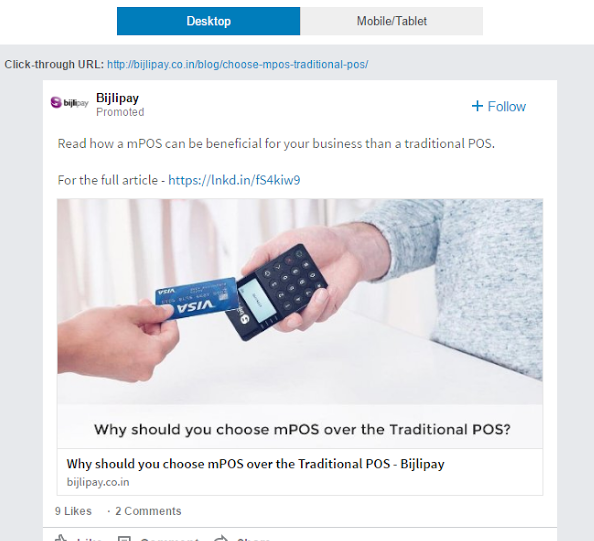
We leveraged LinkedIn Sponsored Posts for one of our B2B clients – BijliPay. We promoted an extensive in-house blog on the benefits of choosing mPOS devices over the traditional POS devices. The blog gives the reader a detailed insight into the services provided by BijliPay and indirectly works as a lead generation platform to convert the reader into a potential client.
LinkedIn lead ads take lead generation for B2B businesses to the next level. They work like usual lead ads, except that when you click on the call to action, the browser takes the user to a pre-filled lead form. The form is pre-filled with information retrieved from the user’s profile, eliminating the need to fill it up manually. Apart from saving a lot of time and effort, this feature allows users to fill in the lead form in the LinkedIn page itself without the need to visit a landing page or website. These ads are particularly effective after you have been promoting your content to the same target audience. Since the audience is already aware of your brand and has started to trust you, they will be more likely to submit the form.
InMail Ads are ads presented in the form of emails to the LinkedIn inbox of your target audience. This form of marketing is extremely effective as you get to handpick your audience based on their LinkedIn profile and do not need their personal or professional email ids to reach them. Additionally, these emails have a guaranteed delivery rate as they are sent only to the active LinkedIn users. Apart from products and services, you can also use InMails to promote your content and initiate downloads of ebooks and promotional videos.
No lead generation strategy is complete without a landing page. A landing page is a single page website that collects the visitor’s information through a lead form. Whether you are promoting your product or allowing visitors to download content (ebooks, webinars and podcasts), building a landing page is often the solution. A targeted landing page will help you capture leads at a higher rate and will help the sales team initiate the lead nurturing process to ultimately convert the leads generated.
A good landing page, especially for B2B, needs to always have a clear headline, copy and direct call-to-action, so that the target audience understands exactly what they are signing up for. This is exactly what we did for one of our B2B clients, LatentView. The landing page for their downloadable white paper clearly conveys what the company does and what value audiences will get from the white paper.
So you’ve generated an extensive database, with the methods mentioned above, of potential clients who have shown interest in your services. But, what next? The B2B space has notoriously long lead cycles, which can prove expensive and time-consuming for companies. That’s when the tried-and-tested method of email marketing comes into the picture.
Email marketing is probably one of the first types of digital marketing, and it still remains a go-to strategy for many organisations. Since emails are one of the most personal forms of communication, they can help you initiate and sustain a strong relationship with potential clients. With email marketing, it’s generally best to keep it simple and use plain-text emails than designed templates. This makes it seem more personal, encouraging people to actually read them. Additionally, you can customise your email as per the preferences of your potential clients with various techniques of retargeting and make your services even more irresistible to them. All you need is a strong email marketing database and a fool-proof email campaign checklist for guaranteed lead conversions.
Sundaram Business Services is a business process outsourcing company headquartered in India, with operations in UK and Australia. As a B2B company, a majority of their leads came through referrals and by networking. To scale up, they needed a strong digital marketing technique that could help them acquire new clients faster and more effectively.
The target audience for Sundaram Business Services is very niche and difficult to identify. With such a limited audience, generating high-quality leads that had the potential to convert would be more difficult than it would be for a B2C brand with a widespread audience. Additionally, since B2B client relationships are longstanding and based on trust, convincing accounting firms to start outsourcing to Sundaram Business Services would be challenging through digital marketing alone.
Starting lead generation ads in isolation wouldn’t help for a B2B brand as it only targets individuals at the bottom of the funnel. To successfully acquire high-quality leads, we needed a full-funnel strategy:
The Sundaram Business Services blog is a complete knowledge repository, with the right mix of highly relevant and trending topics. We utilised this invaluable tool to its full potential by promoting the blogs on LinkedIn. This created brand awareness and developed our reputation as an expertise in the field of accounting.
We created a specialised landing page for Sundaram Business Services which provided concise details of the services and USPs of the brand. By bidding for high search volume keywords, we ensured that our landing page would show up for relevant searches. This further increased brand awareness.
Credibility and trust are the foundation of any B2B relationship. To build this for Sundaram Business Services, we created a client testimonial video and promoted it on LinkedIn. This showed our audience the positive relationship we share with our clients.
After building awareness and trust among our target audience, we started lead form ads on LinkedIn to actively start generating leads. These ads provided a clear picture of the service we provide and the benefit firms can gain by partnering with us.
Since the B2B space is so small, we knew we had to go the extra mile to ensure high quality leads. Content driven marketing is key to generating leads for B2B. Because of this, we promoted an authoritative white paper for which users had to submit a pre-filled form to download. This white paper was by far the best lead generation technique we used for Sundaram Business Services. The white paper was downloaded by CFOs from some of the top companies in India, providing us with valuable information we wouldn’t have been able to achieve through any other strategy.
Through the white paper, we were able to achieve an 800% reduction in cost-per-lead with 0 junk leads. In such a niche segment, these results were truly remarkable. It ensured an optimal use of advertising budgets and a large volume of premium leads we could use to initiate the lead nurturing process. These incredible results only prove that content is the only way forward for generating B2B leads.
If you are from the B2B sector, its time you implement each one of the above-mentioned marketing strategies in your workplace to take your business to revolutionary heights.
Are you still stuck in the paradigm of an offline marketing strategy with a 60-second TV commercial being your leading mode of communication, supported by print and outdoor advertising? If you are nodding your head in approval, you are being rapidly left behind by those who have adopted a ‘Digital-First’ marketing approach!
Brands are steadily transitioning from traditional advertising to digital marketing because of the higher reach, better engagement and increase in generating high-quality leads. Read on for the top seven reasons why your brand should adopt a digital approach.
With over 450 million Indians online today, your prospects and customers are spending more of their time online than ever before. And this number is slated to grow to 735 million online by 2021. Of these, 199 million will be English speaking, and 536 million language speaking, with over 70% of them accessing the Internet from a smartphone throughout the day. They are increasingly spending more time online than on any other medium. Is there a better way for your brand to engage with India’s next billion Internet users and reach the tier 2 and tier 3 cities in India as well?
The online population accesses digital platforms over 150 times a day for various reasons including search. Additionally, 80% of Indian users use their phones to access the Internet. This only proves that it is imperative for your brand to adopt a mobile-first strategy to rank higher than your competitors and leave a stamp in the digital world. From accelerated mobile pages for lightning-fast speed to optimising your web pages for better visibility on a mobile search, you need to leverage a custom-made digital strategy with a mobile-first approach to reach your potential consumers. Everything starts with the recognition that your digital marketing assets need to be optimised for the way consumers are behaving online now and in the future.
We leveraged the speed of accelerated mobile pages for a landing page developed for India Home Health Care, a top provider of home nursing and related healthcare services. The page helped reduce the cost per lead by a whopping 33% with a 20% increase in conversions.
How discoverable is your brand or business? Search Engine Optimisation today is very different from what it was a few years ago. Deep and relevant content, like pillar pages and other long-form content, which is easily discoverable and distributed across multiple platforms, or amplified using social media works well. Consumers today are information seeking, with a ‘discovery mindset’, using search many times a day for multiple purposes- both business and personal. So why not market your brand by making it rank on the most used search engine in the world? Featured snippets are a great way to increase brand visibility and drive organic traffic to your website.
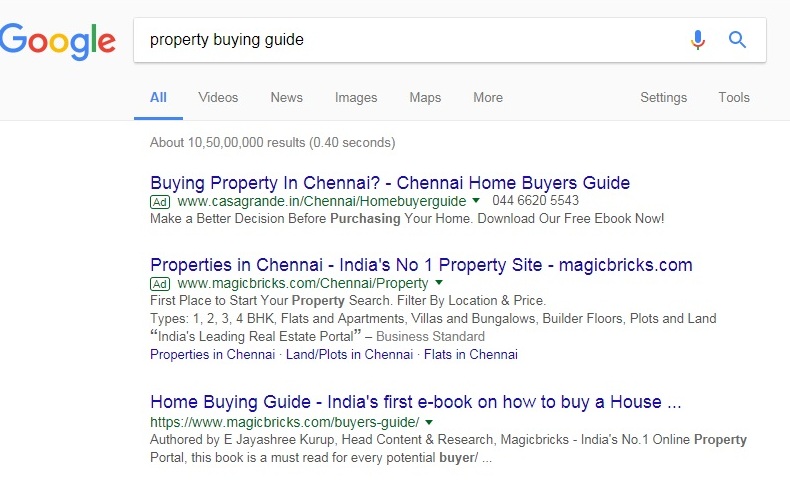
This is exactly what we achieved for Casagrand – one of India’s leading property developers with a strong presence in the south. Their blog on the best places to invest in Bangalore got highlighted as a featured snippet with an image and a list of all the locations presented in the blog.
Being discoverable is a key result area for your digital marketing assets so that consumers find your brand when they are searching for something they need. From using SEO plugins for WordPress to leveraging local SEO and Google Maps for your business, ensure your brand gets the visibility it deserves.
The world's second largest search engine, YouTube, is also a great platform to reach your target audience on. For tips on how to rank your videos, read our in-depth article: YouTube SEO Tips: The Secret Sauce to Ranking Your Videos in 2019.
Is your online communication primarily elements of your offline marketing campaign? If you have to spend to reach your target group with your advertising, what makes you think they will choose to come to your social media pages to see your ads? Instead, your online marketing campaigns must seek to engage consumers by rewarding them in some way with relevant communications on social media platforms. Make sure all your online assets are designed in such a way that they trigger engagement and ultimately result in conversions. You need to leverage the two-way communication model that digital platforms offer to understand what your audience finds intriguing and feed them with high-quality content that converts. Read our blog on how a redesign strategy for Chola helped increase social engagement for more insights.
YouTube is the second most used search engine in the world after Google with over 100 million Indian users watching YouTube videos every single day! To add to that, according to YouTube Brandcast 2018, 9 out of 10 users consume videos that are in regional languages. This means that you must have a strategy for YouTube that could involve videos on your YouTube channel, or advertising on YouTube to maximise impact. Your channel must be optimised with effective YouTube SEO tips for discoverability, and the videos disseminated on social media platforms. And your ads on YouTube can be optimised based on brand objectives including calls to action. What you cannot afford to do is be absent from a burgeoning channel teeming with users.
Showcasing your brand through engaging and informative videos on your YouTube channel is one of the most effective ways to reach potential consumers and widen your clientele. Social Beat’s YouTube channel features a section on “Digital Bytes”, where experts share their insights on the top digital marketing trends of the industry.
With the introduction of affordable data plans by Reliance Jio and the drop in the prices of smartphones in India, Internet usage has seeped into the tier 2 and tier 3 regions of the nation. This has unlocked a huge database of online users waiting to be targeted. The only way to connect and convert with these users is by incorporating an end-to-end multilingual marketing approach in a language your consumer is comfortable in – which is exactly what we offer at 22 languages. With the growth of regional content online, we tailor-make a language roadmap for your brand from landing pages and website development to social media campaigns and search engine optimisation. The sooner you start, the faster you will become proficient in the use of language content and communications to grow your business.
For instance, we tapped the reach of vernacular content for Cholamandalam Finance by creating an engaging video about the financial life lessons you can learn from an ant. The English video reached 96,000 users with 3,113 shares. However, the same video in Hindi reached 2.3 million users with 80,524 shares, proving that going regional is the best way to increase your brand’s visibility and reach.
Today, digital platforms enable you to interact with consumers when they are in the decision-making process to positively influence their choice towards your brand. From information search, comparison of brands, to the sites they visit, consumers signal their intent with their digital footprint. They can be addressed during this process to move them down the marketing funnel to fulfillment. Affinity and custom intent audiences of consumers who have expressed their interest in certain kinds of products or services can also be addressed to get their attention at the top of the funnel. Your offline marketing efforts should drive people online to your content or messaging so that you can engage with them positively to influence their decision.
Keeping these fool-proof reasons in mind, it is time you shift from print to digital media and give your brand the launch pad it needs. Whether you are a leading real estate developer, a top FMCG brand, a renowned financial organisation or a celebrated B2B firm, unleash the power of going digital and take your business to towering heights.
A lot of brands are making the shift from traditional advertising to YouTube ads and there is no surprise why. Marketers have always opted for YouTube ads for top-of-the-funnel objectives like brand awareness and recognition. But, with YouTube introducing custom intent audiences for better targeting, you can now reach potential consumers who are on the verge of making a decision. Let’s find out how.
Unlike in-market audiences, custom intent audiences help marketers tailor-make their target group as per the video they are promoting or the services they are providing. Since the targeting is much more concise, they provide a higher return on investment. In fact, according to Google, this approach was built keeping performance advertising in mind, proving to be all the more effective in your marketing strategy. Additionally, you can create your target group with the help of high purchase intent keywords to drive more relevant traffic to your video.
For example, let’s consider your brand is one of the leading providers of shock-proof wires and cables. You are planning to promote your recent ad that introduces a new line of waterproof and shockproof cables to the market. Through traditional in-market audience targeting options, you can reach a generic set of audiences that cover industries, factories and other B2B organisations who are closest to your target group. But with custom intent audiences, you have the option of targeting on a deeper level with high intent keywords. You can reach the users who are specifically looking for your brand and your competitor’s, along with specific keywords of the type of product offered in the video.
Creating a custom intent audience is your best bet when it is hard to find an in-market audience that is relevant to your video content. Go to the audience targeting window and scroll down. You will find a “New custom intent audience” option right below the in-market audience targeting options. Once you click on it, you can tailor-make your audience on the basis of high-performing keywords that align with the services offered in the video.
Apart from providing a deeper level of targeting, custom intent audiences also help brands target users who have keyed in similar queries on Google search. Additionally, once you select a few purchase intent keywords, you can also choose from other recommended keywords that are suggested based on your targeting.
In a nutshell, it is safe to say that a custom intent audience will give you a much more control on targeting while running ads on YouTube. Whether you are a real estate giant, a leading FMCG brand, or a top financial organisation, it is time you leverage the power of custom intent audiences to expand your reach.
For more tips on how to rank your videos, read our in-depth article: YouTube SEO Tips: The Secret Sauce to Ranking Your Videos in 2019.
As the saying goes, “Everything old becomes new again”.2018 has witnessed a definite shift in design, setting precedence for the years to come. Graphic design trends from the past are taking centre stage with a new, fresh and modern twist added to them. Few of the major trends include exploring the 3-dimensional realm, rich photography and vibrant colour palettes. We are now at a fascinating turn-point for design, and we are looking forward to experimenting more in this space. Here are the top 7 design trends you can incorporate in your marketing strategy and engage with India’s next billion Internet users.
Gradient or colour transitions, which were already a rage till late 2007, made a huge comeback when Instagram upgraded its logo with a gradient background. This trend has been on the rise ever since. Colour transitions have diverse and modern applications that are vibrant, smooth and flexible to flat design aesthetics. This trend will continue to diversify in its own innovative avatar, with the usage of bright and vivid colours in a combination of textures – like the ones featured below.
With the increase in the number of users accessing the Internet through their mobile phones, designing your web assets with a mobile-first approach is more of a necessity than a luxury. Responsive design is one which adapts to all screen sizes. However, since the logo of a company is one of the smallest elements on the screen, creating a mobile-responsive logo without losing the visibility of all its elements is one of the main challenges faced by designers. The ingenious solution to this lies in making versions of logos for different screens. Logos have become adaptive, with different versions for mobiles, tablets and desktop devices. Featured below are few logos and their mobile-first versions.
Retro modern illustrations have made a huge comeback in 2018 with generous usage of the 80’s and 90’s colour palette. From pretty pastels to electric hues, age-old visuals have taken a modern route with a semi-flat design. Today, a lot of brand leaders and influential personalities belong to the generation of the 80’s and the 90’s. Additionally, these generations also form a large pool of key target audiences, making this trend an easy way to trigger nostalgia and create engaging posts that boost social engagement.
These illustrations combine modern, sleek lines with throwback colour palettes. The characteristic feature of this style lies in its fluid yet crystal clear messaging. It is truly the best of both worlds. Few designs with retro modern illustrations are displayed below:
Typography for the digital space is more than often an extension of its print counterpart. This trend has just gotten bigger, bolder and better! The only limitation to your typography style is your imagination. Contrary to popular belief, typography is never seen as a minuscule part of the design, but a form of design itself, coupled with an artistic twist. While usual sans serifs fonts remain as fashionable as ever, you can also get creative with designer, artistic and hand-made fonts.
We are also likely to see the comeback of the serif fonts since Google has such an impressive collection for web design. In a quest to stay in sync with design elements across all media, designers usually stay away from serifs as a thumb rule. However, as the acceptability of this font is increasing online, it is only a matter of time for the font to make a complete comeback. Scroll down for interesting ways in which typography is used as an element of design.
A very interesting trend that marks the beginning of the next era in design is 3 Dimensional styles – from 3D still photography to 3D typography. Seeing that there is no limit to innovation and imagination, you can also experiment with a mixture of 3D and 2D.3D capabilities have grown to such an extent that the intersection between virtual and reality have been blurred out and indistinguishable.
Another growing trend is isometric projection which is an interesting method to visually project a 3-dimensional object in a 2-dimensional space. It is safe to say that this type of projection is one of the leading design trends of 2018, used in all kinds of visual mediums including photography, 3D design and illustration, to name a few. Additionally, this trend helps in creating great visual posts on social media. Few of them are showcased below:
An interesting design style for those with nimble fingers and an eye for detail is using paper cut illustrations. This trend uses actual paper cutting, stuck using double sided tape to give it depth and a semi-flat finish. The illustrations end up looking very surreal and can help in telling brand stories through various layers. Featured below is a brilliant amalgamation of hand-made crafts made with the help of our design tools.
Claymation – a process of using clay modelling in animation – is one of the leading trends in stop-motion design. From the main character to the background, claymation gives the advantage of making each aspect of design deformable because of its malleability. This creative and innovative trend is used extensively for gaming animation and in Hollywood productions. As you can see below, though it is a little tedious and time consuming the output is generally worth the effort
Cinemagraphs, or animated photographs, are an evergreen trend in both social media and websites. The best part aspect of cinematography is that they can elevate any kind of page to another level and you do not need to be a leading fashion brand or a design studio to use them.
Cinemagraphs can grab the user’s attention and keep them hooked to your page for a longer time, thus increasing engagement for your page. These animated images work best on product pages where the important aspects of the product can be highlighted from a different angle. They also load faster than videos, making them the perfect fit for light websites.
Now that you know what the top design trends of 2018 are, it is time you implement them in your brand strategy and attract potential consumers. Whether you are a real estate developer, a top FMCG brand or a leading financial organisation, add these design trends to your marketing approach and grow your business.
Did you know that 28% of search queries in India are already done by voice? And that by 2020, 50% of all global searches will be voice searches? In fact, India is seeing 270% year on year growth in voice searches, as revealed in the recent Google for India event.
The rapid adoption of personal assistants - Alexa, Siri, Google Assistant and Cortana - is changing the way consumers search the internet. Voice search is fast becoming the preferred mode for people to interact with their connected devices. The Mary Meeker 2018 Global Internet Report also noted the advancements made in voice technology and its growing adoption.
So how do we as marketers adapt to this change? Well, that's what this article is all about!
We'll talk about the growth of voice search, what it means for you as marketers and how you can use it to drive awareness, engagement and sales for your brand.
Well, to start with…
Over the last decade, laptop and mobile screens have been the primary ways users have interacted with the internet. However, with the advent and growth of voice assistants, particularly smart speakers like Google Home and Amazon Echo, this is changing.. and changing fast!
The interaction has now started happening through voice, with smart speakers, without using a screen in most cases.
As marketers, we have spent years optimizing for screen User Interfaces and screen User Experiences but when there is no screen anymore, then these aspects become obsolete. The focus is now shifting to building conversational User Interfaces and screen User Experiences, which we will talk about later in this article.
The second thing which makes voice so important is the ability to reach new audiences.
Think about it - the next wave of India's Internet growth - the next billion or so internet users - are going to be largely from smaller cities and towns. For most of them, voice is a much easier and effortless way to interact as compared to typing on a small screen device. While there are indic keyboards to help these new users, voice is also a natural way to ask a question or query. Google is seeing a 270% year-on-year growth in voice queries in India. As a marketer, voice is your gateway to reach them.
Great, so now that we've seen why voice is important, how do we leverage it?
Almost all the keyword research that we do today is based on keywords that are typed into a search box.
However, the queries that people type in are drastically different from queries that people ask a personal assistant.
Think about it - let’s say you wanted to know who the CEO of Google is. If you're using a laptop, you would just head to Google and type "Microsoft CEO".
If you're using a personal assistant like Siri or Alexa, you would ask "Who is the CEO of Microsoft".
The first query was two worlds long while the second one was 6 words long!
Voice queries are almost always conversational, tend to contain questions and tend to be much longer. The average query length on desktop is 1 to 3 words, while voice is 7 to 8 words.
In fact, Moz pulled out data for query length for Cortana searches and compared that with the query length for general text searches. This is what they found:
This changes the way we as marketers should approach our keyword strategy. Brands will need to start optimizing for longer voice-based queries, as compared to shorter keywords that are more used with traditional typed search.
For those of you who use voice assistants frequently, where do you think the assistant pulls up most of its answers from? Well, most of it comes from something called an answer box.
Let me give you an example. Let's say you ask - "Hey Google, what are the top marketing blogs in India?"
Google gives you this answer:
You can see that the assistant credited the brand site here, from which it pulled out the answer.
Now, type in the same query into a Google search box and you will find that the assistant actually read out the answer from the first search result:
This is the answer box, also called a featured snippet or "position zero". To ensure your brand gets featured in answers to relevant voice queries, start building and optimizing content for the answer box.
Here’s a great guide from Moz on how to optimize for featured snippets.
A good percentage of voice searches are for local queries. For example, "What are the best Chinese restaurants around me" or "Where is the nearest coffee shop?"
Owing to this, optimizing for voice search becomes all the more imperative for businesses with a local physical presence. Ensure your local SEO strategy takes into account location-specific conversational based queries.
Here is a useful article on how to capitalize on voice search for Local SEO.
The smart speaker market, led by Amazon Echo and Google Home is projected to reach 225 million installed devices by 2020.
Currently, there’s no way to run sponsored ads on Amazon Echo or Google Home, though I personally feel this will roll out at some point in the near future. However, as marketers, you can use Alexa Skills and Google Home Actions to drive audience engagement, product use and even a new point-of-sale.
Quite a few brands have already started doing this. Just search for Alexa skills in India and you will find all the skills that are currently available.
Brands like ClearTrip, UrbanClap, Byju's and FreshMenu have been early movers here and are already using this to engage their audiences in different ways:
In the US, Tide has a very useful stain remover skill, with step-by-step voice instructions on how to remove over 200 types of stains - a great example of digital marketing for FMCG brands tailored for voice.
Another example of a brand using Alexa Skills really well is Nestle Purina, which helps you find the best canine companion for you, based on your lifestyle.
As the interface to interact with the internet moves from screen to voice, brands must start focusing on building more conversational user interfaces and experiences, modelled on natural human conversation. To start with, this could be as simple as adding voice functionality to the search bar on your website, which can now be done fairly easily by using the Google Web Speech API. Chatbots are another example of a conversational user interface
Voice is one of the biggest trends in digital marketing in India at the moment. As marketers, the faster you begin adapting to it the better.
So, which of the points that we have just talked about are you going to act immediately? Are you going to relook at your keyword strategy? Are you going to optimize for position "0"? Or are you going to try building Alexa skills? We look forward to hearing from you in the comments below!
The most important factor that will compel consumers to choose one brand over the other is not the actual benefits of one, but the existing relationship they have with the brand and their perception of it. The most effective digital marketing strategy for FMCG brands is to consistently engage with their customers by reaching out to them through social media platforms. With consumers spending more time on social media than ever before, digital has been driving FMCG sales in India. The Google India Search Insights 2018 revealed that by 2020, $45 billion of FMCG sales in India will be influenced by the internet. Households who have internet access spend 2x more on FMCG products, making them very important for brands. But effective social media marketing goes deeper than merely posting a few updates. Here are the top social media trends that are taking the FMCG sector by storm.
Customers don’t respond well to generalised messages. They want to feel like a brand truly understands their needs and is personally speaking to them. This is why brands need to communicate to their consumers as individuals and not as a homogenous group. Social media offers brands a number of ways to create personalised messaging strategies. Brands can target specific psychographic segments and developed specialised content for them. Retargeting allows brands to showcase products that consumers have already expressed interest in along with similar products. This offers customers a curated selection of products which can improve the quality of leads generated and increase conversion rates.
The biggest advantage digital marketing has over traditional marketing is that it allows brands to have a two-way conversation with their customers. Doing this humanises a brand for consumers, which helps them develop a more meaningful relationship with it. For brands to encourage a conversation with their customers, they need to be active on relevant social media platforms and keep a close track of all brand mentions. Many times, consumers will specifically mention brands they are currently using or ones that they love. Responding to these consumers will help them feel closer to your brand and will encourage brand loyalty, which is crucial for the FMCG sector.
However, not all mentions are positive. When your consumers have a negative experience with your brand, they are very likely to speak about it on social media. Ignoring these instances can do even greater harm for brands. Instead, brands can turn this into an opportunity to improve their brand image and retain customers. By responding to negative brand mentions, offering compensations or special goodies, FMCG brands can change perceptions and turn negative comments into an opportunity for relationship building.
While personalising your marketing strategy is undoubtedly important, the challenge for brands is to do this while talking to thousands of customers. With rapid improvements in AI technology, chatbots have become one of the most popular tools for brands to interact with their customers. Chatbots can instantly respond to customer queries, gain information about them and even guide them towards making a purchase. In the realm of online shopping, chatbots can act as personal shoppers, helping customers finding products related to what they’re looking for and suggesting others that they might be interested in. With chatbots now available on Facebook Messenger, it has become easier than ever for brands to implement them on their pages.
Instagram Stories are one of the most useful features brands need to take advantage of. While the concept of ‘ephemeral content’ first originated on Snapchat, Instagram Stories has quickly overtaken it to become the more popular medium for it. Staying active on Instagram Stories helps you engage more with your customers, tell your brand story in a creative way and promote your products. A key feature which makes Stories more valuable for brands than Snapchat is that it allows you to tag and link to pages. This can help FMCG brands drive traffic to their website or shop for products. Stories can also increase user engagement through polls, contests and user-generated content.
Influencer marketing is one of the most powerful avenues for FMCG brands to explore in 2018 and beyond. It helps brands build credibility, widen their consumer base and even drive sales. A study by Nielsen found that 92% of consumers trust earned media (such as recommendations from influencers) over brand communications. By promoting your product through a network of relevant influencers, you can build awareness in a more organic way.
When Himalaya launched their new facial wipes, they activated a large pool of influencers for their campaign #WipesOnTheGo. These fashion and lifestyle influencers posted extensively about the facial wipes on their social media channels. Bloggers also wrote reviews of the product so their followers could learn more about it. By using influencer marketing, Himalaya was able to build awareness of the product among their target audience in a very short period of time.
A rise in disposable income along with the widespread penetration of affordable smartphones and mobile data have made consumers in tier 2 and 3 cities increasingly important for brands. While these cities have always been major markets for FMCG brands, especially those in the lower and middle segments, traditional marketing for these brands have always focused on traditional mediums like television and print. But as more of these audiences come online, brands will need to reach them through digital platforms as well. A Google and KPMG report found that almost 90% of rural users are more likely to respond to digital ads that are in their local language. Communicating with these users in the language they understand best also helps brands build trust.
One of the best examples to illustrate how powerful bi-lingual content can be for FMCG brands is Kovai pazhamudir Nilayam. With almost all their marketing efforts targeted towards audiences in tier 2 and 2 cities and towns in India, Patanjali has made extensive use of regional content. This could be an important factor in their dominance of the Indian FMCG market.
While brands have primarily used social media for brand building and awareness, the role of social media today extends far beyond that. FMCG brands can now use social media to directly drive sales. Reducing the amount of time and steps required for a consumer to purchase a product can motivate them to complete a purchase. In the traditional marketing process, consumers would gain brand awareness and recall through social media and then decide on whether to purchase the product at a later stage in an offline store. By making products easily available when promoting a product, brands can speed up a consumer’s decision-making process and compel them to actually make the purchase.
Facebook has enabled brands to showcase products used in a video or post along with a link to where users can purchase it. When users click on the link, they are shown a description of the product along with an option to purchase it on the website. Instagram is also rolling out a new ‘Shop’ feature that can help users purchase products that are tagged just by clicking on them. Making your products easily available on digital platforms is crucial for a complete social media strategy.
Videos aren’t just the future of marketing, they’re an important tool brands should start using immediately. For FMCG brands, in particular, video content could directly translate into sales. Surveys have shown that around 74% of users who had watched an explainer video about a certain product, eventually purchased it. Videos can be one of the best ways to help your audience understand your product better in a very short period of time. If you are selling your products online, creating videos is even more important. 57% of consumers have responded that they were more confident about purchasing a product online after watching a video about it.
But it isn’t just explainer videos that convert. Videos with humour content perform extremely well on social media as they connect with consumers on a personal level. They also help you build a relationship with your audience that goes beyond just your product offerings. One of the best examples is On1y, a premium spice brand with a signature grinder to ensure you get maximum flavour. They chose to speak about their product USP in an unusual way and effectively use humour to capture the attention of their audience.
Brands have for a long time kept a safe distance from social issues, for fear of alienating a large section of their consumer base. Doing so today, however, might not earn brands any benefits. Millennial consumers, in particular, are more likely to have a positive perception of a brand if it takes a stand on pressing social issues. According to a study by Sprout Social, around two-thirds of consumers want brands to voice out their opinions on social issues. Showing support for a social movement can help build a brand’s personality and help them form an emotional bond with their customers.
While getting involved in political issues can still be tricky, there are many social and environmental issues that brand can and should take a stand on. But this doesn’t mean that brands should voice their opinion on every social issue that crops up. The key here is to ensure that your message is in line with your brand offerings and that it doesn’t seem opportunistic. Nothing can alienate consumers faster than a brand that appears to be using a social movement for profit. You don’t have to look further than Pepsi’s controversial video that trivialised social protests to understand how insensitive communication can backfire on a brand.
If a customer’s relationship with your brand is on a purely transactional basis, then they are unlikely to develop any loyalty or emotional connection to your brand. These social media trends can help brands create a personalised, user-centric marketing strategy which will help create a lasting connection with consumers.
In the last two years, Facebook has become immensely crucial for business owners. Small businesses, in particular, largely depend on Facebook for promotions and customer acquisition. However, as the number of businesses on Facebook increase, the total space available on the platform is diminishing. Organic reach on Facebook is at an all-time low, virtually eliminating the possibility of a customer becoming aware of your brand on Facebook without promotions. To compensate for the falling reach, Facebook has now redesigned their Business Pages. These pages will no longer be just a marketing tool, but a place for customers to gain actual utility from.
Here are the top changes you can expect to see in your Business Page.
Stressing on its commitment to providing audiences with greater utility, Facebook will now include use-specific options on a Business Page. A restaurant page, for example, will have an option for users to see the menu or make a reservation. A beauty salon could have a CTA to make an appointment on their page. To give audiences a more reliable idea of a business, Facebook is also going to showcase recommendations made by users on the Business Page. When users write reviews on the page, it will now be limited to 25 characters to improve clarity.
Ephemeral content that contributed to Snapchat’s success has become immensely popular and a social media commandment brands swear by. Facebook has utilised this previously through Instagram and Facebook Stories. Now, Business Pages will also be able to use Facebook Stories to engage with their audience. This can be very useful for small businesses because it gives them an opportunity to promote their brand beyond just the NewsFeed.
Facebook has already launched a Facebook Local app, but now, it also has plans to roll out a Local tab on the desktop version. This tab can be very useful for small businesses as it will help relevant audiences discover them. It can even help circumvent the issue of declining reach as it offers businesses a new way to connect with their audience. With Facebook updating its privacy policy to block third-party data providers, the local bookmark can also let a business find new customers and widen its base.
In what might be seen as a double-edged sword, Facebook will now also showcase related pages on a Business Page. For example, when users visit the Business Page of their local bakery, they will also be able to see pages of other bakeries nearby. On one hand, this feature can help small businesses become more discoverable. At the same time, however, it might also distract audiences and lead them to a competitor’s page. The exact implications of this update are yet to be seen.
Facebook hasn’t traditionally been used as a job search platform in the way LinkedIn is, but that might soon change. A new job applications section will be introduced to help businesses with staffing. It can also be a new way to become more visible on Facebook.
These updates will be very valuable for businesses competing for presence on a crowded News Feed. Apart from increasing reach, the updates will also help them have more meaningful interactions with their customers.
To learn more about how Facebook can help your business, read about how we achieved 4x higher return via Facebook for Mahindra Lifespaces and how Casagrand generated a record 190 crores in revenue via Facebook.
Google announced the beta launch of its Neighbourly app last week. Neighbourly is a location-based app that connects you to people in your neighbourhood and helps you find the most up-to-date, relevant, and credible answers to your questions about the locality.
For example, if you want to know if there is a good, affordable math private tuition centre in the vicinity, people in your neighbourhood can help you find one. Likewise, if you’re looking for a reliable electrician near you or a place where you can quickly get a print-out, the app is designed to help you.
So, how is the launch of the Neighbourly app going to impact the digital marketing landscape in India? Here are five key points:
The Neighbourly app has been launched by Google, as part of their Next Billion Users (NBU) project.
India’s internet population stood at 481 million in Dec 2017. With the population at about 1.4 billion, there are still nearly a billion Indian's yet to access the internet! It is these billion users that Google is going after with their NBU initiatives like Google Station (providing free WIFi to 400 railway stations across India) and now, the Neighbourly app.
These initiatives will accelerate the pace at which the next billion users come online and will rapidly increase the reach for digital marketing.
If you are looking for the best ways to reach the next billion users, here’s a deck that will help you:
The Neighbourly app works in English, Hindi, Marathi and six other Indian languages. This is in line with Google’s recent push on vernacular language content and advertising.
Out of the next billion users yet to access the internet in India, over 90% of them are not proficient in English. That will bring about 900 million people online who will want to access the internet and consume content in their vernacular language.
If you want to succeed with your digital marketing efforts going forward, you must include vernacular language content and advertising as part of your strategy. Here’s an interesting case study of how a multilingual approach got us 90% growth in leads
Google CEO, Sundar Pichai, has said in an interview to The Economic Times in 2017 that “Over time you will see more global products that are developed in India first.”
India’s diversity in terms of languages, regions, traditions and social strata, combined with the fact that less than half of its 1.3 billion-plus population is using the internet, makes it a great testing ground for new internet apps and products, for large global companies like Google.
Neighbourly is not the first app or initiative which Google has built with an India-first approach. Payments app Tez, two-wheeler navigation on Google Maps and missed calls in Google Adwords are other initiatives where Google has earlier adopted an India-first approach.
Going forward, we could see a lot more global companies using India as a launch pad for their tech and internet products
One of the key reasons why Google is building apps like Neighbourly is to capture user data. With apps like Neighbourly, Google can capture a lot of hyperlocal user data from millions of users. Moreover, with the growth of voice search, we are hoping the same will be integrated with the Neighbourly App, leading the next billion internet users in India to have a seamless experience. This data is invaluable and can be used not just for extensive research but also to enhance ad targeting capabilities. Which brings us to the next point.
Google Adwords has been constantly enhancing its targeting capabilities to make the platform more powerful for advertisers. Some of the more recent additions have been the inclusion of custom intent audiences and life events targeting. All these improvements become possible only when Google knows more and more about each individual. As Google becomes more data-rich with its various NBU initiatives, Adwords will become a much more potent tool for digital marketers.
It’s important to keep an eye out for these feature enhancements and test them as soon as they come in to stay on top of the game.
What are the other ways you think Google’s next billion users project could impact digital marketing in India? Do let us know in the comments below.
.