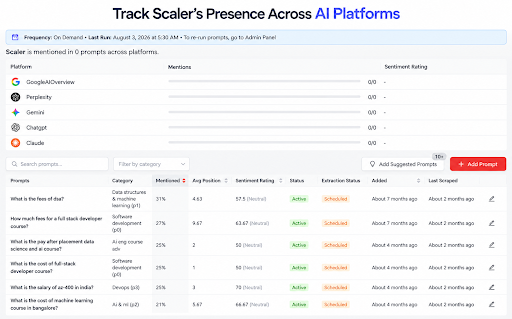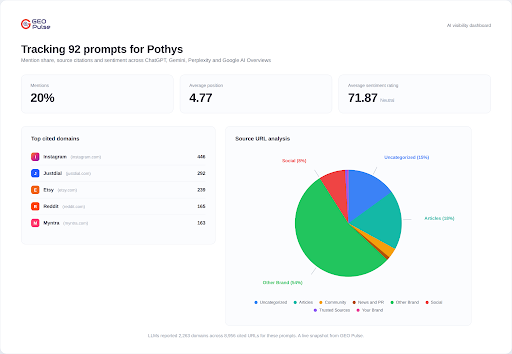
From brief to governed creative: how Social Beat uses generative AI to build, test, optimize, and scale advertising creative.
Creative production is becoming the new bottleneck in digital advertising.
As platforms like Google and Meta automate targeting, bidding, and optimization, creative assets increasingly drive attention, clicks, and conversions. The challenge for brands is creating enough relevant creative quickly to keep pace with media plans, without compromising brand consistency or compliance.
Social Beat built SB Studio, to solve for this – its AI-first creative production engine inside PRISM
A brief moves through intelligence, concept development, image and video production, adaptation, and quality control in a single governed workflow. More than 10,000 creatives have been produced through SB Studio to date, while creative adaptation time has reduced by approximately 80%.
The broader opportunity lies in connecting creative production directly with media performance, allowing performance insights to instantly inform future creative output.
Why AI is changing creative production
For years, digital advertising allowed agencies to differentiate through targeting. That is changing.
Google and Meta now automate much of the audience selection and campaign optimization previously managed manually. As targeting becomes automated, creative assets carry the primary responsibility for driving engagement.
This has created a new requirement for creative teams: Creative needs to become a testing engine, not just a production function.
A single media plan often requires dozens of creative variants across YouTube, CTV, display, retail media, and social platforms, testing different hooks, formats, languages, CTAs, and treatments against performance. Traditional creative production was not built for this volume. In India, regulated categories like BFSI, healthcare, and pharma face additional compliance layers, requiring specific disclaimers, mandatory language, and regional adaptations.
The core challenge is: How do we create relevant content faster, while keeping every asset on-brand, performance-ready, and compliant? That is where AI-powered creative production becomes useful.
What is SB Studio?
SB Studio is the AI creative production layer within PRISM, Social Beat’s broader AI-powered marketing platform.
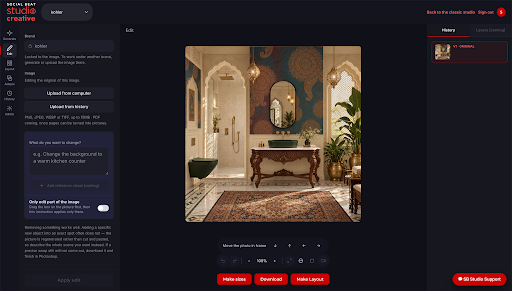
It takes a creative brief and routes different parts of the production process to the models and tools best suited to the task, bringing image generation, video generation, copy, reasoning and creative workflows into a single system. The technology underneath will continue to evolve. The intelligence and governance around the technology are designed to remain consistent.
At the centre of SB Studio is what Social Beat calls the Brand Brain.
The Brand Brain: a single source of truth for every creative
A Brand Brain contains the information an AI creative system needs to understand a brand before producing an asset.
That includes:
- Brand colours and typography
- Tone of voice
- Visual identity
- Mandatory brand elements
- Approved legal language
- Regulatory requirements
- Claims the brand can and cannot make
- Things the brand should never say
- Historical creative and performance learnings
- Brand-specific creative guidelines
Designated owners manage versioned Brand Brains across 19 brands. This structure ensures that while AI models change, brand intelligence and governance remain intact.
Four layers of AI-powered creative production
SB Studio brings four interconnected layers into one creative workflow: intelligence, concept and copy, image and video, and quality control.
1. Intelligence: turning brand and market data into creative inputs
The first layer continuously feeds intelligence into the Brand Brain.
This can include:
- Competitor creative analysis
- Platform best practices
- Brand guidelines
- Historical creative performance
- Creative trends
- Category learnings
- Previous campaign results
Structuring and sharing intelligence across workflows ensures that each brand maintains a single, evolving source of creative intelligence.
2. Concept and copy: AI-assisted, human-led
The creative process does not begin with AI generating random ideas. A planner, strategist or writer starts with the human insight: the audience tension, proposition, cultural angle or creative thought. AI expands that vision into multiple executions, formats, languages, hooks, and variations while preserving brand voice.
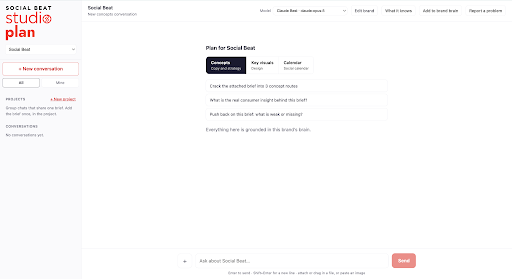
While generative AI scales creative output, human judgment remains essential for deciding what to produce, while AI makes those concepts scalable and testable.
3. Image and video: one master, multiple executions
Once the creative direction is established, SB Studio can generate the assets required for different media placements.
The same Brand Brain governs the output across:
- Static advertising
- Social media creative
- Display assets
- Product visuals
- Video advertising
- Multiple aspect ratios
- Languages and regional adaptations
- Different hooks and CTAs

Mock creatives generated in SB Creative Studio. Directional only.
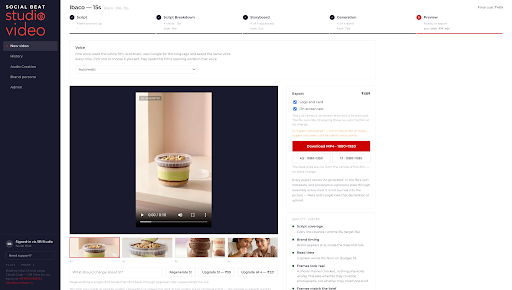
For video, workflows progress seamlessly from script to breakdown, storyboard, generation, and preview, shifting production from building individual assets to adapting a governed master at scale. This changes the production model from creating every asset independently to creating a governed master and adapting it at scale.
4. QC: making compliance part of production
This is where AI creative production becomes particularly relevant for regulated categories.
Rather than relying solely on post-production legal or brand reviews, SB Studio’s QC layer evaluates assets against defined rules directly within the workflow before export.
For example, a brand can define:
What must always be present: Brand elements, required messaging and mandatory information.
What must be present for regulatory reasons: Disclaimers, claims language and category-specific requirements.
What must never be said: Unapproved claims, prohibited language or brand-specific restrictions.
Deterministic requirements are automated; mandatory disclaimers follow defined rules rather than model recall. Every asset can also carry an audit trail showing the originating brief, Brand Brain version, checks performed and approval information. This is why AI creative governance and AI creative compliance are as important as AI image or video generation.
What does AI creative production actually deliver?
The value of AI creative production lies in transforming performance signals into more relevant creative, as shown by SB Studio implementations:
For a two-wheeler riding gear campaign, Social Beat tested lifestyle-led AI videos against product-focused films.
In shopping placements, product-led films achieved a ~3% CTR, compared to ~1% for the lifestyle route. Showing the product proved to be a stronger hook in high-intent environments, enabling teams to pause underperforming concepts and reallocate budget.
The implication was not that product-led creative is universally better. It was more specific. In a shopping environment where consumers are already evaluating the product, showing the product can become a stronger creative hook than showing the lifestyle around it.
The underperforming concepts could then be paused and the budget could be shifted towards the stronger creative direction. That is the real promise of performance creative: create, test, learn and adapt continuously.
For an FMCG client, creative was built and optimized within the media plan, earning Bronze for Best Programmatic Creative Innovation at the Programmatic Asia Awards 2026, demonstrating how creative production and media technology are merging.
In highly regulated sectors like insurance and healthcare, automation delivers value by minimizing lengthy revision cycles. Creative volume only adds value when assets move through approval safely.
The metric that matters: creative hit rate
Rather than tracking total assets produced, the critical metric is creative hit rate: the percentage of assets meeting defined performance benchmarks (e.g., CPA targets). This shifts AI production from simple efficiency to measurable performance marketing.
Rather than asking “How many creatives did AI produce?”, the more useful question becomes: “How many of those creatives produced a meaningful business outcome?” This shifts AI creative production from an efficiency story to a performance marketing story.
When creative and media learn from each other
The biggest opportunity comes when creative production does not operate independently of media performance. That is why SB Studio sits inside PRISM.
The Media Brain, PRISM’s AI-powered media planning and optimisation engine, can evaluate creative at the asset level.
- Hook rate
- Hold rate
- Click-through rate
- Cost per acquisition
- Creative format
- Hook type
- Hook length
- Product visibility
- Brand placement
- CTA timing
Pinpointing specific driver variables, such as hook timing or product placement, creates an actionable feedback loop for ongoing optimization.
From media insight back to creative generation
The loop then becomes: Brief → Intelligence → Concept → Creative → QC → Media → Performance data → Creative insight → New creative
An underperforming asset generates a learning. That learning goes back into the same Brand Brain. SB Studio can then use that learning to generate a new variation. The new creative goes back into the media plan and is evaluated against the same performance framework.
Underperforming assets generate learnings directly inside the Brand Brain to produce refined variations without separate rebriefs or long delay cycles.
The future of advertising is not just AI-generated creative
Speed alone is not the core transformation. The shift lies in AI-powered creative systems that understand brand context, generate variations, enforce governance, and continuously optimize using media performance data. That is the direction Social Beat is taking with SB Studio. The goal is not to replace creative thinking with AI. It is to give creative thinking the production infrastructure required by modern media. Because when media can test twenty creative variants in a week, the creative function needs to be able to keep up. And when a regulated brand needs every one of those variants to be compliant, speed without governance is not automation. It is a risk at scale.
The future of AI creative production is relevant, governed, and outcome-driven creative, moving seamlessly from brief to governed creative, and from performance back into the next brief.
Frequently Asked Questions
What is AI-first creative production in digital advertising?
AI-first creative production integrates generative AI models into a unified, governed engine to automate asset creation across formats, aspect ratios, and languages. By combining brand intelligence, multi-modal asset generation, and real-time performance insights, it transforms creative production from a slow bottleneck into a scalable testing system built for modern performance marketing.
How does generative AI impact digital advertising performance?
As ad platforms automate audience targeting and bidding, creative assets become the primary driver of engagement and conversion. Generative AI enables rapid production of diverse hooks, messaging, and visual formats, empowering performance marketers to execute automated testing at scale and continuously optimize ad creative based on real-time performance data.
Why is creative governance critical when scaling AI advertising assets?
Scaling creative volume without governance creates severe brand and legal risks. AI creative governance uses central brand intelligence—such as a Brand Brain—and automated quality control to enforce brand guidelines, mandatory disclaimers, and regulatory compliance before export, ensuring every asset remains safe, accurate, and on-brand across highly regulated industries.
How do media-creative feedback loops improve creative hit rates?
A media-creative feedback loop directly connects ad performance signals, such as hook rate, hold rate, and cost per acquisition, back into creative production. By pinpointing high-performing driver variables, creative engines can iterate instantly on winning concepts, maximizing the creative hit rate and driving stronger business outcomes.
How does multi-format adaptation accelerate campaign scalability in modern advertising?
Multi-format adaptation automatically resizes, formats, and tailors master ad assets across diverse media channels like CTV, social feeds, and retail networks. By removing manual creative bottlenecks, production teams can deploy automated testing across multiple ratios simultaneously. This process drastically increases campaign scalability while maintaining strict brand consistency and driving peak performance marketing outcomes.
Why is continuous automated testing vital for optimizing creative hit rate?
Automated testing continuously evaluates diverse copy hooks, visual treatments, and call-to-action variations against real-time media conversion metrics. By systematically identifying top-performing elements and pausing low-performing concepts early, performance marketing teams consistently elevate their overall creative hit rate. This feedback-driven cycle transforms static asset workflows into agile, data-backed growth engines.